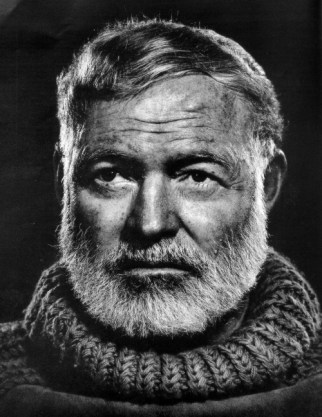
 How are you & how’s your week? It’s chilly and rainy here in Chicagoland, with the potential for snowflakesI I was working on a couple of posts, then realized I could just mash them into one. Hopefully a little something for everyone. Here for your reading pleasure are books, looks, cooks and gardens all in one! Enjoy!
Did you watch the 3-part Hemingway series on PBS? As an English major with a concentration in 20th Century American writers, I positively devoured each episode. (Plus, it’s produced by Ken Burns. How could you go wrong?)
Hemingway is all you would expect from the Ken Burns team — a deep dive into a man both charismatic and cruel, a brilliant writer in search of “one perfect sentence.” Many of his books were deemed instant classics, others suffered withering reviews. While still in his twenties, Hemingway and his first wife became part of the romantic group of authors and artists in Gertrude Stein’s “salon.” In fact, Stein read and critiqued much of his work and F. Scott Fitzgerald introduced him to his publisher.
What has always fascinated me about Hemingway the writer is how spare he is with words. Editing, revising, and editing more. Some of the most telling scenes of the series detailed his careful, endless editing of his own work, crossing out words, sentences, and entire paragraphs until he had the manuscript he wanted. He wrote books and short stories full of perfect sentences, but as the literary scholars and contemporary writers in the series point out, some of his writing was stunning, some just fell flat.
Hemingway the man was complex. He married fours times, falling in love with wives number two, three and four while still married to their predecessors. He adored his three sons but later experienced angry splits with them just as he had with his own mother. He drank too much, dared too much, inserted himself into two world wars and more than one foreign civil war. He loved bullfighting, hunting big game in Africa and designed his own boat for fishing the waters off Key West and Havana. He lived a very big life that was often depicted in his novels and short stories.
For me, Hemingway is both writer and cultural character from a significant period in American history. The series captures that history memorably. You need not be a book lover or Hemingway fan to appreciate the context.
(If you want to toast the new season with Hemingway’s famous daiquiri, you can get the recipe from David Lebovitz here, )
French toast perfection
 For years I made the most basic pancakes and waffles — you can do just about anything with that box of mix, right? My husband, however, really likes french toast. His is pretty basic: sandwich bread dipped in beaten eggs and grilled. I just never saw (or tasted) the charm. However, our annual beach trips have always included at least one trip to a breakfast buffet I would describe as breakfast nirvana — chafing dishes of bacon, sausage, grits, potatoes, waffles, pancakes or — wait for it — french toast. This is thick, flavorful french toast, much more than eggs and bread. Earlier this spring, when my husband and I had way too much time on our hands and were hanging around the house waiting for vaccinations, we went on a quest for french toast perfection.
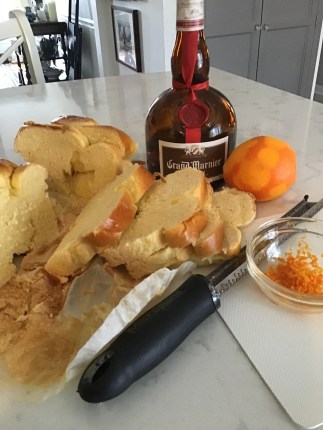 The bread is essential. We tried an unsliced white country-style loaf that we could slice thicker. It was good, but I thought the bread should contribute more flavor. Next we tried a brioche, again in a loaf we sliced. This was too soft (maybe I should have let it sit for a few more days?). It did not hold up well to eggs or grilling. Finally, I found an unsliced challah loaf. This was our favorite, although I think it should also age for a day or so.
We also needed the right egg mixture. We took a look at some “fancier” recipes and began to tinker with each batch. We beat the eggs with cream instead of milk. (Typically the only milk in our refrigerator is skim and it just doesn’t work in recipes requiring a certain silkiness.) To boost the flavor, we added fresh orange juice, orange zest and a dash of Grand Marnier. (The additions in the restaurant recipe we used as a jumping off point.)
The first batch with the country white bread, juice, zest and Grand Marnier was a definite improvement over our old bread and eggs, but too orange-y. When we tried it with the brioche we skipped the juice and used the zest and Grand Marnier. Better flavor, messy toast. Our next effort used the challah and the improved egg mixture. This was the keeper.
We learned a few things from our recipe testing:
- Using cream or cream cut with half & half gave the egg mixture a lot more body.
- Beat eggs until they are completely smooth (no globs of egg white).
- Zest is better than juice; a tablespoon of liqueur adds a subtle touch.
- The bread is everything. It needs to be at least a day or two old and sliced 3/4 to 1-inch thick.
- We dipped the bread in the egg mixture, flipping it over to make sure it was fully coated, then laid the slices in a single layer in a shallow pan. When all the slices were in the pan we poured the remaining batter over them.
 As a cook, I enjoyed making this a few times in quick succession, tweaking the recipe until I had something I was willing to serve friends and family. But, let’s face it, this was a decadent experiment. We only added the bacon and fruit on the last try and each time we made this it was more brunch than breakfast. We used 4 eggs and 3/4 C of cream to make 6 slices, two of which we never touched.
So, we’re ready for houseguests, brunch on the porch and maybe even Father’s Day, but it’s probably best for our waistlines and our cholesterol that we’re vaccinated, the weather has warmed considerably, and we’re tackling a long list of outdoor projects.
Garden starts
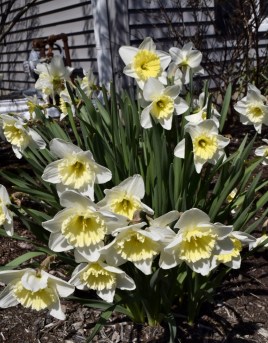
Chicagoland gardening is slow to start compared to so many other parts of the country. But despite erratic temperatures, Mother Nature has been busy. Daylilies, daisies, hostas and perennial geraniums are greening up the beds. I have tulips and daffodils in all stages of bloom. And this redbud is getting ready to show off.


Although I am not at all good at starting annuals by seed, I did start one tray of marigolds and cosmos, and look! They’re coming up. The real trick, however, is making the transition from these nurturing peat pots into garden spaces. Fingers crossed!

I hope your garden is greening up, you’ve found something engrossing to read or watch, and — if all else fails — just make some french toast!
Thanks for stopping by. See you aqgain soon!
 I had planned to talk about the to-be-read and to-be-cooked lists I’ve been compiling for the new year, along with a few stabs I’ve made at de-cluttering and the other ways in which I was planning to entertain myself while we wait out the pandemic. (In the county were I live the Health Department describes the risk of infection as “substantial.” I don’t know what that means but it doesn’t sound good, does it?

 How are you doing? Isolation is hard, but I honestly can’t complain. We’re healthy and so is our family. Right now, that’s everything.
  On Friday my book group met via Zoom to discuss The Lake is on Fire by Rosellen Brown. Fifteen of us logged on to talk, check in with each other, share a few war stories about life in a time of social distancing, and then realized we really could not talk all at once. (This happens even when we meet in person!)
 Lately I have found myself on a bit of a culture course. And while I’m certainly not complaining, I am amused at how things sometimes come together. The last few weeks are a good example.





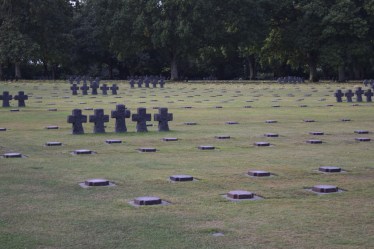 The next day we were up early and walked the half-block our so from our hotel to the departure point for the various D-Day tour operators. Ours was a small group tour, maybe 12 of us in a van. The guide was a young man from Wales who told us he’d become fascinated by all aspects of WWII as a young boy when his grandfather began taking him to some sights. His knowledge was encyclopedic; clearly he was a very good student.
 Utah Beach, Sainte Mere Eglise, & Pointe du Hoc
 Pointe du Hoc was the highest point along the coast between the Omaha and Utah landing beaches. In 1943 Germans troops built an extensive battery here using six French WWI artillery guns and early in 1944 began adding to the battery. D-Day plans included an assault by specially trained Army Rangers to breach the steep cliffs and disable the guns. The cliffs are formidable here and the ground atop them is pock-marked by bombings and gun placements. It’s rough to walk today, particularly in a sharp wind, and impossible to imagine how challenging it was on D-Day.
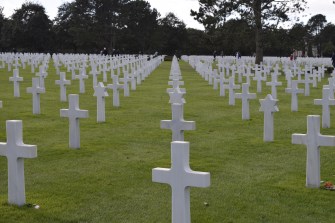
 Our guide timed our visit to the American Cemetery for the hour when the flag is lowered at the end of the day. Walking to the cemetery I was tired. Despite lovely clear skies and fair weather, it was a very windy day, and we had already walked a lot. But I think I was also feeling emotionally spent. It’s not possible to walk these roads and towns without thinking of the people who came before. And not just the soldiers. But the brave French citizens who loved their communities and way of life, who were totally upended by the German invaders, many of them risking their lives working with the French underground, and who in the end so gratefully welcomed the Allies.
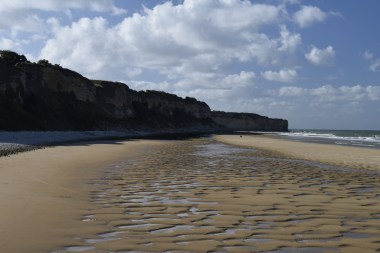 We ended the day at Omaha Beach, and our guide took the time here to diagram, using a stick in the sand, exactly how the landings unfolded and how they fit into the great scheme of the entire D-Day invasion. (Again, he was just so knowledgeable!)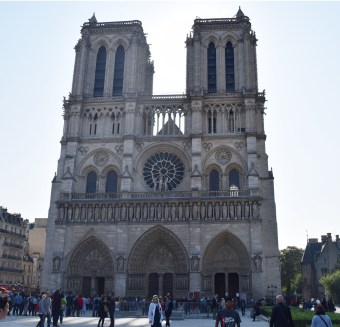

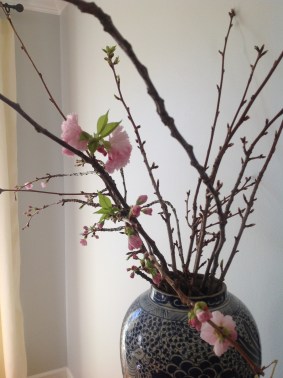
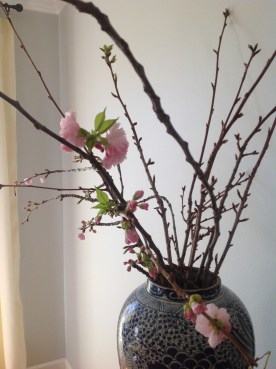 Lately I’ve been obsessed with forcing these cherry branches I found at Whole Foods. Normally, I’m not big on forcing branches to flower, mostly because the forsythia that’s usually available just doesn’t “do it” for me. However, I had not seen the cherry branches before and one bundle had a few soft pink blooms already open. They certainly looked like spring to me!
 If you follow me on
 Ivy & Ironstone