Small pieces of blue and white, .are fun because there
Whenever I post a picture of some of my blue and white porcelain on Instagram, I receive so many positive comments, I thought perhaps it is time to explain how this collection (and the other blue and whites in our house) came to be. Blame my mother.
Actually, that may be too simple an answer. I have always gravitated to classic navy blue. And, as so often happens, the way we dress carries over into the way we decorate. Over the years I had two blue and white couches paired with two different blue and white loveseats in the family room. When I finally bought a “good sofa” for what turned out to be our long-time living room, it was covered in a blue and white Waverly fabric. I used the same fabric on the windows in the living and dining rooms as well as companion wallpaper in the dining room. It was very matchy-matchy.
Mom’sTJ Max finds launched my quest.
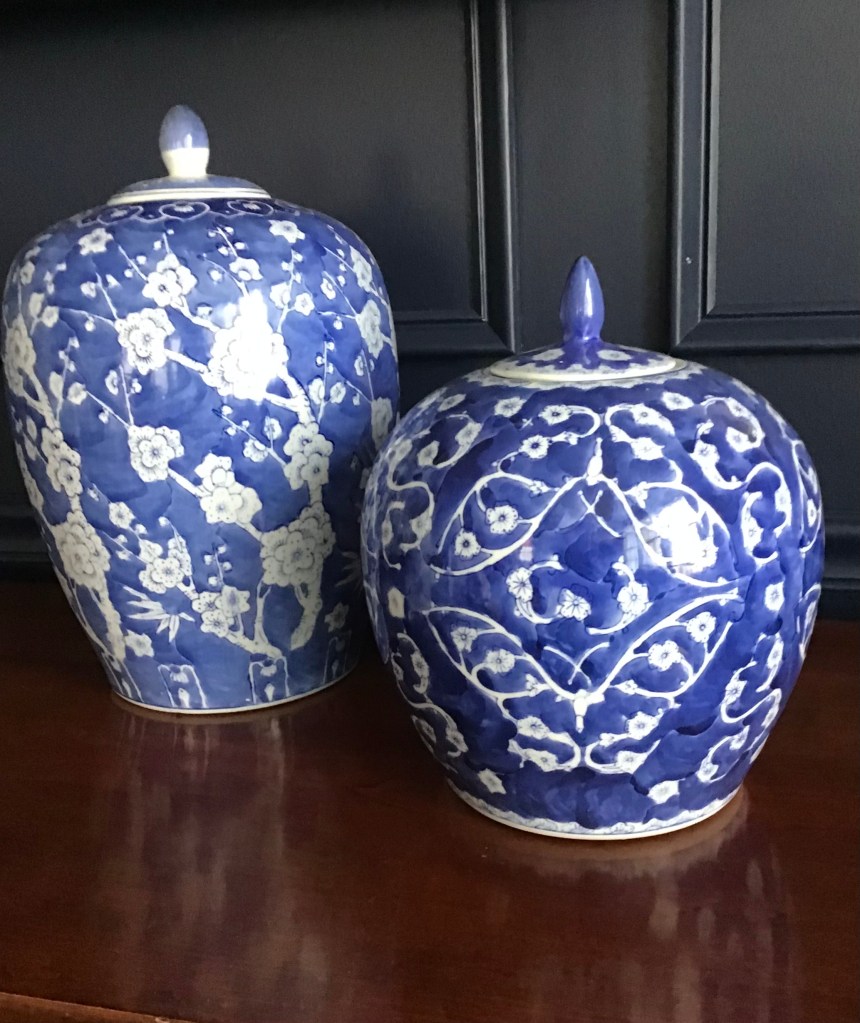
So it was hardly a surprise that my visiting mother got bored one day while I was at work and my kids were at school and took a field trip to TJ Max. She found these ginger jars, along with a smaller jar and a candlestick, long since disappeared, and promptly re-styled our mantel. (And you wondered where my decorating gene came from!).
I liked the look and thus began my quest for a blue and white plate here and a small pitcher or biscuit box somewhere else. Those were the years of some of my most intrepid antiquing, and the smaller plates and pieces were easy to find. As so often happens with a collection, I found myself refining my taste, checking the manufacturer’s stamps on the bottom of new finds and limiting my pieces to those from England.
I began to collect little blue and white moments like this…
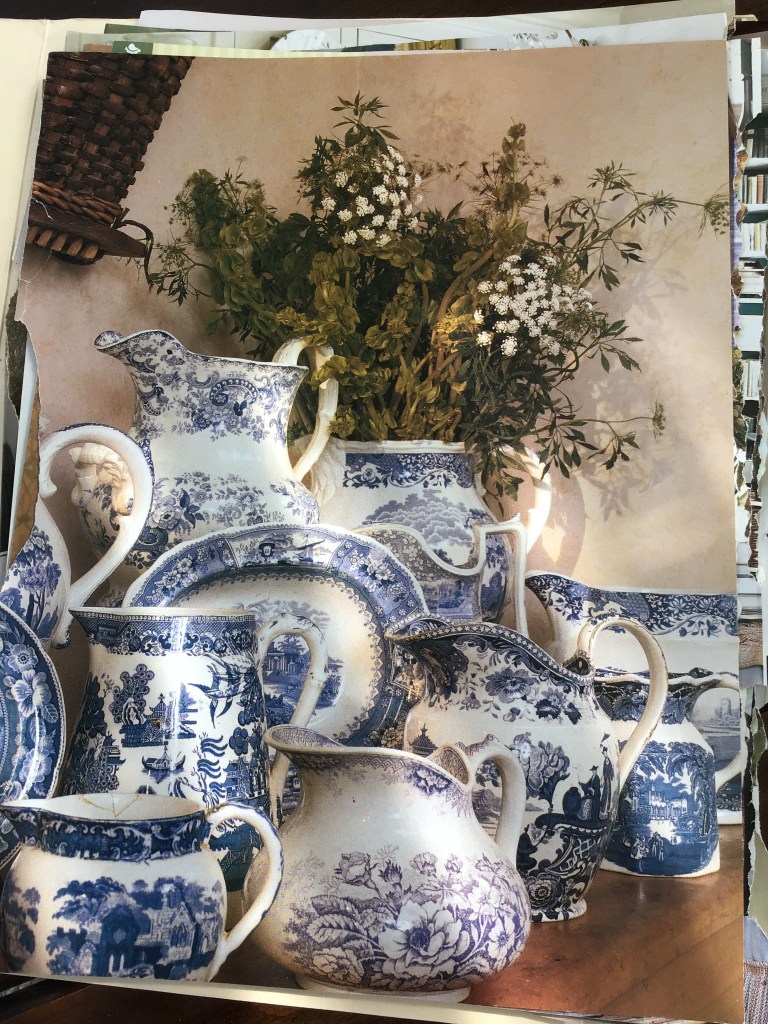
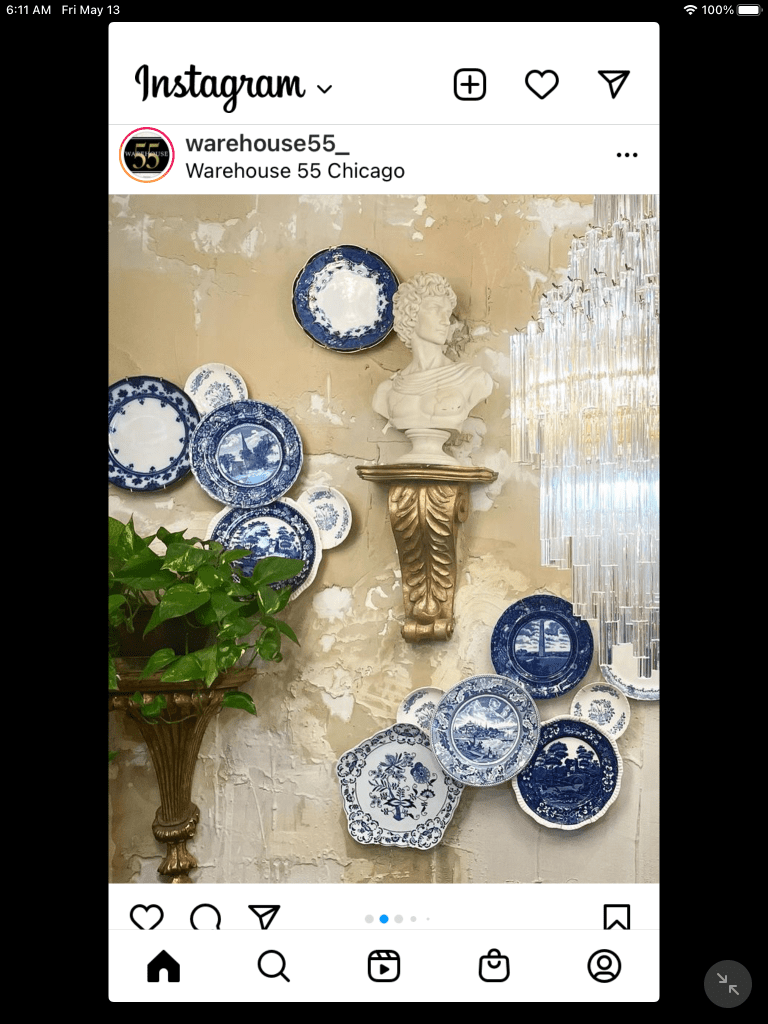
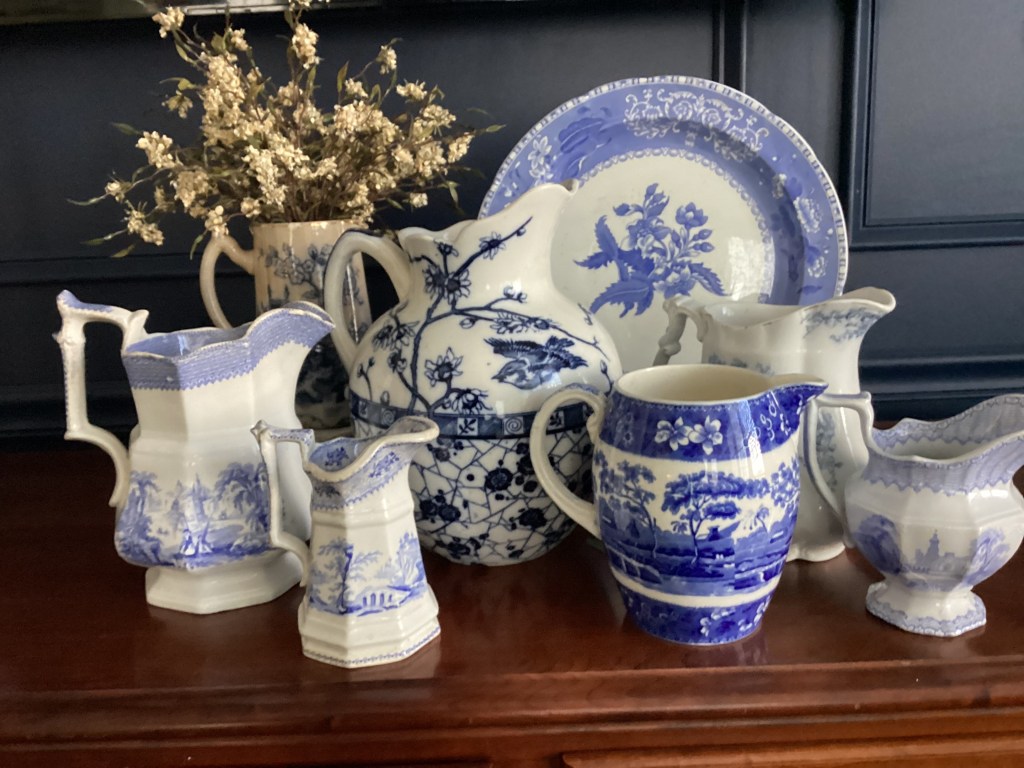
Perhaps most importantly, I began to save images of blue and white collections. This was in the pre-Instagram world, so I saved pages from magazines. This is a favorite, below. It’s not just the quantity here, it’s the variation in detail: floral or scenic patterns, straight or curved shapes, small spouts or larger, more graceful ones, shades of blue that range from the palest to deep indigo.
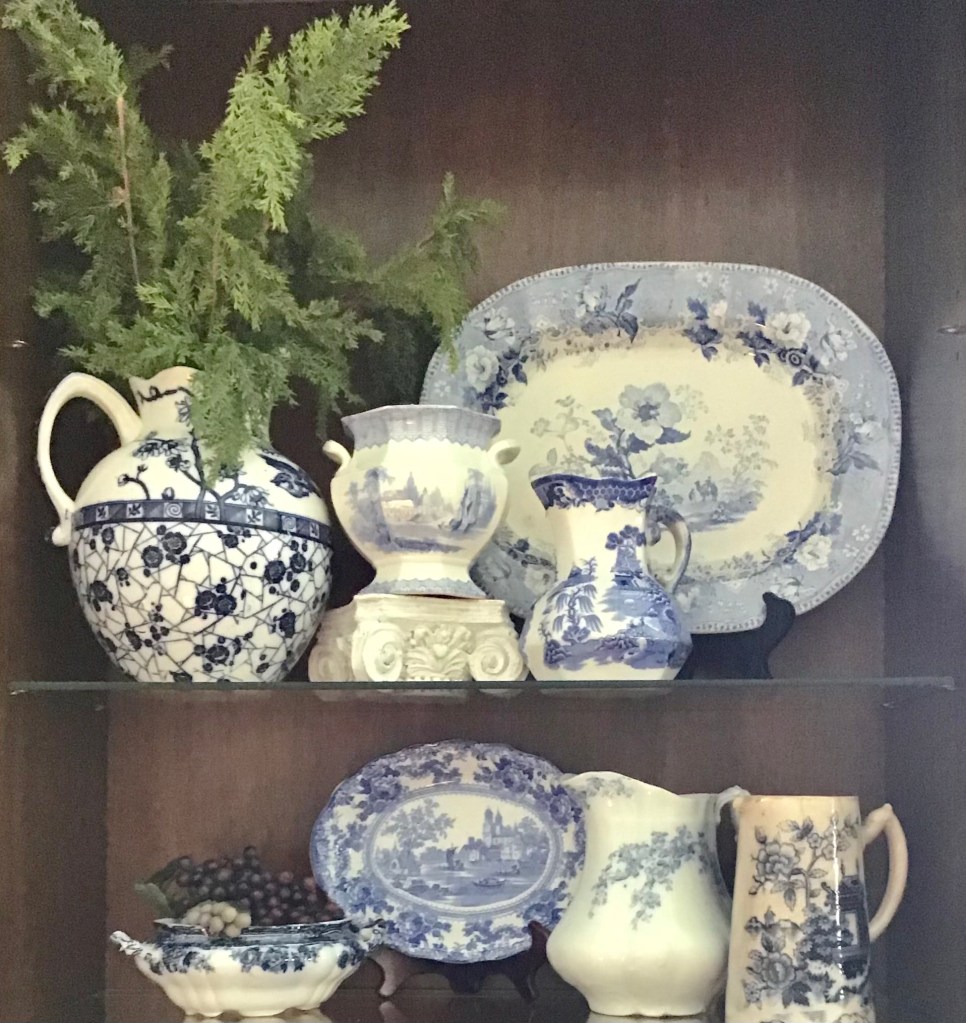
I gradually moved on to larger pieces, like trays and larger pitchers. As the pieces multiplied, I was able to “gang them together” on shelves and in cabinets.
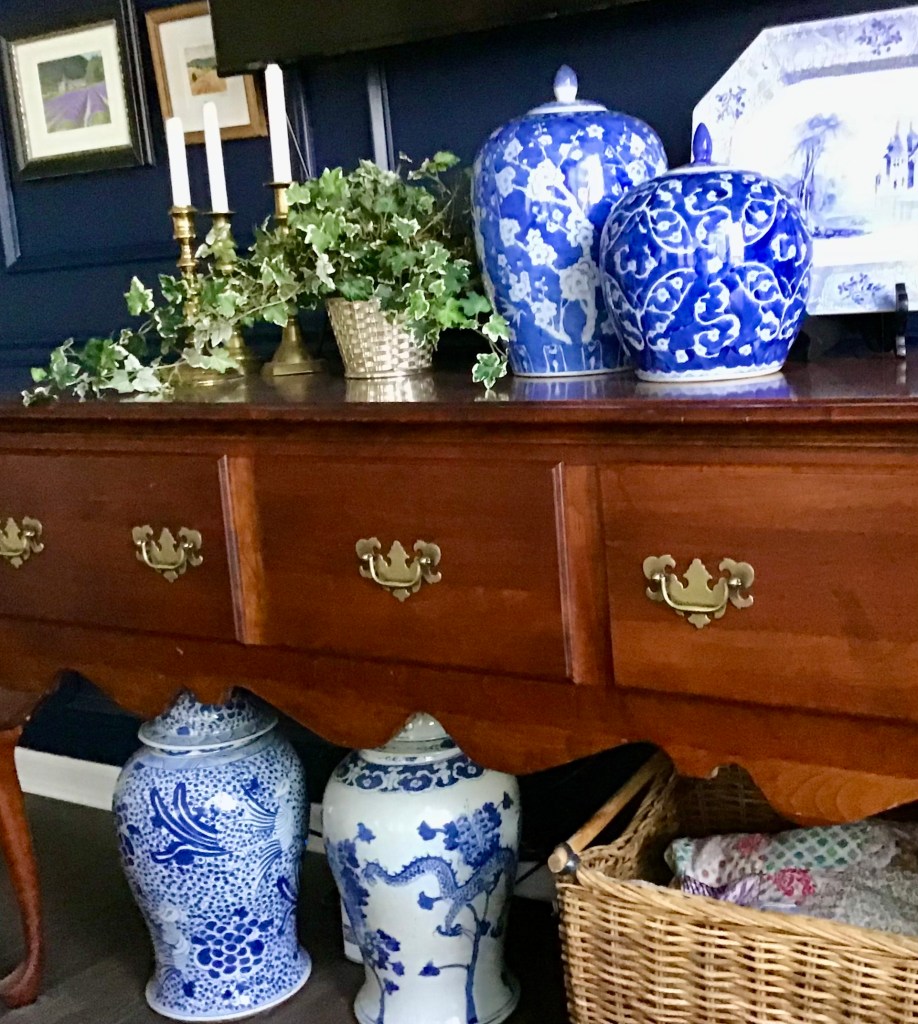
Blue and white inspired the navy feature wall in our current great room. The two really large ginger jars are not antique, but at some point I decided I needed a statement piece. I ended up with two and I’m so glad. (As Charles Faudree would say, always buy pairs when you can, even if you don’t use them as a pair.)
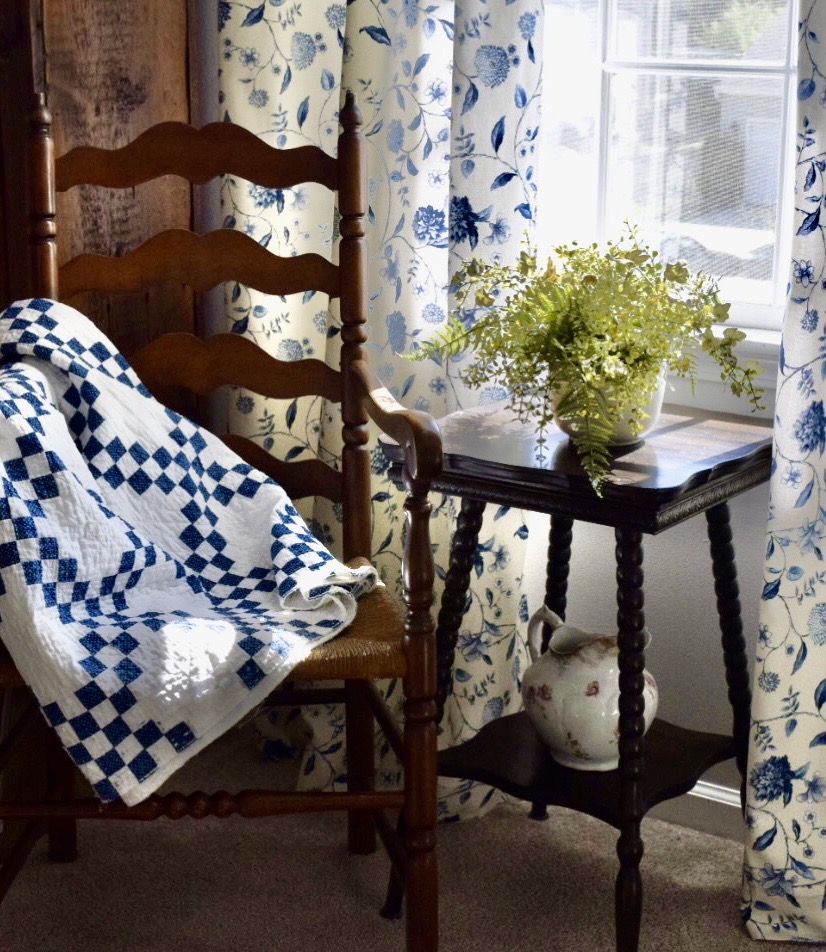
Blue and white fabric worked into the collection, including an old quilt, french grain sacks, and new curtains.
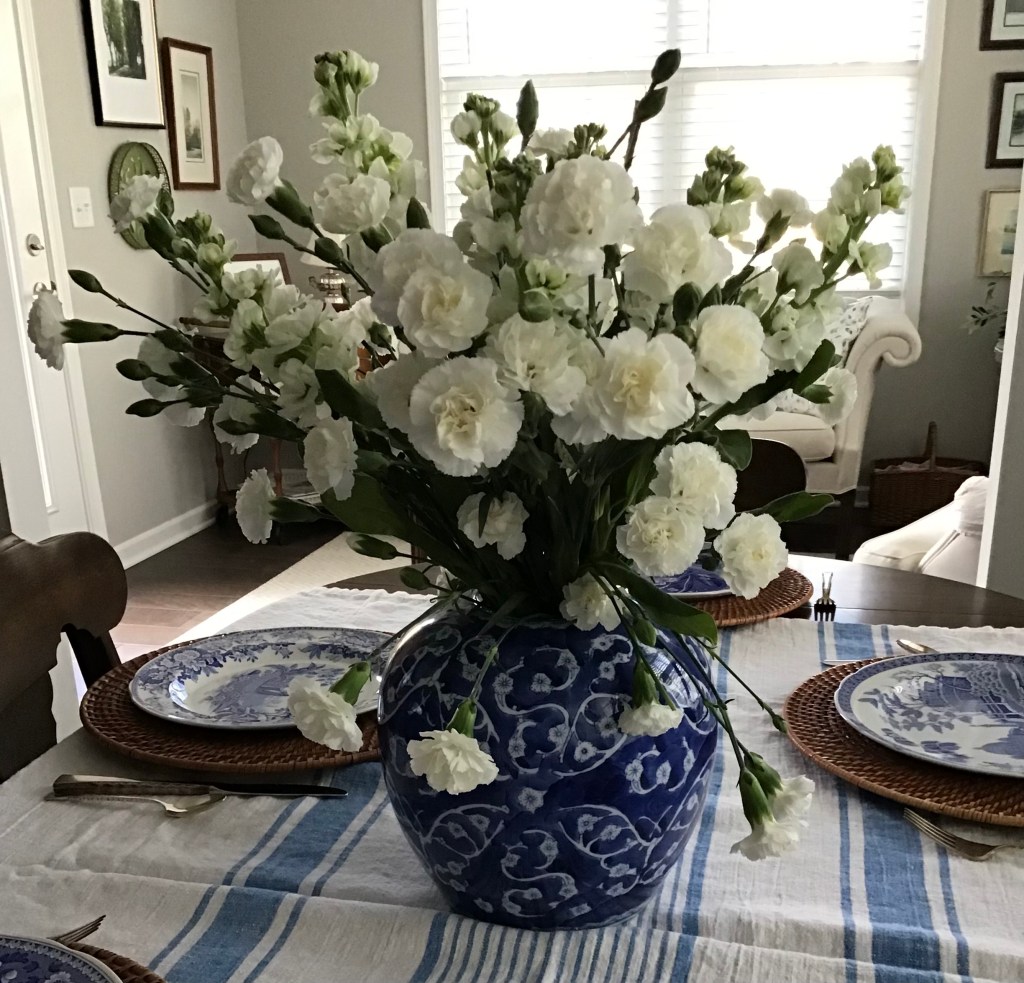
The dining table in our previous home, above, set with assorted pieces and a blue and white cloth. I use the same cloth with blue and white dishes here, below.
I continue to save blue and white ideas. From Instagram…
I love this collection of blue and white pitchers so much, I decided to collect all of mine together and see how they compared. What do you think?.
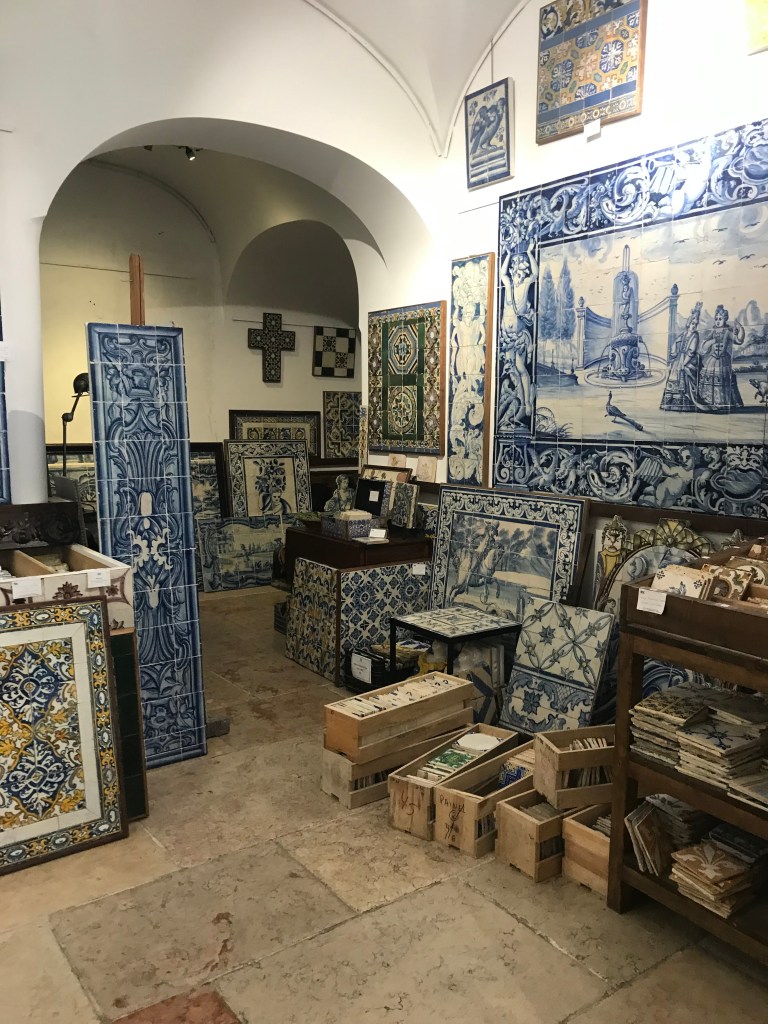
When we moved, I culled a lot from my white ironstone collection, but nothing from the blue and white. I’ll keep collecting, though old pieces — which I prefer these days — seem harder to find. On the other hand, when we were in Portugal last year, I did get caught up in the tiles.
Building a collection takes a special kind of gene. You have to be patient, you have to refine your choices or it’s just so much stuff. I have a small collection of hand-crafted roosters. It began with a handsome pair of ceramic roosters from my mother. Then I found one made from a gourd and my husband gave me a hand-carved fellow he found in California. Along the way I picked up some antique poultry prints from vintage catalogues and books.. Everything in the collection had history and/or provenance. But then well-meaning friends started adding to it — rooster dish towels and cake plates and teacups. Pieces without the same one-of-a-kind design didn’t’t belong with the pieces I had assembled, and, in fact, they kind of “watered down” what I had so enjoyed collecting. I kept those things for a year or two, but I eventually thinned them from the pack. For the most part, I think collections should be left to the collector. While I loved that people thought enough of me to want to add to a collection,
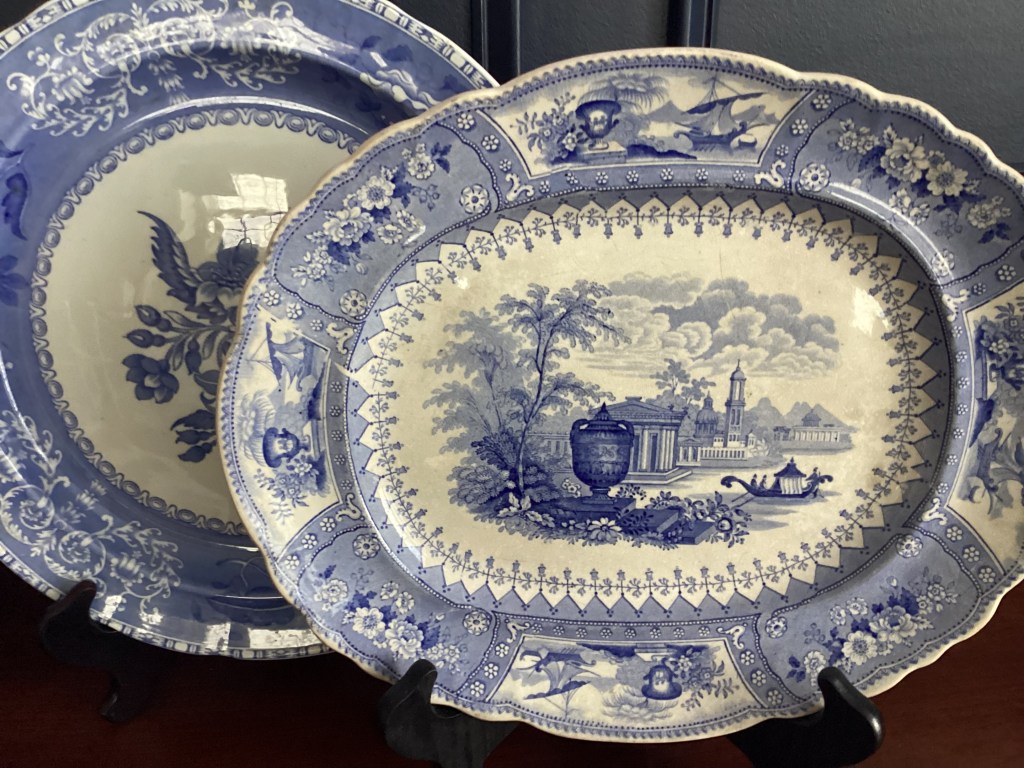
Speaking of collections, here’s my latest blue and white find, an oval platter marked “Stoke-on-Trent.” The color is especially vivid and the pattern is exceptionally crisp. Plus, I love the scall0ped border. (And this is the potential for collecting — it makes you pickier and pickier!)
Once a collector, always a collector! What is it you collect?
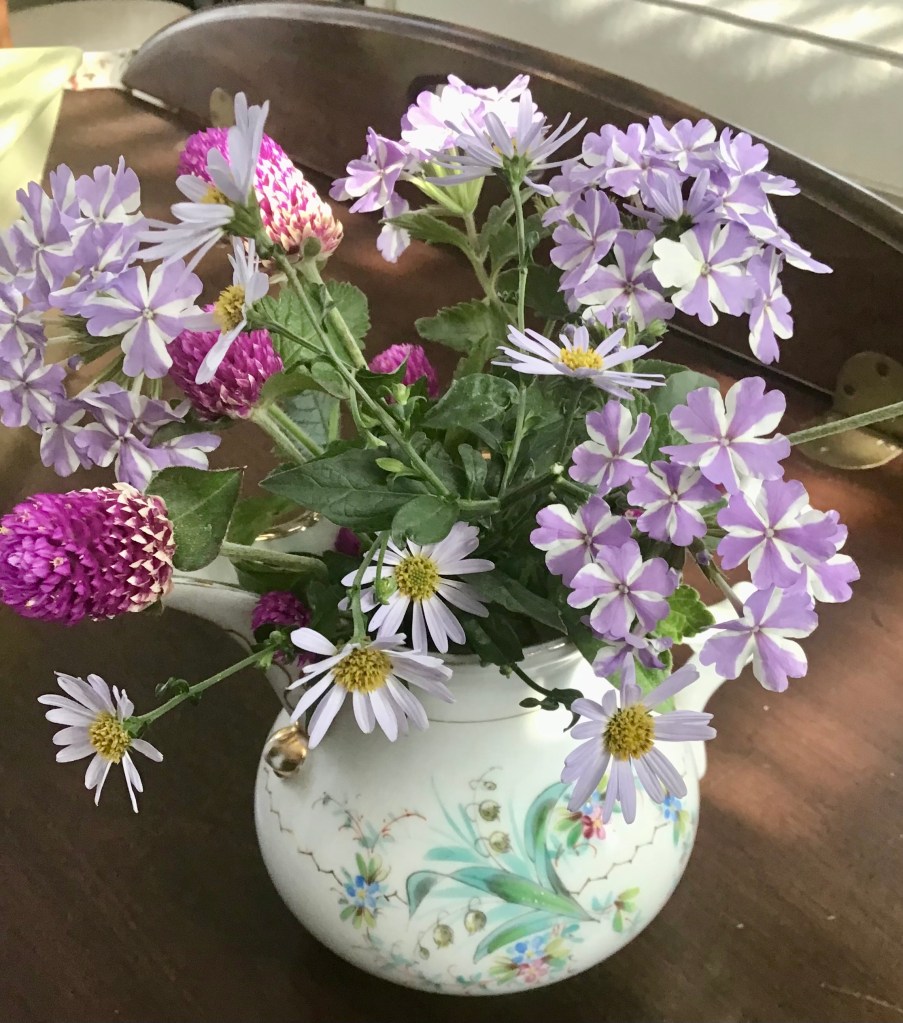
P is alsoc for purple; I seem to have lots of purple flowers sright now.
How are you? I know it’s been awhile. How’s your summer? Mine is going way too fast. I thought it was time I filled you in on at least some of what’s happening here.
Years ago Steve and I had neighbors who were always in search of the “A-List.” You know, the one with people who supposedly had more money/power/status. Until they found it, however, they were content to travel along life’s path with the rest of us. I suppose we should have been insulted by this attitude, but they were so blatant they were funny. (And we weren’t the only ones thinking that.) Not surprisingly, the relationship quietly drifted apart. Maybe thy found the A-List? However, the A-List remains a running joke in our household.
This post has nothing to do with money, power or status, but it is a dump of what I’ve been up to this season and it turns out that it all starts with the letter P. .
First there is the patio
The whole patio is not ready for prime-time, but here’s a slice.
The patio the builder attached to this house was a small cement rectangle that barely held a round dining table and four chairs along with a grill. In fact, if you chose the wrong chair you were the lucky one able to reach out from your seat and flip the burgers. So, a few weeks ago we had that slab removed and a new, much larger one poured to replace it. I am not a fan of cement slabs, but in our really little yard (we have the smallest lot in the subdivision), it seems to ground the landscape and offer some good possibilities for additional landscaping.
Just to complicate things, our design/decision-making was somewhat delayed by the fact that the house behind us, which actually sits perpendicular to ours, is on a lot that was graded a few feet higher than ours and those of the neighbors on each side. This was probably the fault of the initial developer, but thankfully the new owner in that house — not wanting his lawn, etc., to wash into ours or the neighbors’ — put his foot down with the builder. After weeks of work and readjustments to drains and irrigation, a landscaping company has installed a low, very attractive stone retaining wall. Win, win for all concerned. It looks soooo good.
Meanwhile, Steve and I, along with some extra muscle from our son, softened the cement block look of the patio with some dwarf hydrangeas and perennials. There is more landscaping to come along “the wall” and outside the sunroom, but not until we are out of the worst of this heat. In the meantime, we’re excited to move forward with this and have been having coffee on the patio most mornings! If there is anything we have missed from our Wheaton home, it’s the mature landscaping, but starting from scratch is an interesting challenge.
Painting
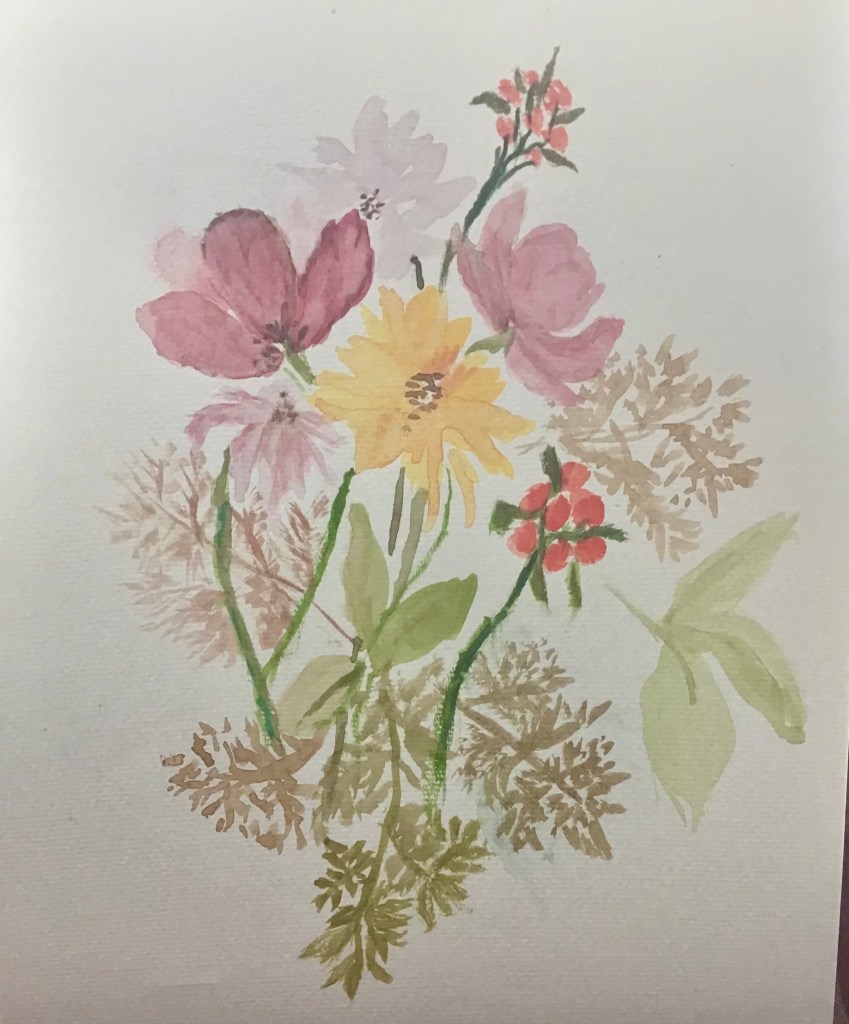
This is pretty rough. I’d like to think my technique has improved since I painted it, but it is one of my favorite efforts, largely because it’s my own composition as opposed to a painting from a tutorial or class.
I happily admit that I am now totally obsessed with my watercolor efforts. I’m watching YouTube videos, reading, and now trying to do sone sketching or painting every day. And, of course, my class continues to meet. It’s interesting to sample the different watercolor styles of my classmates along with the artists I’ve discovered on YouTube.
I’ve acquired a very cool pocket-sized set of paints to use when painting away from home as well as a small sketch pad to carry with me. Plein air painting is a joy. There is something about being surrounded by Nature that feeds whatever artistic inspiration one has. My goal is to draw or paint a bit each day. But that’s easier said than done, and some days the results are very satisfying, some not so much. I find I look at artwork, scenery, a vase of flowers, or even a vignette of books and candles on a tabletop or shelf differently.
Postcards
During the last election cycle in 2022 I joined my daughter and daughter-in—law in the postcard project to contact individual registered voters and encourage them to vote in the coming election. Basically we hand write a short, non-partisan “get out the voter” message provided by the project on postcards also provided by the project, address them to individuals from the registration lists provided, and mail the postcards on a specific day in late October. The project does not endorse specific candidates or a party, although it is sponsored by the Progressive Turnout Project whose mission is to rally Democrats to vote. Statistically, the project knows this personal contact significantly improves voter turnout.
I’m not comfortable ringing doorbells or making phone calls for a specific candidate, but like many people I feel helpless in in the midst of a messy campaign and an election that could completely alter our lives. In fact all of this would give me a monumental headache if I did not feel as though I am at least doing something. If you are interested in learning more about this grassroots project, visit the website, www.turnoutpac.org.
I hope you are cool, dry, and enjoying the sweetness of summer. Thank you for stopping by.
Okay, you may not consider it fun, but I do. Today’s post celebrates my girlish passion for a new box of crayons, my half-hearted sidesteps into art, and my recent discovery of painting with watercolors.
After months of cajoling, a neighbor — who also happens to be a watercolor artist and teacher — agreed to offer a class to some of us wanting to flex our artistic muscle. And now I’m hooked. Watercolors are not easy and there is a lot of technique to learn (the most basic being how do you make the water and the paint work together?), but I’ve found it to be a welcome challenge, a good test for my latent creative muscles, and, therefore, a bit addictive.
I have always loved the idea of drawing and coloring. A new box of crayons could set this girl off on artistic adventures for days. When I was in junior high and high school, my dad was an avid photographer. He recognized my artistic bent and bought me the paints and brushes to hand color some photos. We were just getting really good when color photography crept in and stole our thunder!
In college I was able to take a few studio art classes in drawing, painting and printmaking for half credit (therefore requiring much less work) and scratch my creative itch. I loved it! Studio classes were a nice break from books and the library, and I discovered some like-minded friends in the process. We were not “arty” like the art majors (a terrible generalization I’m sure), but in retrospect I think we were engaging in a bit of art therapy at a challenging time in our lives.
In the intervening years, my writing profession — pages and pages of ad copy, newsletter and magazine copy and the accompanying layout sometimes required made it hard to separate the art from the words. I was picky, picky, picky about color, type face, and photos, what worked and what did not, all of which probably made me a difficult co-worker from time to time. Meanwhile, away from work, my personal passion for decorating and collecting grew. You can see how I fed that artsy muscle.
Fast-forward to the present, where watercolors have become an increasingly popular hobby. It turns out several of us were eager to try; we just needed a teacher. And now, some of us are really hooked. I’m not at all good, I paint too fast, I don’t always use the water to great effect, and I’m just beginning to appreciate the value of mixing colors from red, blue and yellow instead of being seduced by the other colors in the paint box. Right now I’m practicing small “studies” like individual flowers to learn and practice techniques and explore the use of paint and water together. The exploration is at once engaging and — as you can see — primitive.
One of the most interesting aspects of this process is how differently we each approach the same lesson and paint the same flower. Talk about the “eye of the beholder.” I’ve also begun to mentally consider other subjects to paint. In class we have focused on simple floral forms, but what about fruit or vegetables or greenery? My imagination runs wild…
It’s fun at this stage in life to embrace a new challenge, to look forward to carving out time to paint, to make new friends who share your new interest. I’ve even carved out some “studio space” in our loft. (Which is really just my way off spreading out in safer space than the kitchen island!)
What’s on your creative challenge “wish list” ? Let’s talk about the risks and rewards of tackling something new.
Thank you so much for stopping by and reading along with me. See you again soon!
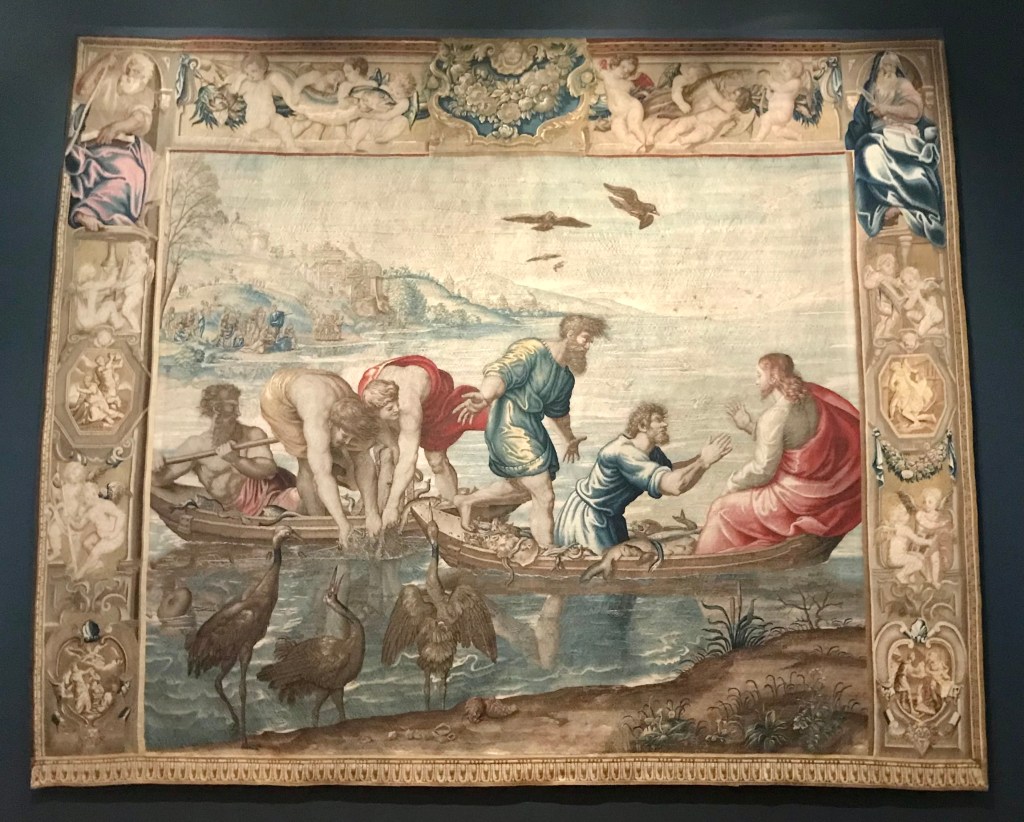
Last week we took a cultural field trip, visiting the Columbus Museum of Art to view the Dresden Tapestries, based on cartoons by Raphael in 1515-16 and commissioned by Pope Leo X to hang in the Vatican’s Sistine Chapel. Although we had seen tapestries in French chateaux and other European museums, this was our first opportunity to get a little closer and to learn more about how they are made. The bottom line: they are really art times two, the artist’s initial cartoon and the fiber art of the tapestry produced from it.
What is a tapestry?
The more intimate setting of the Columbus museum and the quiet weekday timing offered a perfect opportunity to view the tapestries more closely. A docent gave the group we were with a basic overview of tapestry weaving as well as the history of these particular pieces. Tapestries are a unique fabric art, woven to portray a scene, story or event, often biblical or historic. These tapestries focus on the ministries of Saints Peter and Paul. But more about that later.
This is the cartoon by Raphael for the tapestry “Christ’s Charge to Peter.” This is just one in a series of ten cartoons.
In essence the tapestry subject is a woven copy of a drawing (known as a cartoon) created by an artist. Tapestries are painstakingly handwoven — most often by European workshops specializing in this art form — with the design on one side of the fabric. To do this, the cartoon is copied (by hand!) and the copy laid face-down on the fabric. The finished tapestry becomes a complete reverse of the original cartoon. The cartoons for the original set of these tapestries were sent to Brussels to be woven in the workshop of Pier van Aelst. They were probably completed in 1520.
About the Raphael tapestries
My knowledge of Raphael was pretty sketchy, so after the museum visit I delved a little more into his life and his role in the Renaissance art world (Of course, it would have been even better if I’d done this homework first!). Along with Michelangelo and Leonardo da Vinci, Raphael is considered one of the three architects of the High Renaissance, a period from as early as 1495 to as late as 1530 of exceptional artistic accomplishment in Rome and Florence, Italy.
Artistic temperaments played a part in Renaissance art. Historians point out that Michelangelo was no fan of Raphael and openly critical of his work. Raphael was generally thought to be more agreeable and charming, traits that may have played a part in his success in acquiring significant commissions. In developing the cartoons for this series of tapestries, Raphael was very aware that they would be in close proximity to Michelangelo’s famous ceiling in the Sistine Chapel; however, the subject matter — Christ turning over the church to Peter and Paul — was different.
Like many artists, Raphael got an early start; his father was a court painter and Raphael was apprenticed at a young age to another master. After time spent elsewhere in Italy, he found his way first to Florence and eventually to Rome. His reputation firmly established, one biographer noted that Raphael had a workshop of fifty pupils and assistants, many of whom later became significant artists in their own right. This was arguably the largest workshop team under any single master painter. The workshop included masters from other parts of Italy, probably working with their own teams as sub-contractors, as well as pupils and journeymen. There is little evidence of the internal working arrangements of the workshop, but this was the artistic custom of that time. Raphael died quite young (at age 37 in 1520). He is perhaps best known for the frescoed Raphael Rooms in the Sistine Chapel. The series of 10 cartoons for tapestries representing the lives of Saint Peter and Saint Paul was commissioned by Pope Leo X in about 1516.
“The Miraculous Draught of Fishes.” Like all the tapestries in this series, the subjects refer to Christ turning the church h over to Peter and Paul.
The Dresden tapestries are one of numerous sets woven from these cartoons after Raphael’s death. Seven of Raphael’s original 10 cartoons for the series have survived and are now in the Victoria and Albert Museum in London. The tapestries woven for the Vatican no longer hang in the Sistine Chapel but are displayed on a rotating basis in the Vatican Museum. They returned briefly to the Sistine Chapel in 2020 in honor of the 500th anniversary of the artist’s death.
This is the cartoon for the tapestry above. Note the images are reversed.
The impact of the tapestries and Raphael in the art world is evident in the second part of the exhibition, which includes drawings by Raphael that were studies for his cartoons. Numerous other works—paintings, prints, drawings, and sculpture—were created by artists influenced by Raphael’s designs. The artist’s style and in some cases entire images were lifted from the much larger tapestries to become art on their own or to be worked into other pieces. Noted renaissance and baroque masters such as Rubens and Poussin are among the artists who incorporated Raphael’s work into their own.
The Columbus exhibit is comprised of six works from the duplicates ordered by the Prince of Wales (later King Charles I) about 100 years after Raphael’s death. (Here’s where the world history kicks in.) They were produced by tapestry makers in Mortlake, England. Augustus the Strong, elector of Saxony and king of Poland, brought the tapestries to Dresden, Germany in the 18th century. The tapestries were restored in the late 20th and early 21st century. The Columbus exhibition is the first time they have been displayed outside Europe.
Two lessons in one
I think I always looked at tapestries as works of art, but certainly without appreciating the entire process. First, the artist creating the cartoon has to plan the scene, starting with a series of rough sketches that are refined into final drawings to be included in the cartoon. These are huge works with significant detail and background scenery. This is where the other artists in the master’s workshop came into their own, copying the master artist’s style and intent. This is the first art lesson. The artistry of the tapestry weavers is the second lesson. Perhaps time for more research?
I don’t know about you, but I love when a “field trip” of some sort sets me off on subsequent pursuits. I’d like to know more about the lives of Raphael and Michelangelo. Can you imagine these men elbowing their way for favor among the papal and royal interests of their day? I know Francis I lured Leonardo da Vinci to his chateau in Amboise, France, where da Vinci (and the Mona Lisa) remained until his death. What story lines would you pursue?
Thank you so much for stopping by for my impromptu art history class. See you again soon!
Lately I have found myself on a bit of a culture course. And while I’m certainly not complaining, I am amused at how things sometimes come together. The last few weeks are a good example.
One of the advantages of living in a big city is the access to cultural and entertainment venues. And while that is certainly true, it’s also true that making the time, getting the tickets, and all the other requisite details often get in the way of what the city has to offer. Our suburb is twenty miles west of downtown Chicago, and while we have easy access to the city by car or commuter train, it’s more than a run to the grocery for milk.
My binge started with tickets to see The King’s Speech at Chicago Shakespeare. Perhaps you have seen the movie about Prince Albert, the Duke of York and his struggle overcoming a crippling stutter at the same time his brother, the Prince of Wales, was about to abdicate the throne, making Albert the king as Europe was going to war with Hitler. (Talk about pressure!) The play was enjoying critical acclaim at Chicago’s Shakespeare Theater. Everything I have seen there has been first-rate and this production did not disappoint, including the appearance of Harry Hadden-Paton, of The Crown and Downton Abbey, as Albert. My husband and I totally enjoyed the evening.
But then, less than a week later, I found myself at Symphony Hall. I am joining a girlfriend this season in a series of five concerts. She has been a subscriber for years, but her partner in this venture decided not to participate this season. The seats are good, and the cost when you subscribe ahead of time is do-able, so of course I said yes. Well, these seats are more than good; they’re in the fourth row. I can watch the violinists finger their instruments. We park in the garage across the street, grab a bite to eat and sit back and enjoy. I may be hooked!
But, wait, there’s more!
My usual cultural destination in the city has always been the Art Institute. (I’ve written about various visits here, including the Thorne Miniature rooms, John Singer Sargent and Gauguin in my Miscellaneous File. ) A year or so ago friends introduced us to a monthly lecture/discussion series at the AI. We are all retired, so when schedules allow we meet there to attend the series and enjoy lunch after. Last Friday was especially appealing, because a new Andy Warhol exhibit has just opened. We met early to see as much of Andy Warhol-From A to B and Back Again as possible before the regular lecture. But we may need to go back, because this is an extensive exhibit that takes the visitor well beyond Warhol’s prints of Marilyn Monroe and Jackie Kennedy.
And early pen and ink self-portrait of Warhol.
I wish I had done a little AW research before we went (Note to self: next time do a little homework.) Warhol’s much more than just a pop icon of the sixties, although that certainly describes much of his work. Unlike other artists, Warhol began his career doing commercial art. His first commission was drawing shoes for Glamour magazine in the 1950s, followed by work as a shoe designer for manufacturer Israel Miller.
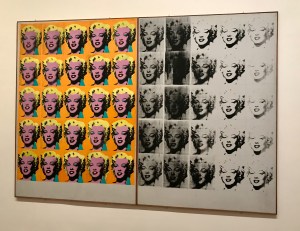
Much of Warhol’s later work continued to be based on commercial art, like the Campbell’s soup cans and the Brillo boxes. He was well known for his silk screen process. Many of those pieces, including the famous and familiar Marilyn Monroe image, were based on commercial photos that he copied and successfully turned into iconic images using a silk screen process. (The Marilyn Monroe image was originally a studio publicity shot for her last movie.) The silk-screened portraits, in fact, became so popular that movie stars, public and private figures came to Warhol for what he referred to as “commercial business.”
In addition to the individual portraits, Warhol often produced multiple versions in one work, sometimes with slight variation in color and/or shading.
This oversized portrait of Mao Zedong (it’s about 125-feet tall) is part of The Art Institute’s permanent collection. The Institute’s archive notes that Warhol’s portrait displays some irreverence towards the image that was widely displayed in China: “Flamboyant brushstrokes compete with the photographic image, forming color splashes on Mao’s clothing. Red rouge and blue eye shadow resemble graffiti.” Some art historians view Warhol’s treatment here as commentary on similarities between Communist propaganda to capitalist advertising media.
Like so many artists, Warhol’s artistic muse went well beyond the canvas. He spent most of his later years exploring videos and movies. Warhol died at only 58, so it’s interesting to speculate on where his art would have taken him. Like many gallery-goers, I’m more drawn to Renoir and Monet than Warhol. But there is no denying the impact Warhol has had on the art world. He used techniques like silk screen and video and blurred the lines between commercial art and fine art. And that alone is saying a lot.
What about you? What kind of art are you most drawn to?
So much for my culture binge. It’s time to take a deep dive into holiday prep, a.k.a. oven cleaning. Thanks for stopping by. See you again soon?
My husband gave me this bowl years ago, and I really do love it! It’s perfect for big, mixed arrangements.
I stopped for a manicure the other day, then realized, as I was heading back to my car, that Trader Joe’s (which shares the parking lot) had an interesting variety of pumpkins piled outside. Of course, I checked out the display and they were even more appealing up close, not to mention well-priced!
And that was the nudge that pushed me into fall.
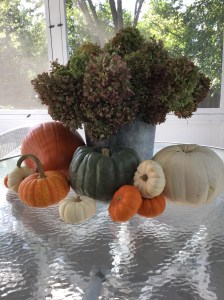
In truth, I had already picked up a few cute pumpkins and updated planters with mums, the latter because the previous blooms had totally withered in the last of summer’s heat. Now, however, I was into the new season. I cut two big buckets of drying hydrangea blooms and arranged them into several plump bouquets.
More than that, however, I began my quest for my own pumpkin patch in the front yard. It’s a challenge to see how many different kinds of pumpkins I can find — green, pink, white, orange — and I also have to protect them from from nibbling by squirrels, rabbits, and whoever else stops by for a bite of pumpkin. And don’t get me started on how easily specimens with soft spots or tiny breaks in their skin can readily rot into messy, mushy piles. (If it sounds like I have had experience with this, you are right.)
Here’s the font yard patch: three different oranges and a pink (!!!) pumpkin.
This is my patch from a few years ago.
This year I armed myself for serious pumpkin protection (or maybe I just need a hobby?). I washed them with soapy water seasoned with a splash of bleach. After they were dry, I spread them on a drop cloth and sprayed them with a clear coat sealer. I have no idea if these precautions will work, but they come from other bloggers who seem to know what they’re talking about. (Which really means they take their seasonal decorating much more seriously than I do.)
Pumpkins getting the “preservative treatment.”
I’ve also done my best to spread some autumnal cheer inside. I have an admirable collection of dried gourds, collected over several years, that I rely on for inside scene-setting at this time of year, but they are currently trapped under the basement stairs behind bookcases and toolboxes re-located for the duration of our drainage repairs (which should be wrapping up in another week or two. Hooray!!). So instead, I’m using more pumpkins, fruit, fresh and faux leaves to set the scene inside.
I piled my ceramic pumpkins from Berea, Kentucky, along with some some baby boos and a few real ones here on the antique dresser in the living room.
Then I thought about how good orange looks with blue and white, so I tried this in the dining room.
Finally I paired one of my buckets of hydrangeas with these pumpkins on the back porch!
Most importantly this has fed my puttering/tweaking gene, which spills over into a bit of fall cleaning, polishing and generally dusting-up. (My grandma would be pleased.) My house needed the attention and I needed the “therapy.”
This photo and the one below are from April, 2015. We had just enjoyed coffee and croissants at a cafe behind Notre Dame and were on our way Saint Chapelle.
This week has been a lesson in the highs and lows of the human heart. On Sunday morning in Chicago we awoke to mid-April snow. Not flurries, not a dusting, but inches of wet, sloppy, slushy white stuff. In November we would have found it fun. But in April, on Palm Sunday, I didn’t get the joke at all.
In fact, I wanted to pull the covers over my head.
Instead we drank coffee, read the papers, and my husband turned on the Masters Golf Tournament. We got caught up in the drama of the last hole and Tiger Woods’ amazing finish. If you saw this, you know what I mean: sheer joy in every fiber of his being. The crowds and his competitors were equally jubilant. This was a moment Woods was afraid would never come. But it did. A testament to the simplest work ethic: never, ever, ever give up.
What an emotional high. If you watched him hug his children and his mother without feeling tears come to your eyes, you might be missing a heart.
Monday’s punch
I was in the car on Monday when I heard that Notre Dame de Paris was on fire. How is this impossible? Architectural icons don’t burn; they weather revolutions, plagues, World Wars and Nazi occupations. But this was real. When I got home my husband had the news on, and he said, “This is awful. It’s like Katrina. You can’t stop watching.”
He was so right. We watched it off and on throughout the afternoon, waiting for the firemen to somehow get on top of the blaze, to get it under control, but instead the fire kept growing, and we watched the spire fall. The news commentators talked about the added tragedy of this happening during Holy Week. And we looked at each other and recalled a family story.
Our Notre Dame story
Another springtime shot, on the north side of the cathedral looking towards the bell towers.
Seventeen years ago Steve and I made our first trip to Paris together. It was a little earlier in the spring and we got back in time to celebrate Easter with my mom, her brother & his wife. (Our kids were away at school.) This was well before smart phones and selfies and so we took along a stack of printed photos (remember them?) from the trip to share over dinner. And as the five of us poured over the iconic sights from Paris — the Louvre, the Eiffel Tower, the Arc de Triumph — my uncle studied one of Notre Dame and remarked that he had been there for Easter in 1945.
What? How could he not have told any of us this story?
Bill was a Chicago kid in the Navy who spent WWII on a small boat escorting much larger ships back and forth across the Atlantic. He spent a lot of time in England and then in Le Harve, France. It was hazardous duty, and like so many WWII vets, he had never shared much about it. But back to Notre Dame…
When we found our voices, we asked what he was doing there. Well, he said, he and several shipmates had leave for Easter and they ended up in Paris. On Easter morning they headed for church. They didn’t know about Notre Dame or go looking for it, it was just the church they found (as if you could miss it, right?) The locals welcomed these young sailors warmly as “Yanks” and led them to seats right up front. I suppose they represented the liberators.
I can only imagine Bill’s blue eyes and his Evangelical and Reformed heart taking in the majesty of Notre Dame: its cavernous space, monumental pillars, stained glass, row after row after row of seats. How can you even take it all in?
Since hearing Bill’s story, I have been to Paris on a handful of additional visits. Notre Dame is simply part of the city, part of the skyline, we’ve walked by it a hundred times (often noting the crowds waiting to get in and said we’ve been here before and we’ll come back at a quieter time), we had breakfast with friends in a cafe just behind it, we’ve admired it up close and from across the river. We’ve picked it out of the skyline from the Musee d’Orsay and Sacre Coeur.
Notre Dame is Paris.
And clearly it will be repaired and rebuilt and continue to play its Parisian role. In the meantime, it hurts the heart to think of its blackened walls and collapsed roof. At the same time we’re heartened by its resilience. Icons can be fragile, it seems, and that should give us pause.
What about you? Do you have a Notre Dame story? I’d love to hear it!
I’m not sure what I expected, but French highways (and Italian) look a lot like what we travel in the States.
In thinking about this blog post, it occurred to me that though I never thought of myself as a “French Riviera kind of girl,” after our visit there last fall, I’d go back in a heartbeat.
The French Riviera is incredibly beautiful. Blue skies, even bluer Mediterranean water, sunsets that defy any camera to adequately capture them. Turn away from the water and there are hilltops covered in the tiled roofs of villas and, beyond that, mountains.
We included the Riviera on our “great French road trip” because getting that close and skipping it would be foolish, and we wanted make at least some some stops on the “art trail” in the South of France. (You may recall we had been making our way along the western coast of France, beginning in Rouen, then Normandy and Mont St. Michel, before heading to the chateaus in the Loire and then wine tasting in Bordeaux.)
After a beautiful cruise thru the French countryside, with the occasional walled chateau or abbey along the road, we found ourselves navigating in bumper-to-bumper traffic on ridiculously narrow streets, lined with parked cars on each side and street vendors selling everything from sunglasses to take-out dinners. Bikes and pedestrians criss-crossed our paths. What had we done?
Steve, after parking our car on a sidewalk (along with so many others) in Juan les Pins.
But wait, it gets better.
As we motored our way thru the congestion (it was Friday afternoon, the last Friday on the last weekend of the season as it turned out), we were trying to follow Google’s directions to our hotel in Juan les Pins, across the street from Antibes. Google meant well, but when she said turn left, she meant at the intersection we passed 20 yards ago. After a series of ridiculously convoluted detours, we finally pulled into a “parking space” on a sidewalk among a number of other cars and walked to the hotel. Then, having a somewhat better grasp of where to go, Steve moved the car to the underground garage where we happily left it until Sunday morning! (This park nd walk maneuver is one of our best tips. Sometimes finding someplace on foot is easier.)
Our room was large and lovely with a tiny balcony from which we could see the Mediterranean. We would be here for four nights. I don’t think we’d fully appreciated how much we had been “on the road” until now, stopping only for one or two nights along the way. And what a place to take a break. We walked down to the beach, found an empty cafe table, a glass of wine and just enjoyed the sunset. The next morning, after a leisurely hotel breakfast, we walked — yes, walked — about eight blocks, a little uphill and then down, and we were in Antibes!
The French Riviera is a string of cities like Nice and Cannes, and smaller cities and even villages along this lovely coast. We chose Juan les Pins/Antibes as a base because it was smaller than Nice and not as “high end” as Cannes. We could stay close to the water for a reasonable price. All of these cities are connected by a train line than runs frequently throughout the day, like a commuter rail. In fact on Monday, we walked to the station and took a short train ride to Nice.
This is Picasso country
Antibes was a fairly busy place on a Saturday morning, but we easily found our way to the Old Town with the usual tangle of charming, narrow streets and interesting shops. Our destination was the Picasso Museum. (Actually, there are Picasso Museums all over France it seems. I have also been to one in Paris.)
This was on a Saturday morning and we had been taking our time, ooh-ing and aaah-ing over the Antibes waterfront and wandering thru the old town. We arrived at the ticket office just before noon. We walked up to the ticket wndow along with some other visitors only to have the ticket-seller (who on this day was apparently also the ticket-taker) announce to all those around, that it was his lunch time and he would be closing until 1:30.
This is so quintessentially french, you just have to go with it.
Just one view of the waterfront in Antibes.
So, we wandered back to a food market complete with a cafe, ordered a light lunch, and did some people watching. I checked out a brocante market and we got sidetracked by two wedding parties celebrating along the way. Back to the museum.
This particular museum is housed in the Chateau Grimaldi, a 14th Century Roman Fort turned museum in which Picasso enjoyed a work space in 1946. His time in this space was short, from September until mid-November, but his artistic output was remarkable. He produced 23 paintings and 44 drawings during this short time. Interestingly, he donated all this work to the museum, which eventually acquired much more, including sculpture and ceramics.
The collection here included a number of sculptures on a terrace facing the Mediterranean.
About Picasso. Although I am not a huge Picasso fan, I have come to genuinely appreciate his work and its evolution, as well as his influence on generations of artists. The range of his work extends from painting, drawing and sculpture to include set design and ceramics. I wish I pictures of his ceramics, they were stunning. (This is what happens to me. I get so busy looking that I forget to take photos!)
The next day we dared to take the car from the garage to the outskirts of Nice to visit the Musee Matisse.
Self portrait, 1918, in the Musee Matisse.
After a predictably adventurous drive, we arrived at the museum, where interestingly (ironically?) there was a substantial exhibit recalling the friendship and rivalry between Matisse and Picasso. (Did I say this is Picasso country?) Matisse and Picasso met sometime in 1906 at Gertrude Stein’s Paris salon. (Americans Gertrude Stein, her brothers Leo and Michael and Michael’s wife Sarah were important collectors and supporters of Matisse.) Picasso, who was 11 years younger, and Matisse were artistic contemporaries. One of the most interesting displays in the exhibit was a pair of black and white films of each of them at work on similar pieces.
Matisse was 48 and a successful artist when he first came to Nice in 1917. Initially he wrote that it rained every day for a month. He was about to leave when the sun came out and he was hooked by the light. He never really left.
After Matisse we headed further inland to St. Paul de Vence, hoping to at least have a drink at La Colombe d’Or, the restaurant where so many artists paid their tabs by offering a painting or drawing in lieu of money. Did I mention this was a Sunday? On the last weekend in September? Everyone in France goes out to lunch on Sundays, especially beautiful September Sundays. The views on the drive were breathtaking, the town was packed, and the restaurant was unapproachable even for a drink without a reservation.
We knew better, but in our “carefree vacation” mode we just assumed they would throw open the doors for Janet and Steve. Happily, we found a table in an outdoor cafe and enjoyed a delicious lunch and some serious people watching. But we found the town too crowded to enjoy. C’est la vie.
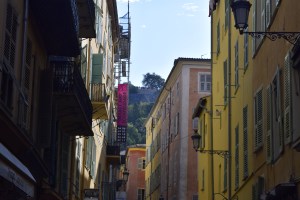
On our last full day on the Riviera, we took the train from Juan les Pins to Nice to explore the old town. It took less than 30 minutes and, once in Nice, there is a handy tram a block from the train station that runs down to the water, making several stops along the way. This was a day to walk and enjoy. Nice is very old and so close to Italy, that the influence is striking. Look at these pastel hued buildings, so different from the neutral stone in the rest of France.
This streetscape of fountains and park amid more substantial buildings is in the heart of the town near the water. Note the clouds: a change in the weather was on the way. Although the sun shone all day, it was much cooler by the time we went to dinner.
We enjoyed a delicious lunch at an outdoor cafe just off to the right of this photo.
This is the Promenade des Anglais. We walked here for several yards before I realized this is the idyllic spot where terrorists drove a huge truck into the crowds celebrating Bastille Day on July 14, 2016. Today the promenade is lined with bollards, but the horror of that night is hard to imagine in the midst of sun and sea.
As luck would have it, we were in Nice on the day of their regular antique market, which in this case was blocks-long, winding from one square to another. I was in heaven, Steve not so much. One of the most striking aspects of these markets is the age and provenance of the goods. There are chandeliers and gilt mirrors, confit pots, textiles and more that I have just never seen in a market in the midwest.
Despite our “longer stay” on the Riviera, we left the next day, promising ourselves to come back. In fact I would call this our “preview visit” to the Riviera. There is so much more to see on the art trail, we never got to Monaco or St. Jean Cap Ferrat or Cannes.
This is the mantra of our travels. And it is, I suppose, why we are totally unapologetic about returning to places that we love. There’s always more to see. What about you? Are you willing to make a return trip to a destination you really liked? Or do you feel each place you visit — in this country or around the globe — needs to be new? I’d love to hear your thoughts on this.
Thank you so much for stopping by. See you next time!
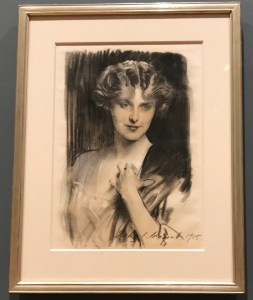
Singer Sargent’s charcoal portrait of Mrs. Marshall Field III (Evelyn Field) was actually done in New York in 1905. Though many of his subjects and collectors were Chicagoans, he did not complete many works in the city.
Last week Steve and I finally went to see the John Singer Sargent exhibit at the Chicago Art Institute. It’s a relatively small show compared to others mounted by the AI, but with a interesting cross section of his work. After reviewing his work and doing a little more research, I’m struck by how “American” his work seems, although he spent most of his life in a variety of European cities. Tell me what you think.
Most of us think of Sargent as the painter of Gilded Age portraits. And these he did beautifully. The facial expression, body language and clothing in each is remarkable and distinctive. No wonder he was so “in demand” from a relatively early age.
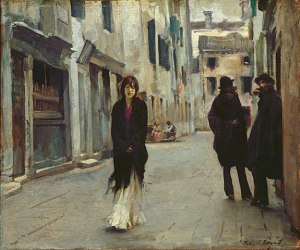
But before Sargent began accepting portrait commissions, he honed his skills on other works. Street in Venice, 1882, below, is one of several paintings he completed while painting there. (Although Sargent was American-born, his parents took him to Europe as a young child; the family remained there permanently.) I think it’s impossible to escape the moodiness here, or not wonder about the stories behind these three characters.
La Carmencita, 1890, is a more glamorous portrait of dancer Carmen Douset which captures her haughty (or is it defiant?) expression as well as a theatrical pose in equally theatrical dress.
When I think of John Singer Sargent portraits, I think of traditional works like this, Mrs. Edward L. Davis and her son Livingston Davis, painted in 1890. I like the crisp black and white here and the silky texture of her skirt versus the somewhat rumpled suit her son is wearing. And, most important, I think the pose looks totally natural: Mother with her hand on her hip, son just leaning into her.
Two years before the Davis portrait, Singer Sargent painted this portrait of Alice Vanderbilt (later Vanderbilt Morris) of the Vanderbilts when she was just 13. This seems a bit more traditional, but together with the Davis portrait, above, they are a clear representation of what we think of as “Gilded Age” portraits, from a time when new American money could buy the trappings of old European aristocracy.
Shortly after the turn of the century, however, Singer Sargent stepped way from his successful portraiture commissions to spend more time in pursuit of plein air painting. Many of these pieces feature vivid watercolors, including a number of paintings from Venice. The Gondoliers Siesta, 1904, is a beautiful example.
One of my favorites from the AI exhibition, The Fountain, Villa Tortonia, Frascati, Italy, 1907, captures Sargent’s transition from portraitist to plein air painter. The couple are Wilfred and Jane Emmet de Glenn, professional artists and friends of Sargent.
Sargent painted a series of watercolors much later while staying at the Florida estate, Vizcaya, of his friend and benefactor James Deering. One from the AI exhibition is The Terrace at Vizcaya, 1917. Here the color is much lighter, more “Florida.”
Despite living most of his life in Europe, John Singer Sargent never gave up his American citizenship, and painted many of the American political and industrial greats of his time. When I look at his paintings, especially his portraits, they seem to be very American: straightforward poses, not a lot of background, pretty much an American sensibility, but perhaps with the added polish of European training. What do you think?
The next field trip
Right now we are packing bags and maps before leaving on a long-awaited “road trip.” I hope you are following me on Instagram. I’ll be away from the blog but try to post often on IG!
Thanks for stopping by! See you next time – and on Instagram!
There’s nothing like one great antique or vintage find to whet your appetite for more. At least that’s how it works for me. One thing just leads to another…
About a month or six weeks ago, I happened upon this blue and white pitcher. In fact, you may have seen it on my Instagram feed. There is something about both the colors and the patterns that is distinctive from the rest of my blue and white transferware. It’s hard to see the detail in the image, but the lip of the pitcher is actually scalloped!
I haven’t had a chance to really research the manufacturing stamp on the bottom, so its real value is still elusive. And I need to be clear about my “antique” hunting. Most of it is just old stuff that catches my fancy, suits my style, calls my name. I don’t have the budget (or at this point even the space) for the $1200 antique Swedish cabinet my friend and I saw last weekend, even if it was truly wonderful!
My porch cabinet, where I keep some necessities and some “fun stuff.”
I have a few more finds in my porch cupboard (a very old, not-at-all-sturdy cabinet basically held together by myriad coats of paint) where I keep paper towels and glass spray to freshen up the dining table, cocktail napkins, an assortment of small vases and flower frogs as well as a flower pot (on the bottom shelf) of hand tools for the garden. (My idea of porch necessities!) I recently added a few more vintage vases to the other pieces on the top shelf. (My husband collected the vintage fans. The larger one needs re-wiring, along with a third one on his workbench, but I thought they looked cool on the porch. Pun intended!)
But wait, there’s more!
Last week I went to the Randolph Street vintage and antique market on Chicago’s near west side. This is a monthly market in the summer and I have attended sporadically for years. Sometimes there are great finds, sometimes not so much. The merchandise is definitely more vintage (30’s and 40’s) than antique, and there are a number of vendors selling old, repurposed, industrial pieces. This is definitely the place to go for “loft-sized” artwork, kitchen islands, coffee tables and more. Last week I saw at least six beautiful, old, oak drafting tables (sorry, I forgot to take any pictures). Fun to look at, but not really my style.
I also picked up that crusty industrial wastebasket behind the print. So much more character than more current versions.
Surprisingly, however, this is where I bought many antique french linens in the past. (One vendor used to come once each summer. Her selection was amazing!) I’ve also found great prints, as well as some fun lamps. Last week I found this sweet little water color, currently residing on a shelf in the dining room.
I also found two neat baskets. One is huge — 23″ by 16″ by 13″ deep — and needs some repairs. I’m going to have to glue the leather straps back in place at the ends of the handles. It also has some loose pieces on the bottom; perhaps from being dragged? I haven’t decided how to handle that, except to treat it gently overall. it’s big enough to hold some pillows on the porch or quilts at the foot of a bed, but I could also put it atop a cabinet to look neat and out of the way of further damage.
And since I found one basket, I picked a smaller one up from the same vendor. It’s really a nice shape and size, perfect for magazines. I don’t know about the rest of you who shop at similar venues, but if I find one thing at a booth, I often find more from the same vendor. It probably has a lot to do with companionable aesthetics. (Price negotiations are also a little easier when buying more than once piece.)
The big find…
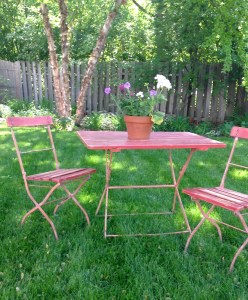
Of course, I’m always looking for transfer ware and ironstone. Nothing last week. Lately I’ve been searching for small vintage vases like the ones in my porch cabinet. I was sure I’d find some at Randolph Street, but no. If there were any, I did not see them. However, I did spot this bistro table and four chairs early on and I could not get it out of my head. Was I looking for something like that? Not at all. Do I have a good spot for this? No!
There are actually two more chairs to go with the table, and all of them are surprisingly sturdy.
I looked at it and walked away. Then I met up with my antiquing buddy and showed her. She agreed it was fabulous, insisted I should really buy it and negotiated a better price (she knows this vendor). I still walked away. We looked at other stuff, stopped for a cold drink, and while we were taking our break my friend asked if I was still thinking about the table.
“Yes,” I said. “And I’m thinking I’d better go buy it.”
Actually, it’s really charming in the yard, propped with a plant. I absolutely love it. My husband does too. We’re just assuming we’ll come up with another place for it.
Most of us who shop antique markets have a mental Rolodex of the pieces we didn’t buy. We were indecisive, couldn’t think where to put it, or someone else snatched it up. But the best shoppers/collectors/decorators offer the same advice: if you love it, you’ll find a place for it. They’re right. That’s the way antiques (or any collectibles) are. They’re really kind of insidious, worming their way into your heart, your home, and finally into a corner of the family room.
What ever it is that you collect, happy hunting! Thanks for stopping by. See you next time!











 Lately I have found myself on a bit of a culture course. And while I’m certainly not complaining, I am amused at how things sometimes come together. The last few weeks are a good example.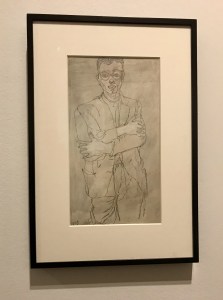








 Antibes was a fairly busy place on a Saturday morning, but we easily found our way to the Old Town with the usual tangle of charming, narrow streets and interesting shops. Our destination was the Picasso Museum. (Actually, there are Picasso Museums all over France it seems. I have also been to one in Paris.)






 Ivy & Ironstone