
My road thru the pandemic has been paved with a significant stash of books. Reading has been (as it nearly always is) my salvation. Like many of you I often tilted these months at something a little lighter, or at least from another time period. I didn’t want to feel like I was reading the news. But along the way I also read three memorable titles.
Some books are challenging, but you still can’t put them down. There are those that are challenging to the point of troubling, but still compelling. I recently read three novels in short order that fit that description. Each had some uncomfortable moments and pushed my thinking — about the pandemic, African Americans, and immigration. And that, of course, is the “reader’s curse.” You read things that make you squirm, feel sad, maybe even make you want to walk away, but then you come back to see what happens next.
First, An American Marriage
I wrote briefly about the Tayari Jones bestseller here. It’s a popular title on a number of reading lists. The story centers on an upwardly mobile African American couple in Atlanta. They are married for just a short time when, on a visit to the husband’s family in a small town, the husband is accused of sexual assault. You can see where the story spirals. He is arrested, tried and jailed. And while he depends on her as his link to the world, she begins to move on.
I am probably over-simplifying here, but Jones does a remarkable job with characters whose life spirals in a predictable way, but one that is perhaps foreign to most readers. I read this earlier this spring, weeks before the death of George Floyd. If you haven’t read it yet, think about doing so now.
Then my daughter shared Valentine
Elizabeth Wetmore’s debut novel was one of Jenna Bush Hager’s recent picks for her Today Show book club. When she announced this title she noted that readers from West Texas will really get this book (and I’m paraphrasing here). Well, I’m not from West Texas, but this is one compelling read. I understand why my daughter couldn’t put it down, because I couldn’t either.
Set in the 1970’s the story revolves around women in a dirt-poor town in West Texas. They are thrown together after a fourteen-year-old girl — an immigrant from Mexico — is savagely attacked. Yes, there is violence, racism and poverty, but there is also strength, humor, hope and bravery. This is Elizabeth Wetmore’s first novel and I think she hits it out of the park.
A Woman is No Man by Etaf Rum
.My book group is discussing this title on Friday at our monthly Zoom meeting. (Also a Jenna Bush Hager choice.) This book opens in Palestine in 1990 when seventeen-year-old Isra is married off to a Palestinian husband from Brooklyn, New York. Her sheltered life hasn’t begun to prepare her for the new home she & her husband share with his family. Isra quickly gives birth to four daughters — but no son — and is expected to shoulder most of the cooking and cleaning for the extended family. Her husband works long hours and she is not allowed to leave the house unchaperoned.
In alternating chapters Rum tells the story of Isra’s eldest daughter Deya, raised by her grandparents after Isra and her husband are killed in a car crash. Deya longs to know more about her mother and what happened, and she dreads the string of suitors her grandmother forces her to “sit with” as she nears high school graduation. Deya’s quest for the family’s truth makes for a good mystery, but the real story here is how a family clings to its cultural ways, no matter how restrictive and controlling. I suspect it’s the story of an endless number of migrant families.
I surfed the web for comments about this book, as well as reviews. A number of readers with similar backgrounds were painfully honest, saying, essentially, “This is what life is for Arab women.” Most of these women also said they were blessed to have families who embraced western customs. The bottom line: this book made me think about how little we really know about the rest of the world.
And now, a moment from my soapbox.
We know that masks, social distancing and hand washing slow the corona virus. Experts in communicable diseases aren’t making this up. But inexplicably in this country that believed so much in science that we eliminated polio and landed a man on the moon, many have decided to ignore the experts. It’s boring. No one wants to be told what to do. It won’t happen to me. There’s always an excuse.
Now simple actions to slow the pandemic have become political footballs.
Meanwhile the pandemic numbers are rising to frightening levels. According to the CDC’s webpage, there were 52,228 new cases of the virus on Sunday, July 5th. More than fifty thousand in one day. It boggles my brain and it’s heartbreaking. I know we all have to work out our own comfort zone, but, please, wear a mask.
I hope you enjoyed a safe and relaxing holiday on this unforgettable July 4th.
Thanks for stopping by and see you again soon.
 A funny thing happened on the way to writing this post…
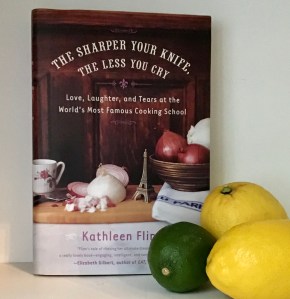
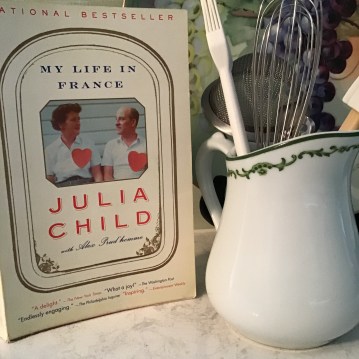 Long before Kathleen Flinn took on Le Cordon Bleu, there was Julia Child. My Life in France recounts Julia and Paul’s early move to France, her discovery of — and passion for — french cuisine and her cooking adventures before, during, and after (including her own time at Le Condon Bleu!). Of course there are recipes, but I really loved this book for the story it told about Julia and Paul. The book is largely based on letters written by Julia and Paul Child to his twin, Charles Child, grandfather of co-author Alex Prud’homme. Julia’s uniquely pitched and enthusiastic voice is everywhere in the book. Most of us think of her as the dynamo behind Mastering the Art of French Cooking, which many say brought french cooking to America, and the subsequent PBS series The French Chef, both wildly successful. But Julia and Paul weathered more than their fair share of personal and professional challenges along the way, and they too are part of the story.
 David Lebovitz is a former pastry chef, who spent 13 years in the restaurant fast lane at Alice Waters’ Chez Panisse before heading across the Atlantic to Paris. (Don’t they all?) He writes a dynamite
  Finally, I’m including The Cook’s Atelier by Marjorie Taylor and Kendall Smith Franchini. They think of it as a cookbook and I do too, but it’s also a coffee table book with it’s oversized, lush photos of the Burgundy countryside and their beautiful shop in Beaune, France. And then there is the story of how Marjorie ran a successful restaurant in Phoenix before following her daughter to France, and their search to build a successful family business around their Burgundian way of life in Beaune, and the business that grew and portraits of the farmers, shepherds, butchers and more that complete their picture. The atelier’s philosophy is built around seasonal cooking, and the recipes are arranged accordingly. for example, Spring Dinner in the Wine Shop includes White Asparagus with Hollandaise, Green Garlic Souffle, and Rustic Apricot Tart.

 How are you doing? Isolation is hard, but I honestly can’t complain. We’re healthy and so is our family. Right now, that’s everything.
  On Friday my book group met via Zoom to discuss The Lake is on Fire by Rosellen Brown. Fifteen of us logged on to talk, check in with each other, share a few war stories about life in a time of social distancing, and then realized we really could not talk all at once. (This happens even when we meet in person!)




 This birthday cake

 My looks this month can be summed up in three words: Charleston window boxes. They are charming, creative, and put a welcome face on homes and businesses across this charming and historic city.


 What I’ve been reading
 One quick cook
 Speaking of grandsons and baseball, Steve and I spent the weekend in Ohio carrying our folding chairs from game to game, following the five-year-old and his T-ball team and the eight-year-old and his coach pitch team (who seem like pro’s after watching T-ball).

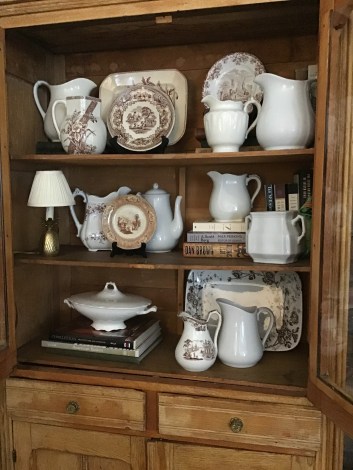
 Ivy & Ironstone