A family footnote to history

This “avenue” of live oaks at Boone Hall was planted by the second generation of the original family. The plantation is privately owned and has been the setting for a number of movies, including “North and South.” The original house is long gone and the current house, though lovely, dates to the 1930’s.

Once in a while, if you are really lucky and paying attention, personal history meshes with the broader picture.

Our family recently spent our annual “beach week” at Kiawah Island, South Carolina. At the end of the week, when everyone else had left, Steve and I decided to linger a few more days in Charleston.

Charleston is great for history geeks like us. Although we have made annual trips there for decades, there’s always more to see. (Last year we went back to Fort Sumter, here.) This time around we decided to drive to Boone Hall Plantation, home of this legendary Avenue of the Oaks (Trust me, it’s this stunning, although the plantation was a bit of a let-down). Getting there took us past Fort Moultrie, on Sullivan’s Island, where we stopped to explore a family footnote to history.

A bit of background

Constructed to protect Charleston Harbor, Fort Moultrie was still unfinished when it was attacked by British forces in 1776. After a nine-hour battle Revolutionary forces led by William Moultrie turned back the British and Charleston was spared. The fort was seriously neglected in subsequent years, but when England and France went to war in 1793, the U.S. determined to tighten waterfront security and a second Fort Moultrie was one of 20 new fortifications. The second Fort Moultrie was destroyed by a hurricane in 1804. Congress next ordered a third Fort Moultrie, this time built of brick, completed in 1809. In 1860, Charleston Harbor was protected by Fort Moultrie, Fort Sumter, Battery Johnson and Castle Pinckney. In December the Federal Garrison abandoned Fort Moultrie for the newer Fort Sumter. A few months later, Confederate troops shelled and captured Sumter. The rest is Civil War history.

Getting personal

In 1936 Fort Moultrie was the first place my father-in-law, a newly-minted ROTC officer from the University of Georgia, was stationed. (By then the fort had been equipped with more modern weapons in the late eighteenth and early nineteenth centuries, then largely disarmed after WWI. It continued, however, to play a key role in coastal security.)

This was the office of the Quartermaster (note the sign).  We think that since my father-in-law’s duty was largely administrative, he could have worked here.
This was the Commissary, though it’s hard to see the sign over the door.

We shared this bit of personal history with the Park Rangers there, and they enthusiastically pulled out some photos of the facility in that era and directed us to the few remaining buildings, some still bearing their Army signage but now converted to high-end condos. My father-in-law would be so amused. In his day it was just a hot, humid post. I think of him walking the streets of what must have been a tiny town in a swampy backwater. Lou was from New York City. Even after those years at the university in Athens, Georgia, Sullivan’s Island must have seemed the ends of the earth.

It’s amazing to think that one army installation was repeatedly called into service for more than 175 years. At some point it changed from an Army fort to an Army/Navy reservation and encompassed most of Sullivan’s Island. Fort Moultrie was decommissioned in 1947 and turned over to the National Park Service in 1960.

We’ve spent so much time in South Carolina without really exploring this exact area. Our visit on this occasion as somewhere between accidental and spontaneous, but I’m so glad we got to look at this piece of the past.

Thanks for coming along. See you next time!


The thrill of the hunt

You may have seen this on my Instagram.

There’s nothing like one great antique or vintage find to whet your appetite for more. At least that’s how it works for me. One thing just leads to another…

About a month or six weeks ago, I happened upon this blue and white pitcher. In fact, you may have seen it on my Instagram feed. There is something about both the colors and the patterns that is distinctive from the rest of my blue and white transferware. It’s hard to see the detail in the image, but the lip of the pitcher is actually scalloped!

I haven’t had a chance to really research the manufacturing stamp on the bottom, so its real value is still elusive. And I need to be clear about my “antique” hunting. Most of it is just old stuff that catches my fancy, suits my style, calls my name. I don’t have the budget (or at this point even the space) for the $1200 antique Swedish cabinet my friend and I saw last weekend, even if it was truly wonderful!

My porch cabinet, where I keep some necessities and some “fun stuff.”

I have a few more finds in my porch cupboard (a very old, not-at-all-sturdy cabinet basically held together by myriad coats of paint) where I keep paper towels and glass spray to freshen up the dining table, cocktail napkins, an assortment of small vases and flower frogs as well as a flower pot (on the bottom shelf) of hand tools for the garden. (My idea of porch necessities!) I recently added a few more vintage vases to the other pieces on the top shelf. (My husband collected the vintage fans. The larger one needs re-wiring, along with a third one on his workbench, but I thought they looked cool on the porch. Pun intended!)

But wait, there’s more!

Last week I went to the Randolph Street vintage and antique market on Chicago’s near west side. This is a monthly market in the summer and I have attended sporadically for years. Sometimes there are great finds, sometimes not so much. The merchandise is definitely more vintage (30’s and 40’s) than antique, and there are a number of vendors selling old, repurposed, industrial pieces. This is definitely the place to go for “loft-sized” artwork, kitchen islands, coffee tables and more. Last week I saw at least six beautiful, old, oak drafting tables (sorry, I forgot to take any pictures). Fun to look at, but not really my style.

I also picked up that crusty industrial wastebasket behind the print. So much more character than more current versions.

Surprisingly, however, this is where I bought many antique french linens in the past. (One vendor used to come once each summer. Her selection was amazing!) I’ve also found great prints, as well as some fun lamps. Last week I found this sweet little water color, currently residing on a shelf in the dining room.

I also found two neat baskets. One is huge — 23″ by 16″ by 13″ deep — and needs some repairs. I’m going to have to glue the leather straps back in place at the ends of the handles. It also has some loose pieces on the bottom; perhaps from being dragged? I haven’t decided how to handle that, except to treat it gently overall. it’s big enough to hold some pillows on the porch or quilts at the foot of a bed,  but I could also put it atop a cabinet to look neat and out of the way of further damage.

And since I found one basket, I picked a smaller one up from the same vendor. It’s really a nice shape and size, perfect for magazines. I don’t know about the rest of you who shop at similar venues, but if I find one thing at a booth, I often find more from the same vendor. It probably has a lot to do with companionable aesthetics. (Price negotiations are also a little easier when buying more than once piece.)

The big find…

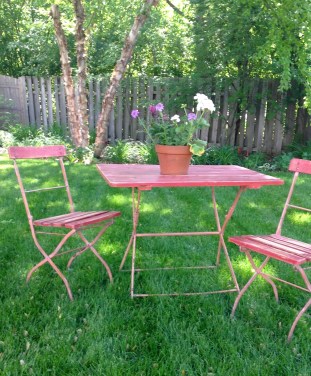
Of course, I’m always looking for transfer ware and ironstone. Nothing last week. Lately I’ve been searching for small vintage vases like the ones in my porch cabinet. I was sure I’d find some at Randolph Street, but no. If there were any, I did not see them. However, I did spot this bistro table and four chairs early on and I could not get it out of my head. Was I looking for something like that? Not at all. Do I have a good spot for this? No!

There are actually two more chairs to go with the table, and all of them are surprisingly sturdy.

I looked at it and walked away. Then I met up with my antiquing buddy and showed her. She agreed it was fabulous, insisted I should really buy it and negotiated a better price (she knows this vendor). I still walked away. We looked at other stuff, stopped for a cold drink, and while we were taking our break my friend asked if I was still thinking about the table.

“Yes,” I said. “And I’m thinking I’d better go buy it.”

Actually, it’s really charming in the yard, propped with a plant. I absolutely love it. My husband does too. We’re just assuming we’ll come up with another place for it.

Most of us who shop antique markets have a mental Rolodex of the pieces we didn’t buy. We were indecisive, couldn’t think where to put it, or someone else snatched it up. But the best shoppers/collectors/decorators offer the same advice: if you love it, you’ll find a place for it. They’re right. That’s the way antiques (or any collectibles) are. They’re really kind of insidious, worming their way into your heart, your home, and finally into a corner of the family room.

What ever it is that you collect, happy hunting! Thanks for stopping by. See you next time!


The heart of a garden

Sometimes writing a blog post reveals more to me than it does to you. That may be the case here. I started out to write about “Getting my spring on” and how nice it has been to get back outside after a seemingly endless winter. But as I typed I began to see that for me, this year, “Getting my spring on” meant a whole lot more.

Forget lilacs and peonies. One of the sure signs of spring here has always been moving the wicker sofa from the family room (where it “winters”) back out to the porch. Then we bring up the wicker rocker and side tables from the basement and the chairs that fit around the dining table out there, and life is good. This is where we eat most of the summer, have drinks with friends, read the paper, check our email, plan our day over coffee.

But the best way for me to get my spring on is digging in the dirt. It’s creative to coax color and texture from seedlings and soil, to pick the right plants for the right spot, to pair colors and textures for the best effect. But it’s a lot more. Planting, pruning and even weeding has always been therapeutic for me, as I think it is for many others.

The power of digging in the dirt

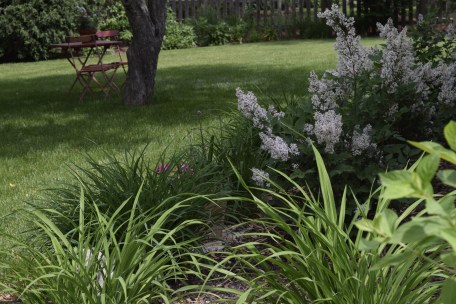
One of my “renovated beds,” with new lilacs and transplanted daylilies.

Gardening is a nurturing process, caring for the plants while enjoying time outside, being nurtured by nature. This is a lesson I learned from my maternal grandfather, who always had a garden. I’m sure the vegetables began as a depression-era effort to supplant the family budget. Grandpa tended the garden; Grandma canned. This morphed into a larger “victory garden” in World War II; it was one way they could support the war effort and I suspect it kept them busy and managed stress while sons, nephews and friends were scattered around the globe.

In addition to the tomatoes, beets, beans, carrots, and more, there were always flowers: geraniums, dahlias, phlox, marigolds. (Thinking back, I wonder how he squeezed so much into that tiny, 25-foot Chicago lot!) Happily he passed that gene on to me! (This totally skipped my mother, whose garden was limited to whatever Grandpa planted for her and that was totally lost on my father, who efficiently mowed down more than one rose bush without recognizing what it was!)

This year I have found my garden to be especially nurturing.

I wrote a few posts ago about suddenly, unexpectedly, losing a very good friend. Her death left me reeling and I was unable to come to terms with it until I got into the garden. I am sure time itself had something to do with it, but the simple tasks of raking and cleaning up the beds, of digging up the weeds and dividing and transplanting some perennials, of dealing with the life of the garden, brought me some peace. (This would be easily explainable if she was an avid gardener, but it’s actually her husband who has a green thumb and has mentored my gardening efforts. Sherry just loved flowers and and for her the garden was a natural source!)

So, this is the year I discovered that gardens also yield comfort.

Daylillies and coneflowers last summer.

I am, however, still left with lingering weeds, the purple coneflowers gone wild, daylilies desperate for division, herbs that need tending and some ideas to renovate tired beds. After assuming I had finally nailed the basic landscape at our house, the light conditions abruptly changed. The large ash tree that shaded our front yard fell victim to the dreaded ash borer. Not only do we miss the shade, but a bed with a number of shade-loving perennials was totally crisped last summer. In the back yard we had a bank of upright arborvitae along the southern lot line. They threw a lot of shade, but they got way too big, and then damaged by a heavy snow a few winters ago. We had them removed & replanted that area with hydrangeas last year. It looks terrific, but it’s pretty sunny now. (Aha! A new gardening opportunity!)

I’ve now spent some time moving things from sun to shade and shade to sun. (I think of this as the gardener’s version of tweaking bookshelves or furniture arrangements!) I’ve also spent two fun mornings at my favorite nursery, searching out replacement plants. I can’t wait to see how this all works out. And I’m feeling a little more at peace with the world each time I dig in the dirt.

These are the challenges gardeners relish and the rewards they reap!

Thanks for stopping by. See you again next time?

Hero Worship

What do basketball and interior design have in common? It’s actually pretty simple. 

Starting in the 4th or 5th grade and continuing for several years, my basketball-loving son enthusiastically followed the career and athletic achievements of Michael Jordan. (Who am I kidding, in the late eighties and early nineties we all loved #43!) His basketball feats seemingly had no limits. There were gravity-defying gymnastics that invariably ended with a basket. But there was also the ball handling, the competitiveness and the work ethic. (I know this because Doug watched tapes of his plays again and again and again. They were the soundtrack of my life for quite awhile.)

Hero worship is something we all occasionally fall into, and, depending on the hero, it’s not all bad. We might learn some new skills and/or acquire some new interests, etc. So it’s hardly surprising that my love of dishes, fabrics, furniture, color and design — really all the decorative elements — have led me to my own group of decorating heroes.

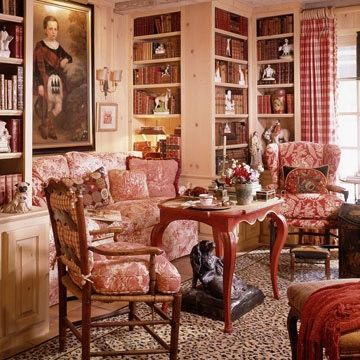
The essence of French country, with the cheery (and cherry) reds, the check and toile fabrics, the curvy legs on the table in the foreground, charming accessories layered into the bookshelves and on the tables.

You may recall that I wrote here about the influence Mary Emmerling had on my early decorating, but she’s not my only design hero. If you checked my bookshelves, you would see that Charles Faudree is clearly a favorite. I’m not at all sure I have ever succeeded in recreating his lush, layered designs, but I’m happy to keep trying.

For those of you who may not be familiar with Faudree, he is an American designer known for his colorful take on country French interiors and credited by many for popularizing the look. I had admired a number of his rooms in magazines like Traditional Home for some time before I realized that they were all the work of one man.


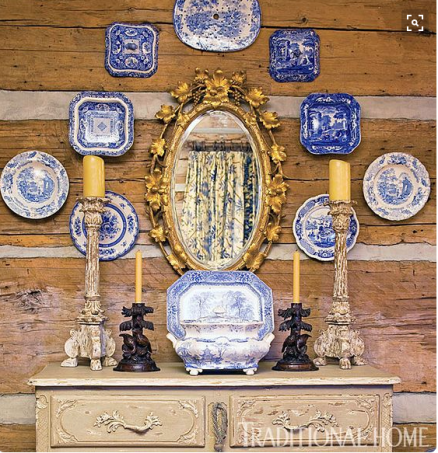
You may recognize this from my post on transferware. Charles Faudree is the inspiration, at least in part, behind my collection..


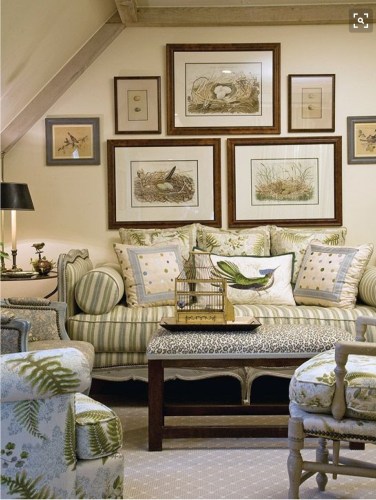
Faudree’s designs feature a lot of center tables like this one, above, in a library (often the way he referred to an office or study) and, below, in an entry. The table tops are always decked with books, flowers and other meaningful brick-a-brack. I don’t have space for a center table, but I have toyed with similar arrangements atop our dining room table and on side tables.

Different spaces, same aesthetic


One of the things I appreciate about Charles Faudree’s designs is his ability to translate his aesthetic into different settings. The image above is a very traditional dining room, but the photo below features a more contemporary, voluminous space that still maintains his country French design.


Not all Faudree rooms are huge nor are they perfectly proportioned. I love the sunroon, below, but it’s clearly a narrow space.

And what wonderful rooms, furnished with beautiful antiques, plush couches and chairs always topped by a variety of pillows in a companionable array of colors, patterns, textures and trims (always trims — elegant tapes, fringe, tassels, ruffles, etc.). So many thoughtful details.


No room is too small or insignificant, no corner too obscure to escape his treatment. This would not work at my house, but I love the powder room below, especially the little Napoleon on the vanity, not to mention the sconces and wallpaper. Why shouldn’t a small powder room be so completely imaginative?


This transitional space, below, which could be clumsy in accommodating a distinct change of level, is instead totally charming; with chairs and a lamp it’s the perfect place to have a cup of tea or leaf through a magazine.


Despite his motto that “More is never enough,” Faudree often allows  a distinctive antique or piece of art to stand on its own. I think the Swedish secretary, below, is from one of his own homes. And look how he allows the brooding Lincoln portrait to dominate the space.


But that “appropriateness” just one aspect of his aesthetic. For me, the real art of Faudree’s talent is in his attention to detail, perfectly placed objets d’arts, picture frames, figurines, cache pots, mementos, etc., all chosen to reflect the interests of the homeowner as well as the overall design. Many are pricey antiques, others are family pieces or flea market finds. (Truth to tell, I think the tension between high end and low end in one room or even one vignette makes a powerful statement.) In his hands, all of this fits perfectly into the greater design scheme. It’s personal, it’s layered, it’s thoughtful.


I’m not advocating assembling and displaying “stuff” for the sake of “stuff.” And I don’t think Faudree was either. But I do think that rooms devoid of artwork, photographs, books, collectibles from a hobby or travel tend to have a very sterile look, as though anyone could live there instead of the individuals who do.


This was the back entry to his own mountain cottage, but look at the style and personality he paired with function here.

I never tire of paging thru his books, reading and re-reading his comments about how or why various elements combined into the finished design. I always learn something new, about wall arrangements or color or collectibles. I also find that I am more than a little charmed by his impish personality, stories from friends and associates about buying trips in France and his prankish sense of humor. This is someone I really wish I could have met.

Sadly, Charles Faudree died in 2013. (I know, think of the rooms he could have designed, the books he could have written!) But, you can enjoy his many books from new and used sellers and even the library. Titles include: Charles Faudree Home, Charles Faudree Details, Charles Faudree Interiors, Country French Florals and Interiors, Charles Faudree’s Country French Living, Charles Faudree Country French Signature, and Charles Faudree Country French Legacy. 

What about you, who or what inspires your interests?

Thanks for stopping by. See you next time!


Grief in the Facebook age

One of the best friends I’ll ever have died two weeks ago. Just died.

She had been diagnosed with a serious condition about ten days before, one that would require medication and some lifestyle changes, but it would be manageable. Her death was shocking and hard to wrap my head around.

It still is.

I was unprepared, as were all her family and friends, but I was equally unprepared for this loss to be shared so widely on Facebook. Although we were among the family and friends her husband called, it took only a few more hours for her passing to appear in a Facebook feed (as had her illness earlier).

Of course, social media being what it is, and Facebook being Facebook, many people began expressing their condolences electronically and the family graciously responded. I’m sure they greatly appreciated the emotional support.

I don’t know how I feel about this.

Death is personal and private. I don’t use the same terms to describe Facebook.

Is it good that social media makes it so easy to quickly send a few lines of condolences or do our friends and family deserve something more personal? At least of course with Facebook, the comfort and condolences and even memories are shared. (That may not always be the case with well-intentioned cards and notes.) But it still seems just a little weird to me. I pretty much think of Facebook as the happy place where we post pictures of a new baby, a new graduate, a vacation. And if we have to post something more serious here, is there a way to whisper? Do these people follow up in a more personal way?

In my book, the friend who held my hand after cancer surgery and helped me empty my mother’s apartment after she died deserves more than electronic condolences. There should be hand-written notes recalling her larger-than-life personality, her sense of humor, even her preoccupation with air conditioning and avoiding frizzy hair (I think the two are related.) This is the friend who always, always used cloth napkins and with whom I shared the traveling wine glasses. She loved her iPhone, but it never replaced a hand-written note.

I suppose I should admit to a few disclaimers here. I’m sure many who responded electronically, also did so more traditionally. I’m certainly not accusing anyone of a major breach of etiquette. In fact, I’m blogging about this. 

Is this a generational thing? I think not. Even my daughter, who manages social media for a living, was uncomfortable with the way this worked. (My friend would have thought it just fine. I’m the one with the problem here.)

The real issue is that Facebook, texts, tweets, etc., are the only way some people are now communicating. Is that modern or a just an easy shortcut? Are they hiding? Writing a note, calling on the phone, or (Mercy!) showing up at the door with a cake or a casserole may seem old-fashioned, but is it more thoughtful?

Life is so much better when we reach out, live in the moment, actually shake hands. (And lately I’m all about living in the moment.)

I’m anxious to hear what you think of this. Some people agree with me that it’s awfully impersonal; others concede that it’s efficient in our modern world. Am I just being an old lady? Is Facebook okay for news like this or do we need a more personal approach?

Cooking from the book

If you follow me on Instagram. you already know how excited I was when my copy of The Cook’s Atelier Cookbook arrived. The Cook’s Atelier is the cooking school I attended last spring in Beaune, France. I wrote about the one-day workshop, here, meeting Marjorie, her daughter Kendall and the rest of the class to shop the local market for ingredients, returning to their 15th Century atelier, and preparing and sharing a remarkable French lunch.

Like that day, this cookbook is much more than recipes. It’s a thoughtful treatise on French culture, particularly in the Burgundy wine country. Ex-pat authors and cooks Marjorie Taylor and Kendall Smith Franchini share their love and appreciation of all things French and the challenges of defining a business based on their passions for cooking and wine and then launching that business in their newly adopted country.

Not only is the food scrumptious, so are the full-page photos!

First, this is a lovely book, beautifully printed on heavy paper. (So French, I’m sure.) The photos are stunning, and document every aspect of their life, from the delicious food, to the countryside, the Beaune market, the local vendors they have come to appreciate and depend on, the elegant simplicity of their shop, kitchen and dining room, and, of course, the family at the center of it all. (If you have been to their shop, then you know the integral role played by Kendall’s husband Laurent and how sweetly their two young children occasionally appear in the shop or kitchen).

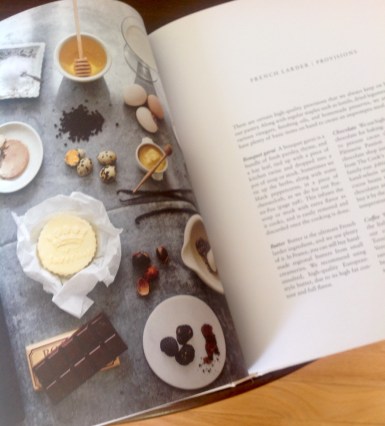
Butter. So quintessentially French on its own, but then there is clarified butter, compound butter, buerre noisette. So much to learn!

Lots of cooks, restaurants and foodies publish cookbooks. There seem to be at least one or two new ones each week. But few spend time on technique and ingredients (well, maybe the likes of Alice Waters and Julia Child). The Cook’s Atelier Cookbook stands far above these latest publications. Charming sections tackle the French larder, cooking tools, burgundy wine, the French cheese course, and traditional cooking techniques like frenching and tying a rib roast and trussing poultry. Recipes are grouped by season and compiled into menus, something I especially appreciate since I am notoriously uncertain about what really goes with what. In short, this is a cookbook you can truly learn from in addition to finding great recipes.

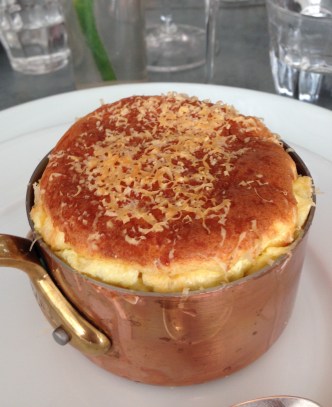
So, you may ask, what have I made? I’ve been making the French butter cake since I took the class. It’s simple and delicious, two prerequisites for French cooking. I’ve also prepared the grilled veal we made in class (and practiced the sauce technique with a few other cuts of meat).  Now I’m working on the green garlic souffle. (Mine tasted delicious, but the presentation needs work. See below!)

Tasted delicious, but the presentation needs work.
What we made in class, served in these wonderful, individual copper pots. I need more practice!

I have added pastry tips and disposable bags to my kitchen equipment and tested them last week on gougers and madeleines. Next up? Coq au Vin. Marjorie and Kendall use white burgundy instead of red, and I can’t wait to try that.

Gather ingredients first!
Gougeres, dainty pastry puffs flavored with gruyere and served warm with an apperitif. I’m practicing my pastry bag skills for these.
Madeleines, best served slightly warm after dinner.

What have I learned? Quite a lot. Fresh — which means seasonal — ingredients make a difference. Ask the butcher for help. Make sure you understand the recipe before starting. Gather all tools, prepare pans, and measure ingredients before cooking. Have fun. The story in my kitchen and yours is the same as the story in theirs — it’s about the family and friends around the table.

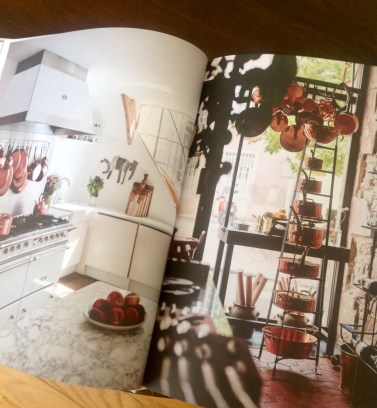
I couldn’t resist showing you a few more pages from the book. The photos are really beautiful. The first is their teaching kitchen and a corner of their shop where they sell their own lovely line of copper pots, along with kitchen tools and a carefully curated selection of wine. Below that is another shot of the book.


As I was writing this post I went back to the original from last June after my class there. In it I said I was smitten. Yikes! I am all over again. To learn more about The Cook’s Atelier, you can visit the website at www.thecooksatelier.com. The cookbook is available wherever books are sold, including Amazon.

Thank you so much for stopping by. I’ll see you again next time.

My everyday 10 and counting

One of the blogs I follow is Mocadeaux, another empty-nester who loves food, wine, travel and grandchildren (pretty much a kindred soul, I’d say). She recently wrote a post on her “Everyday 20,” which listed 20 things she buys and uses every day. The idea comes from an American Express ad encouraging card holders to use their Amex card for these everyday things. We traded comments on that particular post and although it turns out that neither one of us uses that credit card, she encouraged me to try the same topic.

Alas, Mo, I only came up with 10 right now, though there will be a part 2 in the near future. Some of these are one-time or occasional purchases, but they are things I appreciate every day. In the meantime I’m hoping everyone will read on to learn — in no particular order — my “Everyday 10.”

1. My iPad. Like Mo, I am an Apple fan. And though I’d be lost without my iPhone and I love my Mac, what I pick up most often is my iPad. I use it to read and write emails, for Instagram, to view photos, read the news. I even download books to it. It’s all about the bigger screen.

2. Instagram. I came late to the party on this, after my daughter encouraged me to try it. But honestly, I just love it. It’s like a new design magazine every time I scroll down. Who do I follow? Other bloggers, foodies, designers, some magazines, travelers, my daughter (she’s a great photographer). I do not follow celebrities, politics, fashion, music, or movies. I do not follow FaceBook friends. IG is simply my daily dose of the pretty that interests me most. (You can follow me here.)

3 & 4. Rimmed baking sheets and pre-cut parchment papers to fit. I use these daily, sometimes more than one for a meal, for roasted vegetables, meat and poultry browned on the stove and finished in the oven, appetizers, cookies, and more. Although I snapped a photo of them here as my husband was preparing meatballs, I also use a half-size pan that’s perfect for roasting vegetables, etc., for just the two of us.


5. While we’re in the kitchen, the vertical storage in this cabinet. I keep baking sheets, frequently used trays, cutting boards, cooling racks, and a few shallow pans in this cabinet above my oven and microwave. This is one of the custom touches I insisted on when we remodeled our kitchen and I’m so glad I did. I can see and reach everything here. (High cabinets and shelves are lost on short people like me.) In fact I wish now there was space for more of this storage in the kitchen.


6. Grocery store flowers. I am happiest when I can snip flowers or greenery from my own yard and  garden, but the growing season in Chicago is so short and the winter is soooo looong. Frankly the blooms and greenery in the store see me coming and call my name. If you choose well, for $10 you can bring home an armful of sunshine.
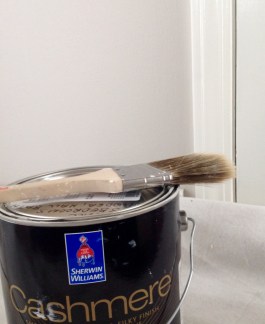
 

7. This paint color. Designers describe Sherwin Williams Popular Gray as a “warm gray,” which I thought of as an oxymoron until I tried it on a wall. I love it! Last year I used it in the upstairs/downstairs hall, the powder room and guest bath. Ditto this year in the spare bedrooms and my husband’s office. It’s a soft, neutral background that works well with assorted furniture finishes, artwork and accessories. In the past our rooms have sported a variety of paint colors (not to mention my wallpaper period) and I’m loving the uniform background. And, see #8 below.

8. White woodwork. The Popular Gray walls are awesome against the Benjamin Moore Simply White woodwork and doors. When this painting mission began, we decided to paint our dark, stained woodwork. And, yes, it’s a lot of work: sanding, priming, then painting two coats. (Full disclosure: pros did a lot of it.) But, what a difference! It totally transformed the house, taking it from subdivision 70’s to now. Paint really is a miracle worker.

9. My sewing machine. Like a lot of women my age, I started sewing in my early teens, cranking out A-line skirts and dresses. As time went on I began to sew more sophisticated garments. I like doing things with my hands, and, of course, I like clothes. Fast forward to my first apartment and then our first houses. I made curtains, so many curtains for about a decade, but sewing with active children underfoot was challenging. I finally pretty much gave it up. I made a few Halloween costumes and even sewed for my daughter’s American Girl doll, but I was rusty and not always pleased with the results. Fast forward once more to my retired self. Not only do I have time to sew, but I can take my time with a sewing project. And, I really wanted lined, white linen curtains in the living room. Not gauzy; something substantial that would hang in graceful folds. So, off to the fabric-lover/decorator’s nirvana otherwise known as Calico Corners and fifteen yards of fabric and lining plus a few afternoons at the machine and I have exactly the look I had in mind. My machine and I will be spending more time together.

10. My new soup/pasta/salad bowls from Williams Sonoma. I’m a bit of a dish junkie, not just in terms of transferware and ironstone collections, but also about what I put on the table daily. I’ve had a set of pasta bowls for years, but they were really big (and encouraging really big servings!). I wanted something that would be more multi-purpose, serving pasta, but also hearty soups, chili, even one-dish dinners like beef bourguignon. These stylish and sturdy white bowls from Williams Sonoma are perfect for all the uses I noted here, as well as an entree-sized salad. Win, win, win!
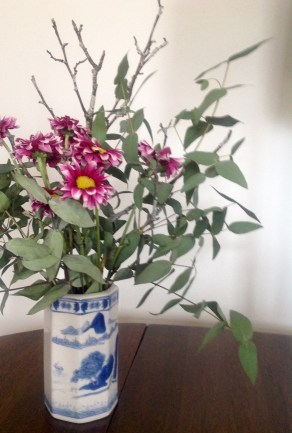
What’s your everyday 10 or 20 these days? I’d love to hear!

Thanks for stopping by. See you again next time!

In awe!

I’m temporarily interrupting the looks, books, cooks and occasional travels you normally read about here, for a topic I just can’t overlook.

I’m in awe of the brave, feisty, and very smart students from Marjory Stoneman Douglas High School for fearlessly taking on the NRA, the United States Congress, the President, and the rest of the establishment that has repeatedly turned a deaf ear (at the least) and otherwise stood in the way of sensible gun control. The determination and straightforward message from the Parkland, Florida students has moved students and teachers, parents and grandparents, and so many more across the country to join them.

It would have been much easier to stage a vigil, comfort each other and privately manage their grief. What they experienced should happen to no one. But they chose to dig in and fight back. Hard.

They are focused. They aren’t giving up. And they are moving the needle.

A blog is a unique medium. It’s fun to share books and recipes and travel, but it’s also personal. And some days the elephant in the room is just too big to ignore. How can I talk about a trip to Italy or a book I just read when yet another gunman walked into a school, killing seventeen people and injuring more than a dozen others. I’m angry that it’s happened, and I’m even angrier that it’s happened so often we just pause to light candles, shake our heads and move on.

To those of us who don’t like guns, who view them as war tools and instruments designed for killing (because what else is an automatic weapon for?), time to step up and support them. Have their backs, vote, agree that this is the time. And to gun owners, who are hunters or who have a personal weapon for protection, it’s also time to think about weapons we need and those we don’t need and why registration and licensing may be advantageous. (This is a big concession for me. I’ve always lived in a gun-free home.)

There’s nothing normal about gunmen shooting up a school, or concert-goers, or nightclub patrons or any of the other hundreds of gunfire victims. Is it me or is there a real disconnect when one dog dies on an airplane in inexplicably awful conditions and Congress immediately proposes appropriate legislation, but hundreds die in schools, churches, nightclubs and concerts and the same Congress says “the time is not right”? More to the point, do we care more about guns than our children?

There are no easy answers here. This is a complicated stew of second amendment rights, lobbyists, money, mental health support (more money!), and a polarized public unable to move. I think we all have a part to play.

Whew! I had to share my thoughts. I hope you’ll tell me what you’re thinking.

Thanks for stopping by. See you next time!

Groceries, the books we read, and where we shelve them

The bag may be recycled, but this grocery delivery vehicle is not all that new. Everything old is new again.

Everything old is new again. I was talking back to the television earlier this week and my husband suggested I blog about that particular angst, so here goes…

The Today show featured a story about the growing competition among online grocery shopping and delivery services. First, I think this is awesome and I would have loved this when I had two small children. But, this isn’t new! Ordering online is new, but not delivery.

Long before the chain groceries (and I know I’m dating myself here), Chicago neighborhood grocers delivered. My grandparents lived in a modest city neighborhood. No one owned cars. They walked to the butcher, the bakery, the bank. I remember doing all these errands on foot. (Which city-dwellers like my daughter still do.)

We carried lots of stuff home with us (Grandma took her special cloth shopping bags along for this purpose; that reusable Whole Foods bag isn’t a totally innovative idea either.) But if we bought many things in the grocery, or heavy stuff like flour and sugar, the groceries were delivered later, in a cut-off carton, usually by a schoolboy who worked for tips. I’m not even sure there was a “delivery fee” involved, but I do remember Grandma making sure she had tip money. And her delivery boy knew to come down the gangway to the back door, let himself into what was really the basement, and leave the box there. (A pre-requisite, I’m sure, for getting a good tip.) In fact, my uncle’s first job was an after-school gig delivering groceries.

Instagram on my mind.

Last month while I was languishing on the couch recovering from the flu (and before I started talking back to the television), I spent way too much time on Instagram, Pinterest, and cruising various blogs. Perhaps because I was still trying to put things back in order here after the painters had freshened up the living room and bedrooms or maybe just because I’m always rearranging shelf space to accommodate books and “stuff,” I started saving photos of shelves. I grew up in a house with book-laden shelves and have always had the same in my own home, so I am always amazed at book-less shelves. I think they’re pretty, but they just aren’t me.

Here are a few of the images I’ve saved to inspire my own shelves.

From James T. Farmer, I love the way this includes plates, pictures and books stacked this way and that. Not too busy but not boring either.
Here, more books on the shelves, but still interesting accents. I love the shelf over the door AND the hats on it. Image from India Hicks posted by Blue and White Home.
I really like this book-lined background for a chair and table. From Nell Hills.


The books on the shelves, or a few recent reads.

If you have been reading my blog, you know it’s hard for me to mention “book” without commenting on specific titles. You also may have noticed that my reading tastes are all over the place: biography, history, historic fiction, current fiction. Do I lack focus or do I just like to read? I have no idea.
My new favorite book recommendation is Jubilee by Margaret Walker. Walker is a widely known and respected African American writer and scholar who used her own family’s oral history and decades of research to tell the story of Vyry, daughter of a white plantation owner and his black mistress. The book spans the lavish antebellum years in rural Georgia, the ruin of the Civil War, and the empty promises of reconstruction. If you liked The Invention of Wings by Sue Monk Kidd, I think you might like this too.

After Jubilee, I needed something lighter, so I read Sue Grafton’s first Kinsey Milhone mystery, A is for Alibi. I love Sue Grafton and I mourned her passing here. I discovered this series a little later on in the alphabet, and I wanted to see if this first mystery was as well-crafted as number 25. I was not disappointed. These are all great reads.

Right now I’m reading The Story of a New Name, by Elena Ferrante. It’s the second book in her Neapolitan series. My book club read My Brilliant Friend, the first in the series, and many just moved right on. I’m enjoying this book more, but it remains a tough read. This is translated from its original Italian. The language often seems clumsy and wordy, characteristics that I think better editing and translation may have improved. However, I love the story of two smart young women in an impoverished neighborhood making dramatically different choices while trying to hold on to their friendship.

Also on my list: The Other Einstein, Marie Benedict’s story of Albert Einstein’s first wife, Mileva Maric; George Eliot’s Middlemarch, because I’ve never read it (and I was an English major!); and Origin by Dan Brown, because I’m a bit of a sucker for his historic/travelogue romps.

What are you up to as we wait for spring? Let me know! I’d love to hear from you.

Thanks for stopping to read. See you next time.

Hanging-out in Lucca

Looking through one of Lucca’s city gates. Can you see why we were charmed?

Have you missed me? We’ve had the flu!

Despite our best intentions, including excessive hand washing and flu shots, I picked up this year’s nasty bug and graciously passed it on to my husband. Fortunately we were both able to take the anti-viral medicine and that, along with our flu shots, seemed to lessen the worst of our symptoms. But the lethargy that follows is daunting. I hope you’ll hang in here with me!

Before the influenza assault, I was planning on sharing a side trip we made to Lucca during last fall’s trip to Italy. One of the benefits of traveling independently is the freedom to tinker a bit with the itinerary along the way. And the more we have traveled, the more comfortable we are tinkering.

We had planned to take a train from Florence to Lucca, spend a day, attend that evening’s Puccini concert, and then take three more trains the next morning to spend a day at the Cinque Terra (and then three more trains back to Lucca) to spend another night before moving on to Rome. Was this overly ambitious? Absolutely.

(In fact, seeing this plan in black and white, I have to ask what we were thinking.)

We arrived in Lucca by train, walked from the station and over Lucca’s legendary ramparts to our hotel and promptly fell in love with yet another Tuscan town. Lucca was blessedly quiet after the tourist bustle of Florence, and despite a light rain, the city is made for walking and wandering. We knew right away that this was the ideal place to catch our breath before going on to Rome. The Cinque Terra would have to wait for another trip.

A bit of background. Lucca was founded by the Etruscans and became a Roman colony in 180 BC.  One of its claims to historical fame is as the host to a secret conference in 56 BC, at which Julius Caesar, Pompey and Crassus reaffirmed their political alliance. Although it was conquered by Napoleon in 1805, it had been the second largest independent city state (after Venice) for centuries.

Today it offers stunning churches, cafes and piazzas perfect for people watching, and one winding street after another to explore.


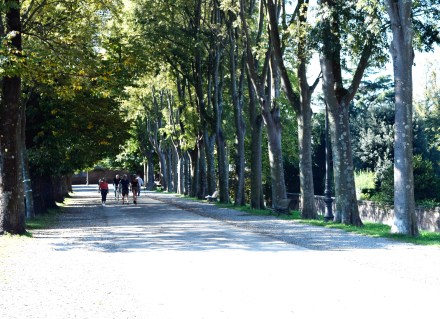
Unlike many of its Tuscan counterparts, Lucca’s defensive ramparts have survived intact and today are a 2½-mile walking/running/cycling ribbon than encircles the city. We walked a significant portion of it the second morning we were there.
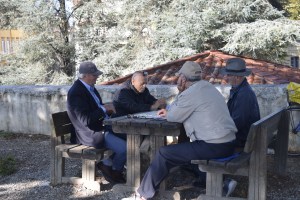
 

Locals clearly savor this space, including this group playing cards at one of the picnic areas along the former rampart. Several women were walking or running the path with strollers.  Can you imagine how wonderful living here would be?
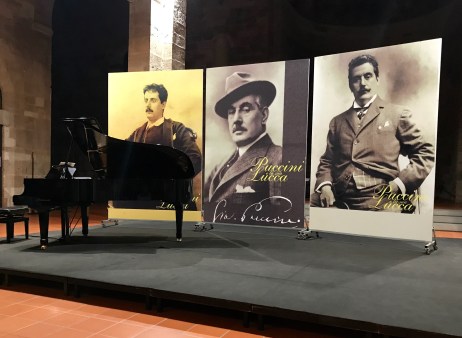
 

San Giovanni Church hosts nightly concerts featuring the music of hometown opera composer Giacomo Puccini. Steve and I know absolutely nothing about opera, but thoroughly enjoyed a concert. Two opera singers, a man and a woman, alternately sang short selections from Puccini as well as a few other works.  Their pianist also played two wonderful solos. They also performed together, including a beautiful finale and encore. San Giovanni is a wonderfully intimate venue (below) and they were clearly having as much fun as the audience. I’m sure their energy and joy in the music, as well as our seats in the second row (!) added to our enjoyment. As it ended my husband said, “This is one of the highlights of our trip!”


We had lunch at one of the many cafes that circle the Piazza dell’Anfiteatro. In the second century, this was a Roman amphitheater. While we were there, a bride and groom arrived to take wedding photos. They were enthusiastically greeted and cheered by everyone and then serenaded by one group. How happy, I thought. This is Italy!
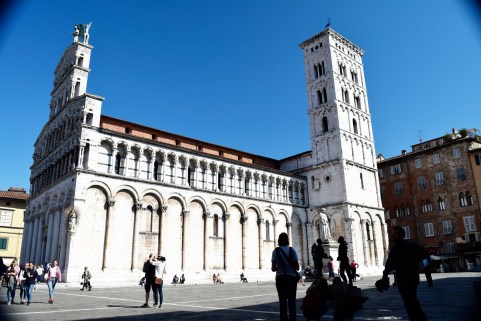
San Michele in Foro, dedicated to the Archangel Michael, is built over the ancient Roman Forum. This photo doesn’t begin to capture the beautiful detail on this church.


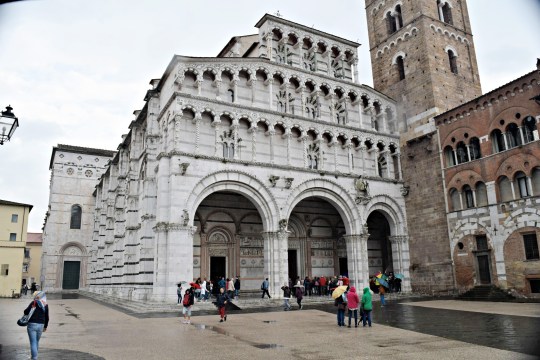
The Cathedral of Saint Martin, below, is the seat of Lucca’s Archbishop. Construction was begun here in 1063 and the apse with its columnar arcades and the companile are original.


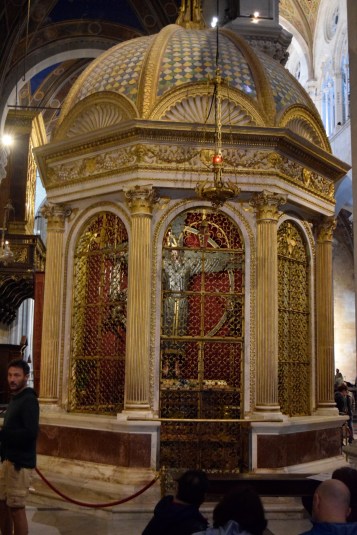
The interior of this church is stunning, including a small octagonal temple or chapel shrine that contains the city’s most precious relic, cedar-wood crucifix and image of Christ or Sacred Countenance, reportedly carved by Nicodemis and remarkably transported to Lucca in 782. The chapel in which it rests was built in 1484 by Luccan sculptor Matteo Civitali.  (Can you tell I love relic stories?)
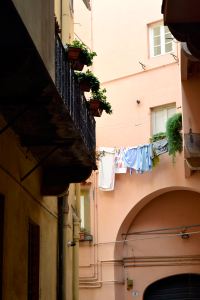
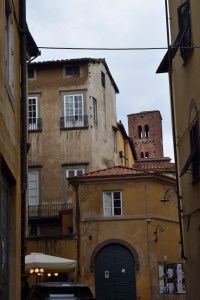


Most of all, Lucca is a series of charming, everyday scenes.


And a few more:


We learned a valuable travel lesson in Lucca: sometimes it’s more important to stop sightseeing and just enjoy the moment.

How about you? Have you come across a travel destination where you just had to sit back and savor the moment?

Thanks for stopping by. See you next time!