Once a collector, always a collector: about the blue and white


Small pieces of blue and white, .are fun because there

Whenever I post a picture of some of my blue and white porcelain on Instagram, I receive so many positive comments, I thought perhaps it is time to explain how this collection (and the other blue and whites in our house) came to be. Blame my mother. 

Actually, that may be too simple an answer. I have always gravitated to classic navy blue. And, as so often happens, the way we dress carries over into the way we decorate. Over the years I had two blue and white couches paired with two different blue and white loveseats in the family room. When I finally bought a “good sofa” for what turned out to be our long-time living room, it was covered in a blue and white Waverly fabric. I used the same fabric on the windows in the living and dining rooms as well as companion wallpaper in the dining room. It was very matchy-matchy.
Mom’sTJ Max finds launched my quest.

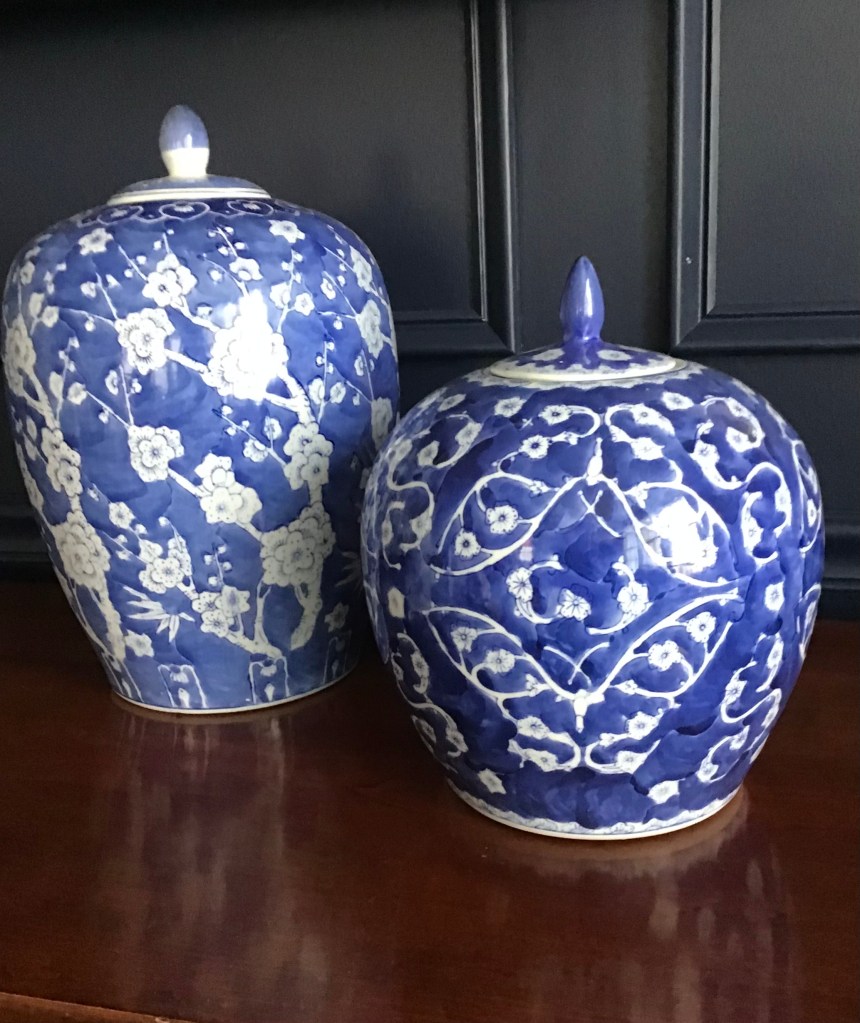
So it was hardly a surprise that my visiting mother got bored one day while I was at work and my kids were at school and took a field trip to TJ Max. She found these ginger jars, along with a smaller jar and a candlestick, long since disappeared, and promptly re-styled our mantel. (And you wondered where my decorating gene came from!).

I liked the look and thus began my quest for a blue and white plate here and a small pitcher or biscuit box somewhere else. Those were the years of some of my most intrepid antiquing, and the smaller plates and pieces were easy to find. As so often happens with a collection, I found myself refining my taste, checking the manufacturer’s stamps on the bottom of new finds and limiting my pieces to those from England.

I began to collect little blue and white moments like this…

Perhaps most importantly, I began to save images of blue and white collections. This was in the pre-Instagram world, so I saved pages from magazines. This is a favorite, below. It’s not just the quantity here, it’s the variation in detail: floral or scenic patterns, straight or curved shapes, small spouts or larger, more graceful ones, shades of blue that range from the palest to deep indigo.
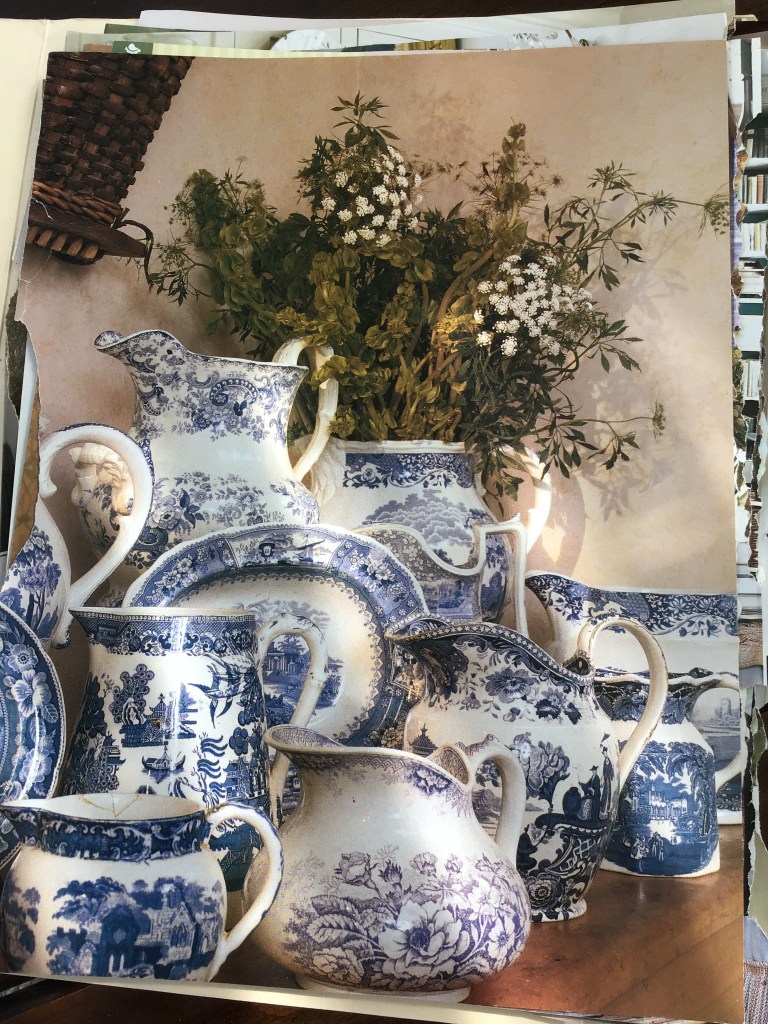
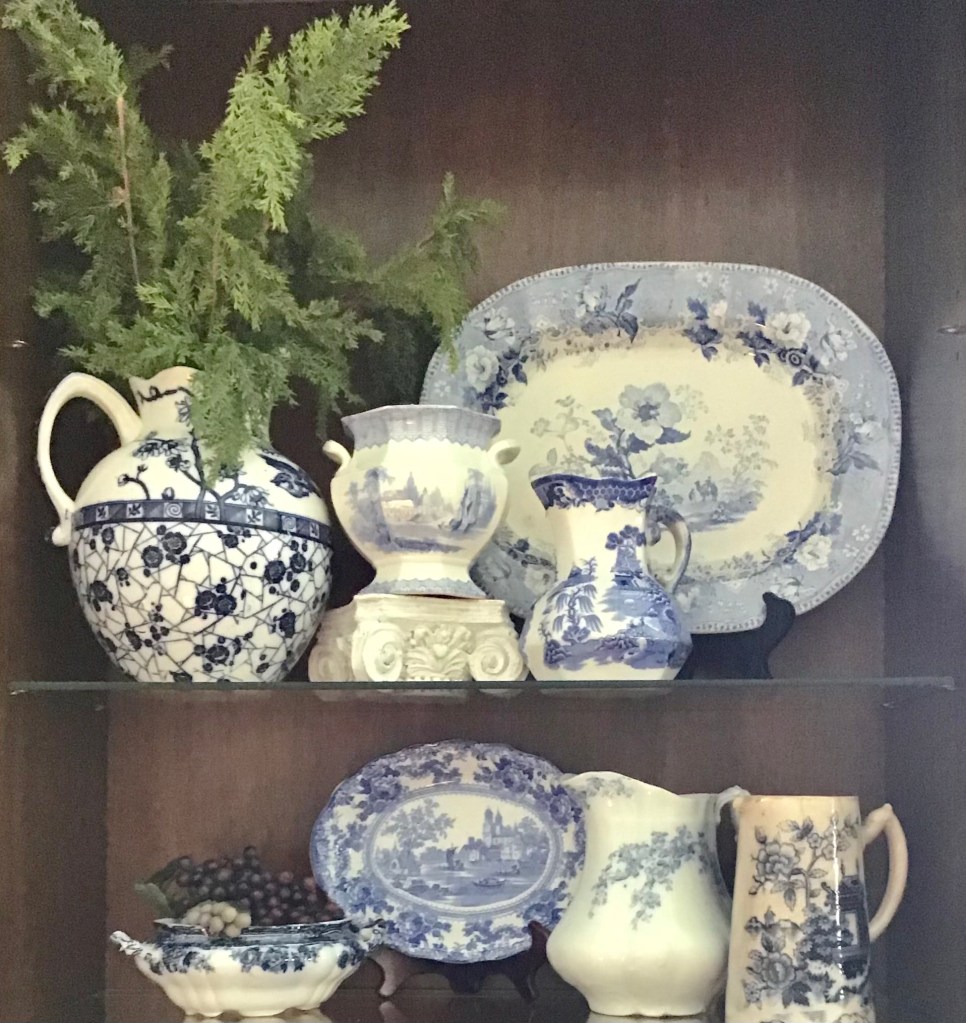
I gradually moved on to larger pieces, like trays and larger pitchers. As the pieces multiplied, I was able to “gang them together” on shelves and in cabinets.
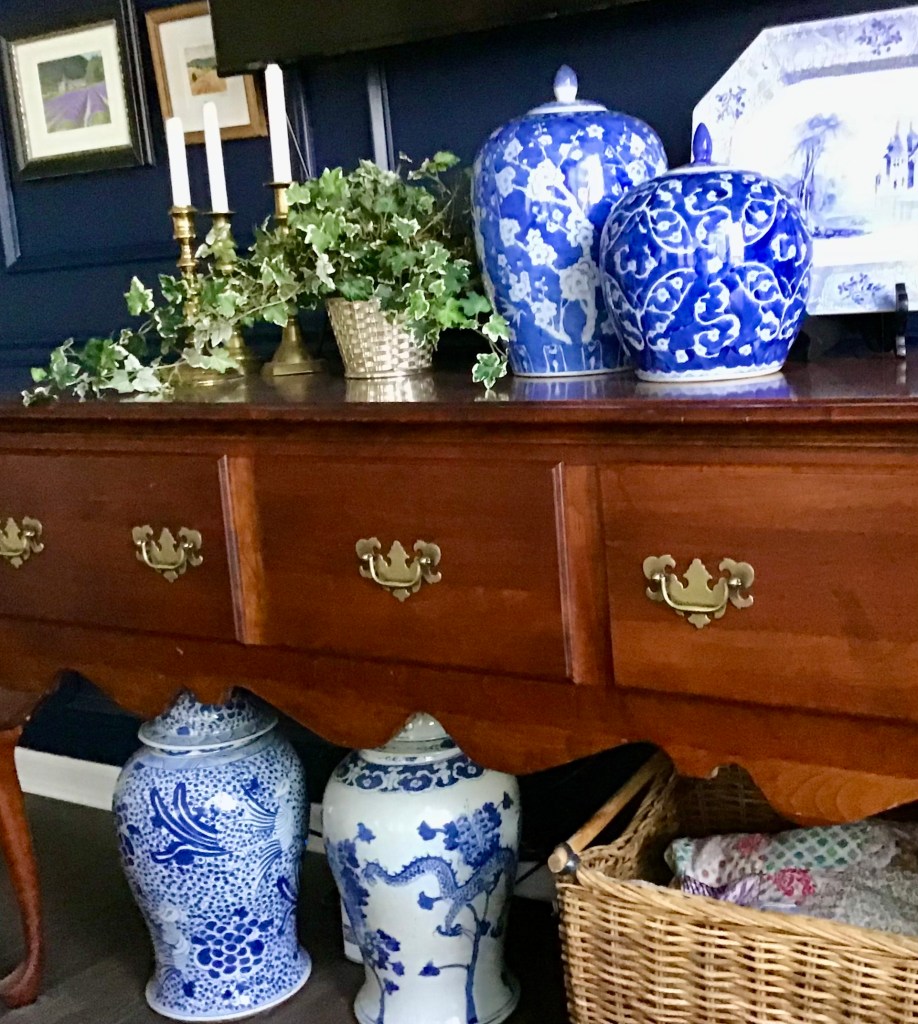
Blue and white inspired the navy feature wall in our current great room. The two really large ginger jars are not antique, but at some point I decided I needed a statement piece. I ended up with two and I’m so glad. (As Charles Faudree would say, always buy pairs when you can, even if you don’t use them as a pair.)
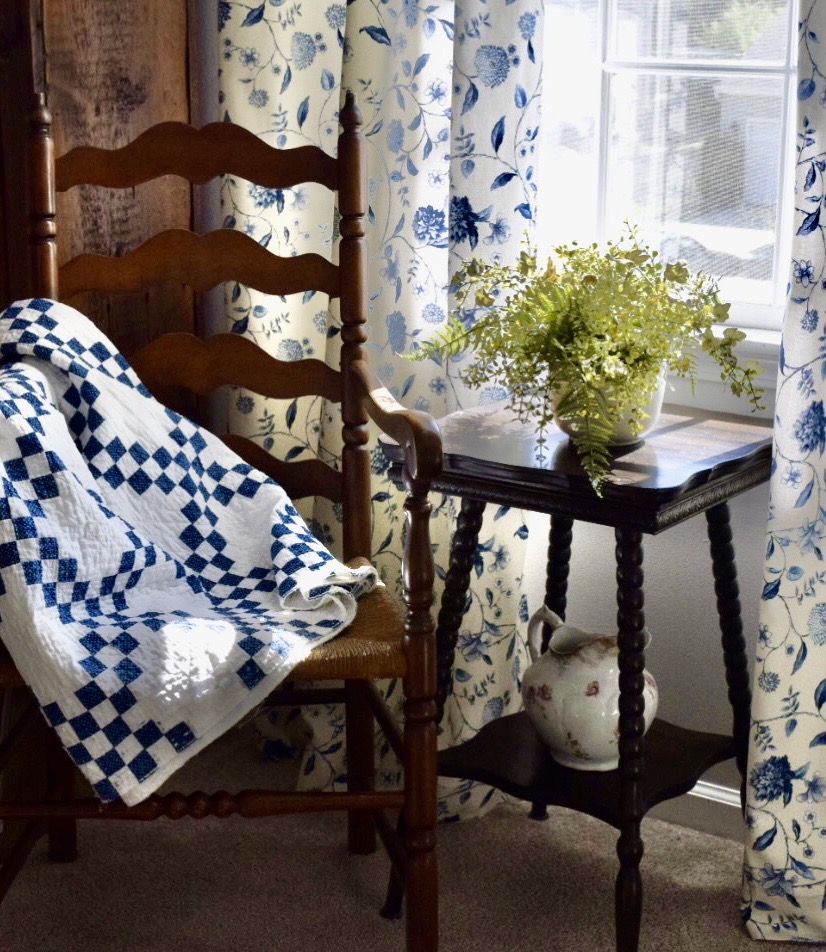
Blue and white fabric worked into the collection, including an old quilt, french grain sacks, and new curtains.
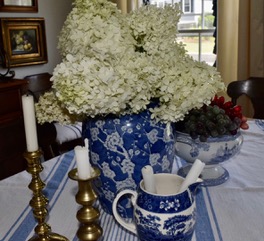
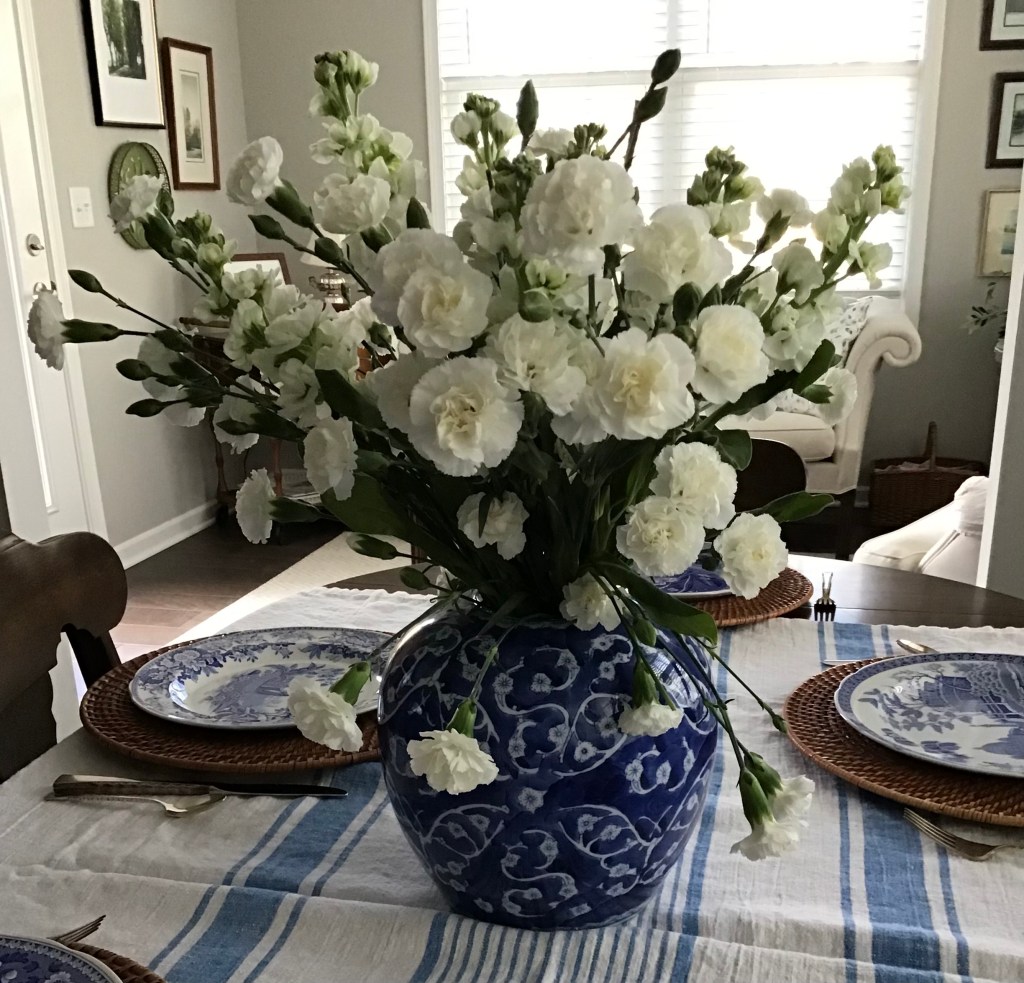
The dining table in our previous home, above, set with assorted pieces and a blue and white cloth. I use the same cloth with blue and white dishes here, below.
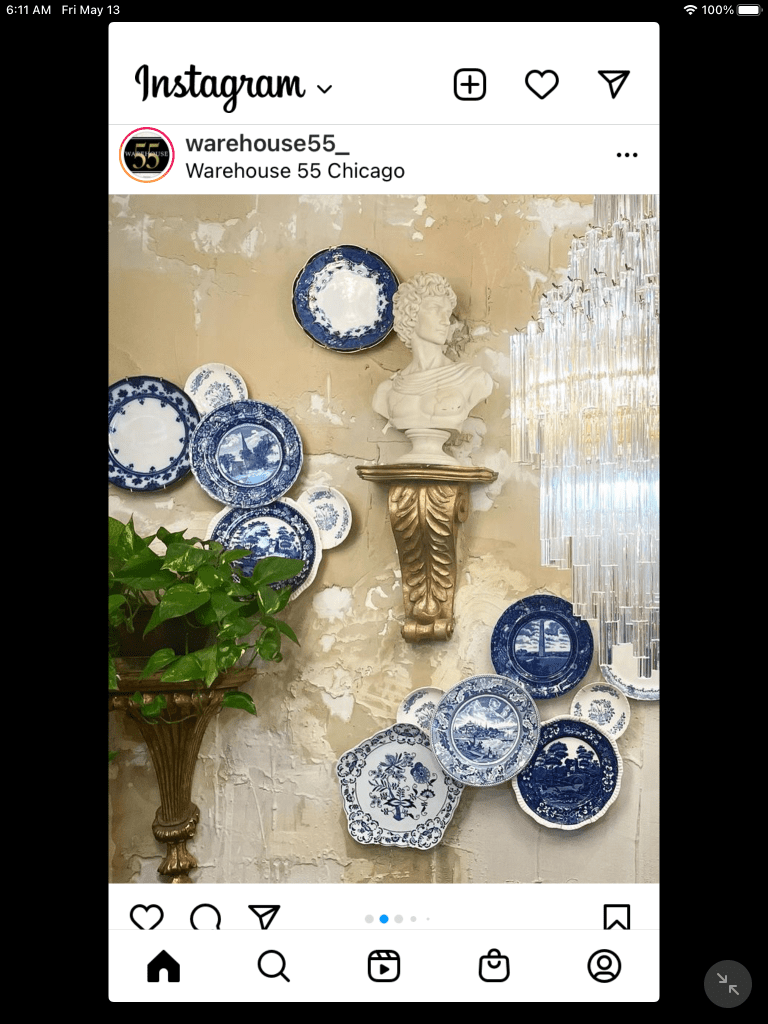
I continue to save blue and white ideas. From Instagram…

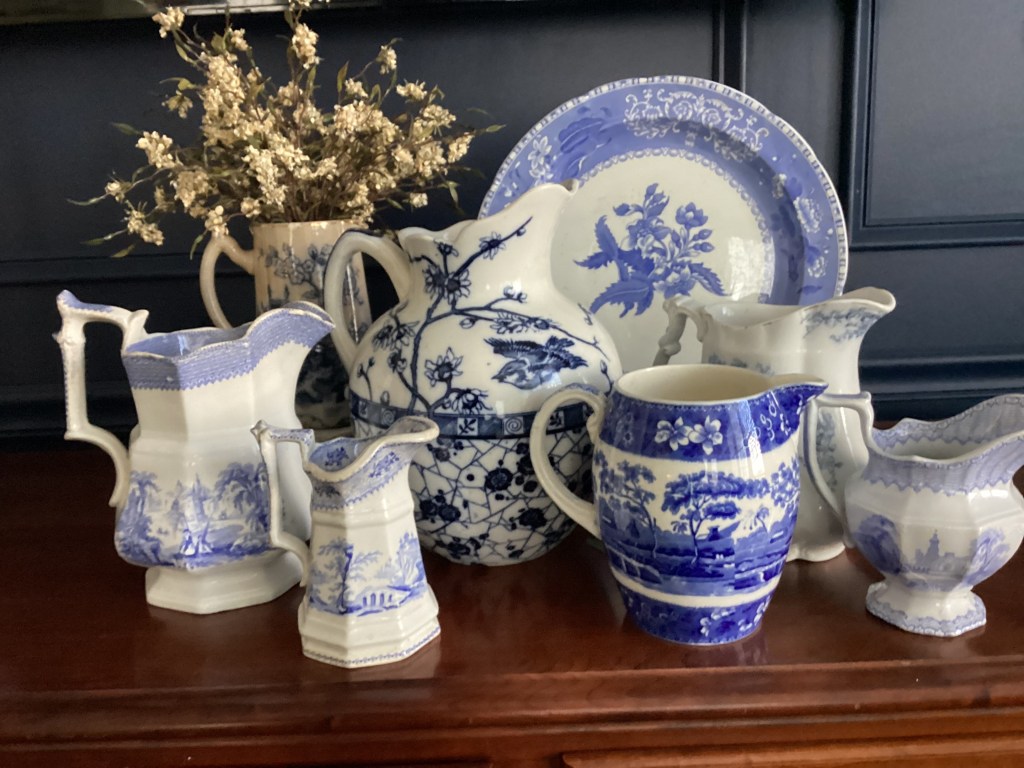
I love this collection of blue and white pitchers so much, I decided to collect all of mine together and see how they compared. What do you think?.
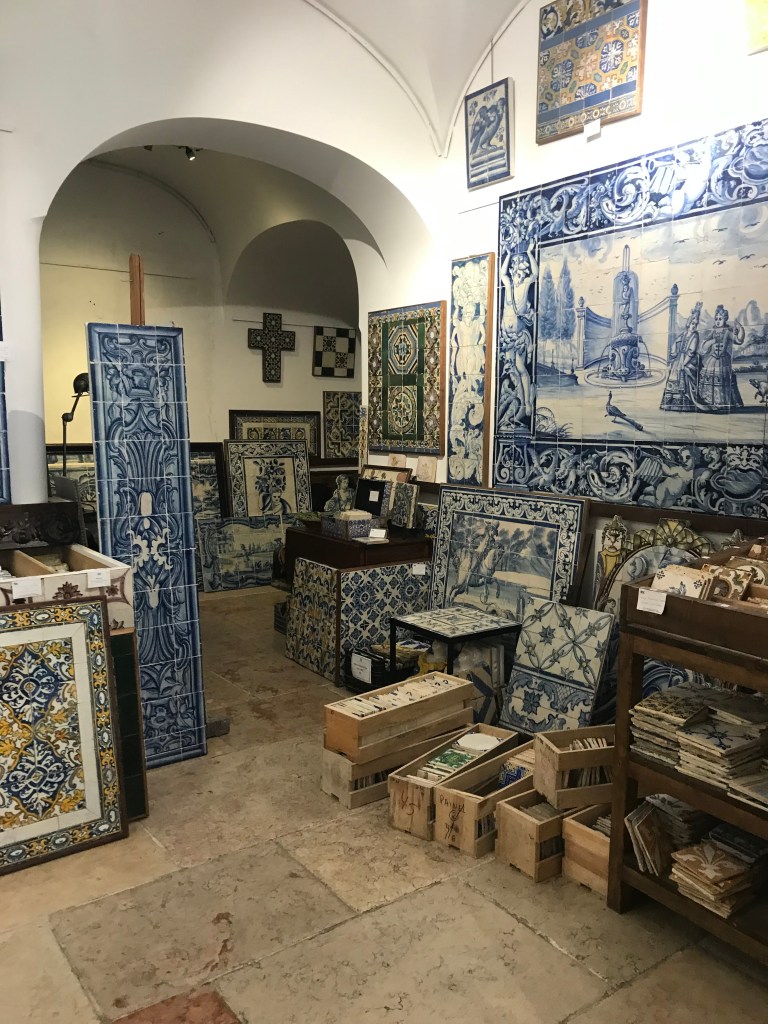
When we moved, I culled a lot from my white ironstone collection, but nothing from the blue and white. I’ll keep collecting, though old pieces — which I prefer these days —  seem harder to find. On the other hand, when we were in Portugal last year, I did get caught up in the tiles.
Building a collection takes a special kind of gene. You have to be patient, you have to refine your choices or it’s just so much stuff. I have a small collection of hand-crafted roosters. It began with a handsome pair of ceramic roosters from my mother. Then I found one made from a gourd and my husband gave me a hand-carved fellow he found in California. Along the way I picked up some antique poultry prints from vintage catalogues and books.. Everything in the collection had history and/or provenance. But then well-meaning friends started adding to it — rooster dish towels and cake plates and teacups. Pieces without the same one-of-a-kind design didn’t’t belong with the pieces I had assembled, and, in fact, they kind of “watered down” what I had so enjoyed collecting. I kept those things for a year or two, but I eventually thinned them from the pack. For the most part, I think collections should be left to the collector. While I loved that people thought enough of me to want to add to a collection,
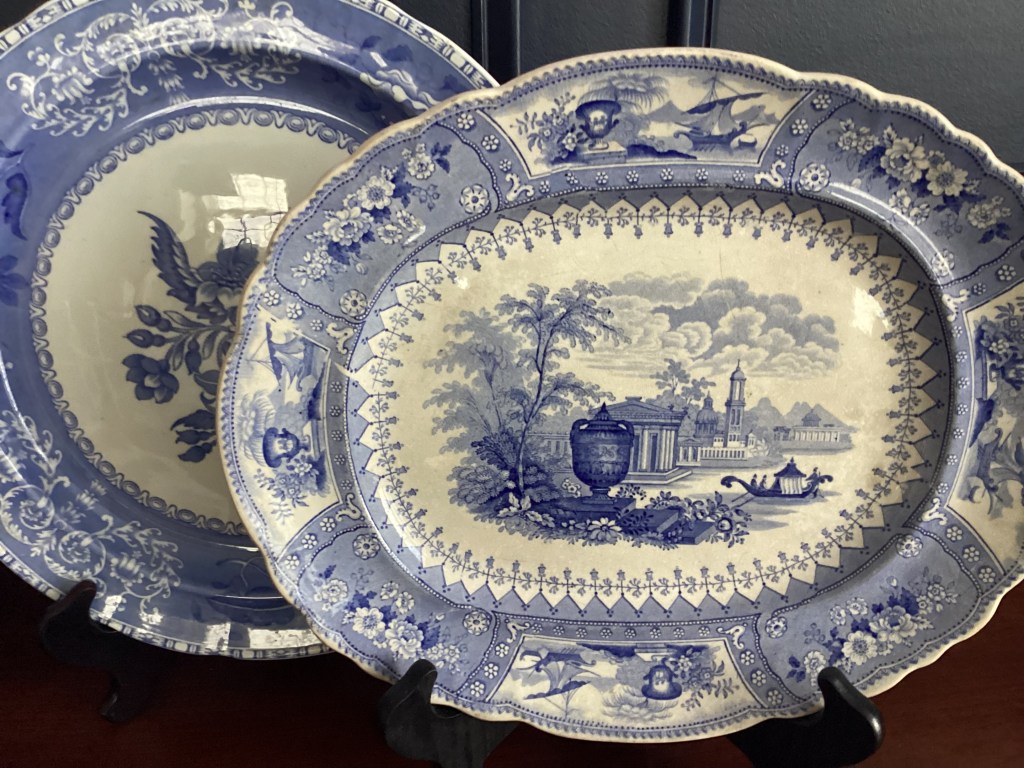
Speaking of collections, here’s my latest blue and white find, an oval platter marked “Stoke-on-Trent.” The color is especially vivid and the pattern is exceptionally crisp. Plus, I love the scall0ped border. (And this is the potential for collecting — it makes you pickier and pickier!)

Once a collector, always a collector! What is it you collect?

Thank you for stopping by. See you again soon?

One book, two pillows, and 500 postcards

I’m really hooked on watercolors. Lately I’’ve filled my sketchbook with dahlias.

Life is such a funny ying and yang.. We have had crews here working on a plumbing issue discovered earlier this summer. The fix was quick but complicated, and so we are now waiting on new flooring in the guest room while that furniture is on sabbatical in the garage. It could be worse. On the plus side, a good friend from my working days will be in town this weekend, and I am really looking forward to catching-up over dinner.

When I wrote about my summer reading here, I totally blew past one of the best reads of the season: Doris Kearns Goodwin’s  An Unfinished Love Story, A Personal History of the 1960s. Goodwin is an historian whose dogged research and deft voice bring history to life for her readers. She won a Pulitzer Prize for Unfinished Love Story, as she did for No Ordinary Time: Franklin and Eleanor Roosevelt: The Homefront in World War II (another favorite of mine). Her other books including Team of Rivals (Abraham Lincoln) and The Bully Pulpit (Teddy Roosevelt) have been equally honored. 

But let me tell you just a little about this book. Goodwin was married to Richard “Dick” Goodwin for forty-two years. About a decade older than Doris, Dick was one of the “bright  young men” that helped get Jack Kennedy elected president in 1960. He named and helped design LBJ’s Great Society and was a speechwriter and close adviser to Robert F. Kennedy. Doris was a White Housed Fellow during the Johnson administration and worked directly for LBJ. Both Dick and Doris lived and worked behind the scenes at the seat of power during some of our country’s most turbulent times, including the Civil Rights movement and the  Vietnam War. The book is part memoir, part biography and part history based on the more than 300 boxes of papers, memos, notes, diaries, and memorabilia Dick had saved over more than five decades of his career. It lends remarkable insight into many memorable public times. This is a wonderful, “inside” look at the events that unfolded and shaped my high school, college, and early adult years. And maybe those of many of you? If you like history, especially an insider’s view, you will enjoy this read.

What was I thinking?

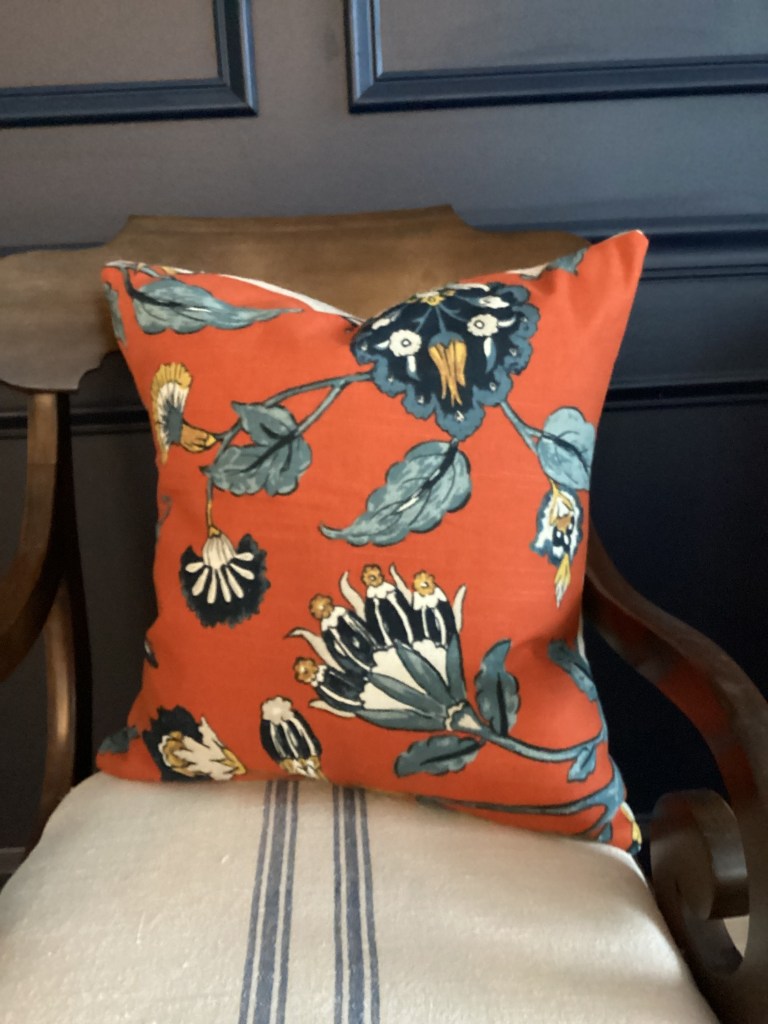
Here’s one of the pillows. See how greets it looks with the navy wall?

Orange is not my favorite color. Not for my house, not for my wardrobe. It feels dated to me, too reminiscent of my mother’s late sixties rust-colored sofa. So, the question is why on earth did I buy these pillows? A few weeks ago, I joined some neighbors in a shopping expedition in search of fall decorative merchandise. I’m not at all sure what I was thinking when I snatched up these very orange pillows. Yes, they are seasonal, which us what I wanted, and, yes, they have that navy print which looks fabulous against the navy accent wall in our great room. ( And truth to tell, I can spot a good navy from 50-feet.)  But they are very orange.

I imagined them on a pair of chairs in the great room, and my neighbor enthusiastically agreed.  What I was not thinking  is that the rug in that room is a very traditional red and navy Turkish design. Trust me when I say red is by far the dominant color .To be fair, there is some green and gold. No orange. 

So then I began thinking about what orange I do have in the house and guess what? There is none, unless you count this blue and white transfer ware plate with some orange flowers, a photo my daughter took in my old garden, and this rooster. That’a it. I have moved the pillows to the sunroom, which is pretty beige. The orange is a nice pop of fall color. And after Halloween I’ll put them away until next fall.  

500 Post cards

This is what 500 postcards look like.

You may recall that I wrote as few posts back about the postcard project, contacting individual registered voters with a personalized, handwritten postcard encouraging them to vote in the coming election. The project provides the  brief, non-partisan message, the postcards, and address lists. “Writers” complete and address the postcards, then mail them on a specific day in mid October. The project does not endorse specific candidates or a party, but it is sponsored by the Progressive Turnout Project whose mission is to rally Democrats to vote. Statistically, the project knows this personal contact significantly improves voter turnout. 

Like a lot of people, I felt helpless this year in the midst of a messy campaign and an election that could completely alter our lives. In fact all of this would give me a monumental headache if I did not feel as though I at least did something. So, I volunteered to write and mail 500 postcards. I finally finished writing & stamping them last week,; and they’ve been mailed on schedule. Whew!

Wishing you plenty of chocolate in this Halloween month and pumpkins in your choice of color. Thanks for stopping by. I hope to see you again soon.

Summer reading

While I have not been blogging this summer, I have been reading furiously and widely, so I have a “something for everyone” kind of book report for you. In fact, it’s a smorgasbord, from history to mystery …Let’s get started. 

Eric Larson takes on the Civil War

Almost twenty years ago my then bookclub read Eric Larson’s Devil in the White City. It was a perfect read for us. We were living in metropolitan Chicago, and the book is based on events surrounding the 1893 World’s Columbian Exposition held in Chicago, focusing on two major characters: Daniel Burnham, a legendary Chicago architect charged with designing and building the fair venue; and H. H, Holmes, a criminal believed to have been the first serial killer in the country. For a lifelong Chicagoan, the streets and people who crossed paths, especially with Burnham, the story really came alive. 

Larson writes about historical events with what i think of as a novelist’s voice; he’s a great storyteller. Each if his works is factual and documented in an extensive appendix. If you like fiction and history, his work is the best of all possible worlds. I have since read Dead Wake, capturing the last ocean crossing of the Lusitania; In the Garden of the Beasts, the story of the American Ambassador to Germany and his family in Berlin from 1933-37 when the city was falling under the spell of Hitler. I also read The Splendid and the Vile, recounting Winston Churchill’s first year as prime minister amidst the initial horror of WWII.

Larson’s most recent book, The Demon of Unrest, details the tensions between North and South in the weeks following Abraham Lincoln’s election in November 1860 and the Confederate attack on Fort Sumter the following April. This book does not have quite the same pseudo-story quality to it. It reads more like a history book, albeit a well-researched one, Demon was a tougher read for me. It focused on the key military players at Fort Sumter as well as in the new Confederacy. Perhaps it was just me, but I had a hard time keeping the various officers and military installations straight. Larson zeroed in on the chivalric code of the South Carolina gentlemen/plantation owners who led the secession charge. (A new angle on the Civil War for me).) Mary Chestnut, a devoted diarist from Charleston who documented much of the activity of the time is the only female with a recurring role.  So, yes, this book suited my nerdy history bent and I’m glad I read it. But I don’t think it stacks up to many of his other titles. 

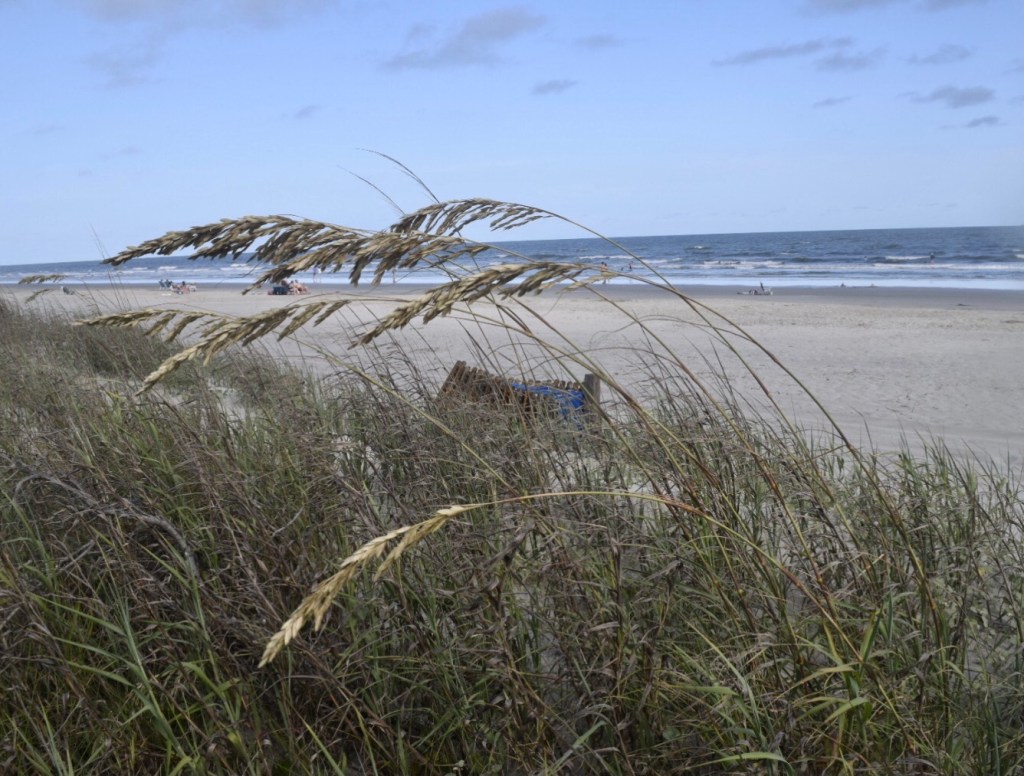
A favorite reading spot, on the beach on Kiawah Island, South Carolina.

Ruth Reichl as novelist 

Ruth Reichl is a well-known food writer and was the restaurant critic for the New York Times for several years, I first discovered her when I read Save Me the Plums, a biography of her nine-year tenure as editor of Gourmet magazine. Published in the early 2000’s, when my interest in cooking — beyond feeding a family or presenting an appropriate party spread — was seriously piqued. Plums was a fun read, about the challenges of balancing family and career (very familiar) and editing (how I was in fact making a living). I knew she had written other books and I should look them up, but you know how that goes — there’s always another book to read. 

However, earlier this summer, I discovered Reichl’s latest book, The Paris Novel. It sounded light and perhaps a bit fluffy, but the Paris setting intrigued me and after Demon of Unrest I needed something lighter. I downloaded it to my Kindle and promptly devoured it (Pun intended). It was full of familiar Paris landmarks (the heroine lives for a time at Shakespeare and Company!), yummy food, legendary restaurants. It also has an appropriate amount of intrigue, hints of romance and a cast of quirky characters. 

That was so much fun that I staked out an earlier Reichl novel, Delicious!, published in 2014. In it the main character, Wilhemina “Billie” Breslin, takes a  job as assistant to the editor of a prestigious cooking magazine, (Again, food and publishing.) Delicious! (a.k.a. Gourmet? Who knows!) with a quirky staff and housed in a legendary New York mansion. It’s a charming setting until the owners decide to cease publication, fire the staff, and sell the mansion. While the former staff are left to nurse their wounds and find their professional way, Billie is charged with shutting down the substantial archive and library before the building is sold. Along the way she solves a mystery, finds love, and discovers her own food talent. Yes, it’s light and fluffy and what I suspect Reichl does best as a novelist, but like The Paris Novel, it’s wonderful story telling and the food is glorious! 

Have you met the Thursday Murder Club? 

I’m currently working my way through Richard Osman’s four-book (so far) series of mysteries solved by a quartet of septugenarians living in a senior community outside London. The fun begins when four otherwise unlikely friends begin meeting weekly to discuss unsolved crimes and how they would solve them. They are a decidedly quirky group led by the charming Elizabeth, long-since retired from Britain’s famed MI6. Then, a developer working on the expansion of their community is found dead, and the Thursday Murder Club sets out to find the killer. They drag reluctant family members and a local police detective into their quest.

I’ve finished book two (a diamond heist) and am well into book 3. Caution: You really need to start with book one and read them in order. Characters come and go at this age, relationships blossom and fade.. 

Reading this I realize that I have gone from an historic book (or paper weight depending on how you view it) to romance to a totally unexpected group of mostly amateur sleuths. Something for the many moods of a reader.   And I that’s one of the joys of reading — there is always something appropriate to your mood or the moment.

I hope your summer is ending on a note of grace; I’ll be happy with cooler temperatures. Thank you for reading this “book report.” I’ll see you again next time!

Not the A-list, but the P-list

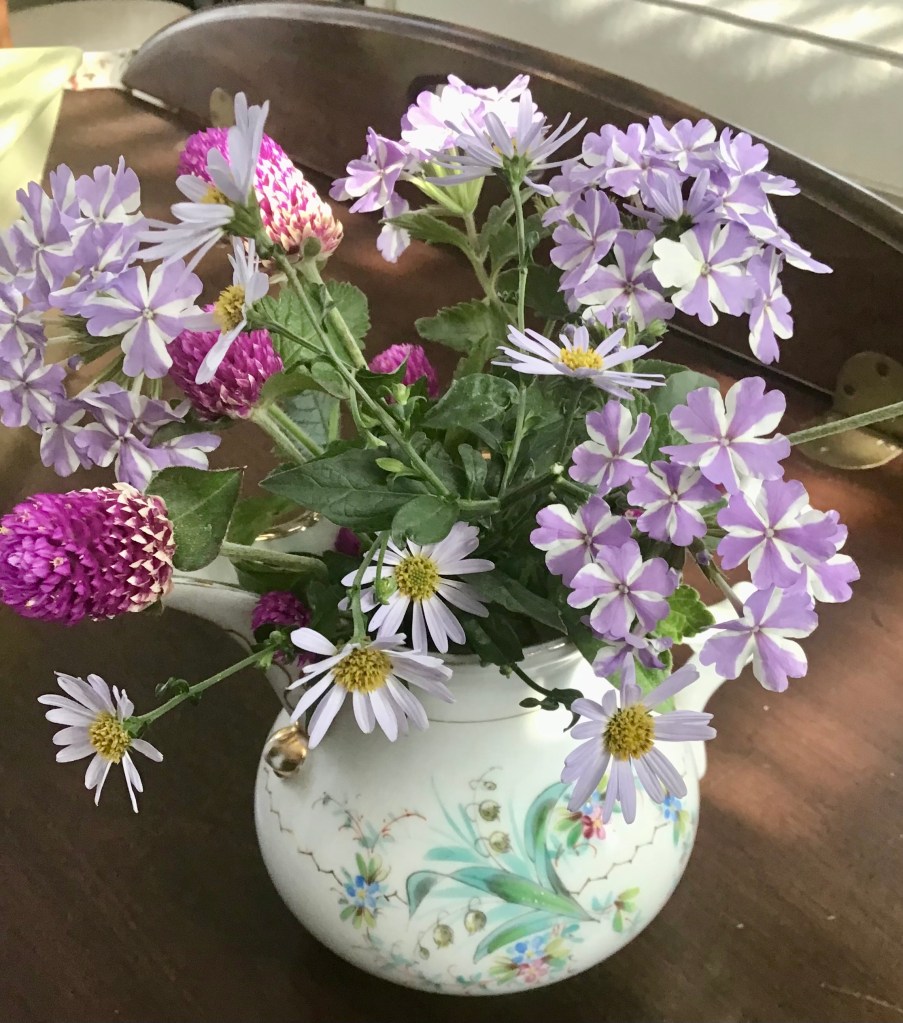
P is alsoc for purple; I seem to have lots of purple flowers sright now.

How are you? I know it’s been awhile. How’s your summer? Mine is going way too fast. I thought it was time I filled you in on at least some of what’s happening here. 

Years ago Steve and I had neighbors who were always in search of the “A-List.” You know, the one with people who supposedly had more money/power/status. Until they found it, however, they were content to travel along life’s path with the rest of us. I suppose we should have been insulted by this attitude, but they were so blatant they were funny. (And we weren’t the only ones thinking that.) Not surprisingly, the relationship quietly drifted apart. Maybe thy found the A-List? However, the A-List remains a running joke in our household. 

This post has nothing to do with money, power or status, but it is a dump of what I’ve been up to this season and it turns out that it all starts with the letter P. .

First there is the patio

The whole patio is not ready for prime-time, but here’s a slice.

The patio the builder attached to this house was a small cement rectangle that barely held a round dining table and four chairs along with a grill. In fact, if you chose the wrong chair you were the lucky one able to reach out from your seat and flip the burgers. So, a few weeks ago we had that slab removed and a new, much larger one poured to replace it. I am not a fan of cement slabs, but in our really little yard (we have the smallest lot in the subdivision), it seems to ground the landscape and offer some good possibilities for additional landscaping. 

Just to complicate things, our design/decision-making was somewhat delayed by the fact that the house behind us, which actually sits perpendicular to ours, is on a lot that was graded a few feet higher than ours and those of the neighbors on each side. This was probably the fault of the initial developer, but thankfully the new owner in that house — not wanting his lawn, etc., to wash into ours or the neighbors’ — put his foot down with the builder. After weeks of work and readjustments to drains and irrigation, a landscaping company has installed a low, very attractive stone retaining wall. Win, win for all concerned. It looks soooo good.

Meanwhile, Steve and I, along with some extra muscle from our son, softened the cement block look of the patio with some dwarf hydrangeas and perennials. There is more landscaping to come along “the wall” and outside the sunroom, but not until we are out of the worst of this heat. In the meantime, we’re excited to move forward with this and have been having coffee  on the patio most mornings! If there is anything we have missed from our Wheaton home, it’s the mature landscaping, but starting from scratch is an interesting challenge. 

Painting

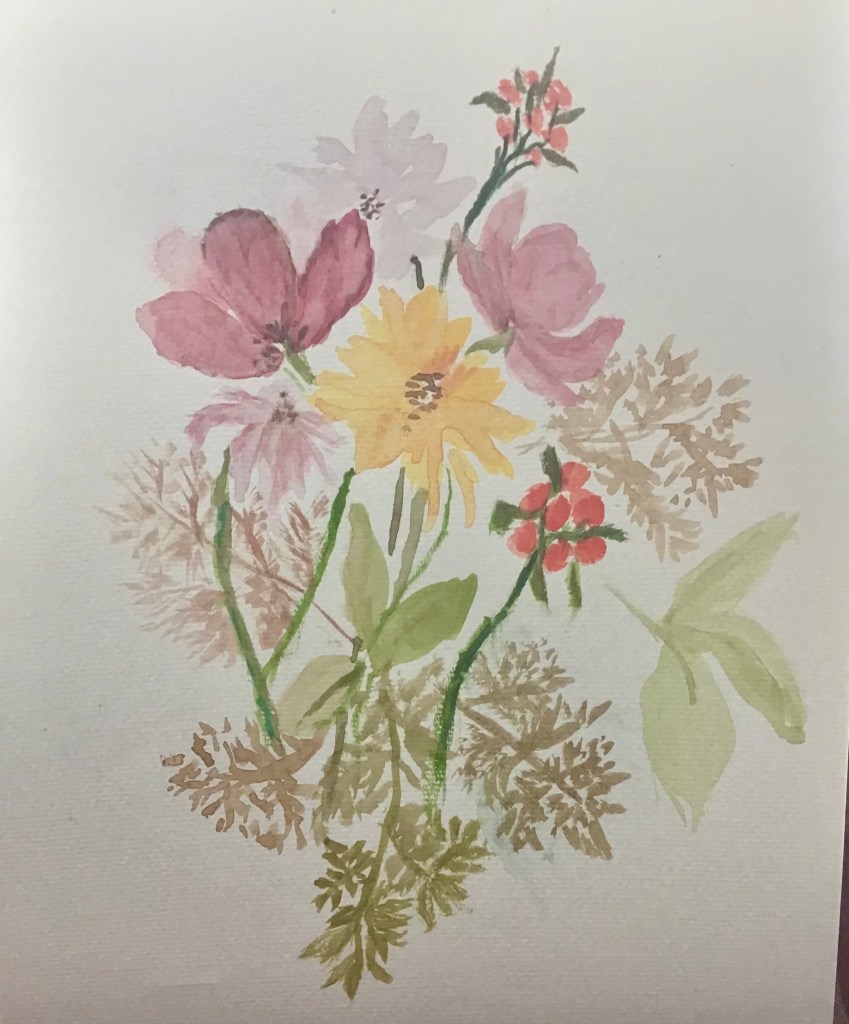
This is pretty rough. I’d like to think my technique has improved since I painted it, but it is one of my favorite efforts, largely because it’s my own composition as opposed to a painting from a tutorial or class.

I happily admit that I am now totally obsessed with my watercolor efforts. I’m watching YouTube videos, reading, and now trying to do sone sketching or painting every day. And, of course, my class continues to meet. It’s interesting to sample the different watercolor styles of my classmates along with the artists I’ve discovered on YouTube.

I’ve acquired a very cool pocket-sized set of paints to use when painting away from home as well as a small sketch pad to carry with me. Plein air painting is a joy. There is something about being surrounded by Nature that feeds whatever artistic inspiration one has. My goal is to draw or paint a bit each day. But that’s easier said than done, and some days the results are very satisfying, some not so much. I find I look at artwork, scenery, a vase of flowers, or even a vignette of books and candles on a tabletop or shelf differently. 

Postcards

During the last election cycle in 2022 I joined my daughter and daughter-in—law in the postcard project to contact individual registered voters and encourage them to vote in the coming election. Basically we hand write a short, non-partisan “get out the voter” message provided by the project on postcards also provided by the project, address them to individuals from the registration lists provided, and mail the postcards on a specific day in late October. The project does not endorse specific candidates or a party, although it is sponsored by the Progressive Turnout Project whose mission is to rally Democrats to vote. Statistically, the project knows this personal contact significantly improves voter turnout. 

I’m not comfortable ringing doorbells or making phone calls for a specific candidate, but like many people I feel helpless in in the midst of a messy campaign and an election that could completely alter our lives. In fact all of this would give me a monumental headache if I did not feel as though I am at least doing something. If you are interested in learning more about this grassroots project, visit the website, www.turnoutpac.org. 

I hope you are cool, dry, and enjoying the sweetness of summer. Thank you for stopping by. 

Something fun for spring

Okay, you may not consider it fun, but I do. Today’s post celebrates my girlish passion for a new box of crayons, my half-hearted sidesteps into art, and my recent discovery of painting with watercolors. 

After months of cajoling, a neighbor — who also happens to be a watercolor artist and teacher — agreed to offer a class to some of us wanting to flex our artistic muscle. And now I’m hooked. Watercolors are not easy and there is a lot of technique to learn (the most basic being how do you make the water and the paint work together?), but I’ve found it to be a welcome challenge, a good test for my latent creative muscles, and, therefore, a bit addictive. 

I have always loved the idea of drawing and coloring. A new box of crayons could set this girl off on artistic adventures for days. When I was in junior high and high school, my dad was an avid photographer. He recognized my artistic bent and bought me the paints and brushes to hand color some photos. We were just getting really good when color photography crept in and stole our thunder!

In college I was able to take a few studio art classes in drawing, painting and printmaking for half credit (therefore requiring much less work) and scratch my creative itch. I loved it! Studio classes were a nice break from books and the library, and I discovered some like-minded friends in the process. We were not “arty” like the art majors (a terrible generalization I’m sure), but in retrospect I think we were engaging in a bit of art therapy at a challenging time in our lives. 

In the intervening years, my writing profession — pages and pages of ad copy, newsletter and magazine copy and the accompanying layout sometimes required made it hard to separate the art from the words. I was picky, picky, picky about color, type face, and photos, what worked and what did not, all of which probably made me a difficult co-worker from time to time. Meanwhile, away from work, my personal passion for decorating and collecting grew. You can see how I fed that artsy muscle. 

Fast-forward to the present, where watercolors have become an increasingly popular hobby. It turns out several of us were eager to try; we just needed a teacher. And now, some of us are really hooked. I’m not at all good, I paint too fast, I don’t always use the water to great effect, and I’m just beginning to appreciate the value of mixing colors from red, blue and yellow instead of being seduced by the other colors in the paint box. Right now I’m practicing small “studies” like individual flowers to learn and practice techniques and explore the use of paint and water together. The exploration is at once engaging and — as you can see — primitive. 

One of the most interesting aspects of this process is how differently we each approach the same lesson and paint the same flower. Talk about the “eye of the beholder.” I’ve also begun to mentally consider other subjects to paint. In class we have focused on simple floral forms, but what about fruit or vegetables or greenery? My imagination runs wild…

It’s fun at this stage in life to embrace a new challenge, to look forward to carving out time to paint, to make new friends who share your new interest. I’ve even carved out some “studio space” in our loft. (Which is really just my way off spreading out in safer space than the kitchen island!)

What’s on your creative challenge “wish list” ? Let’s talk about the risks and rewards of tackling something new.

Thank you so much for stopping by and reading along with me. See you again soon!

Recent reads: all about the women

I am embarrassed to realize that my last post was months ago. I suppose the blog police could get after me, but the truth is I really needed a sabbatical. My broken wrist took longer than I expected to heal (which I’m sure says something about my age ) and the cough and cold virus that had plagued the area all fall eventually caught up with me, compounded by a mild case of Covid and another run at the cough. I was this close to being a “frequent flyer” at Urgent Care before the virus finally left. But…

I’m diving back into the blog with some recent reads. 

Have you ever noticed that sometimes your reading seems to inadvertently fall into a pattern? Three recent reads by my neighborhood book club have done just that, and I don’t think it was at all planned. 

None of This Is True by Lisa Jewell starts with the unlikely meeting of plain, quiet Josie and effervescent podcaster Alix as they each celebrate their 45th birthday on the same day in the same restaurant. It seems at first as though Josie has a crush on the glamorous Alix. Despite their many differences, she works herself into Alix’s life, then conspires to be the subject of Alix’s next podcast series. As Alix struggles with her husband’s growing alcohol addiction, she also begins to question Josie’s murky family situation. But Josie is great material for Alix’s podcast — until she becomes physically threatening. Some of this storyline was increasingly hard to read, as violence and possible pedophilia worked their way into the story, but Jewell handles psychological thrillers well. I won’t reveal the stunning ending, which includes a series of crimes and revelations, but it was hard to stop reading. 

Our next read was The Silent Wife by Kerry Fisher. This story is told from two points of view — Maggie and Lara — in alternating chapters. In some respects their lives are very similar. They are the second wives of brothers, each parenting a troubled child. But there are differences — Maggie is a working class woman married to Nico, who lost his first wife to cancer a few years ago. Maggie is struggling to develop a relationship with his still-grieving daughter and live up to his late wife’s reputation as “the perfect woman.” Massimo divorced his first wife who didn’t want a family to marry Lara, who is determined to be the perfect wife and mother.  If this sounds a little soap-opera-ish, it should. Despite likable characters (especially Maggie’s plain-spoken “Mum”), the fact that they are neighbors living across the street from Nico and Massimo’s controlling mother (and able to jet off to an Italian villa for annual vacations), secrets like adultery, an illegitimate child, and financial hi-jinks make the storyline less than credible. I read to the end because I wanted to see how Fisher was going to resolve all this, but don’t confuse this with a critical success. 

Trust by `Hernan Diaz tells the story — from four different points of view — of (1) the life of Andrew Bevel, a financial baron during the 1929 stock market crash, then (2) his attempt to write his own story, then (3) his secretary’s memoir, and finally, (4) the journal left by his deceased wife, Mildred. If this sounds a little confusing, it is until you get the narrators straight in your head. Each version puts a different spin on the story of Bevel’s great wealth: how he got i9t and how he used it. The title “Trust”implies a lot: financial stability, faith in financial markets, and, perhaps most importantly, trust as in truth. Each telling of the Bevel story peels back another layer of skin (and cover-up), leaving the reader in a totally different place at the end. Critics call this a literary and a financial mystery and it is. And the evolving role of Bevel’s wife is pivotal.  

If Trust minimized a woman’s role to the point of erasing her history, The Women  by Kristen Hannah celebrates the untold but harrowing story of army nurses in the Vietnam War. Let me start by saying I am not among the legions of Hannah’s fans. I read her WWII novel, The Nightingale, and I thought it was good but for me it had a bit of the “magical thinking” of a romance novel. (I freely admit that no one else I know agrees with this observation.) I also read The Four Winds about Elsa Martinelli and her two children escaping the Dust Bowl of the 1930’s and their harrowing travels to California. I realize Elsa was impossibly challenged by her missing husband and the masculine dominance of that world; I just think John Steinbeck wrote the ultimate Dust Bowl novel in The Grapes of Wrath. I’m not sure it needed to be re-told. 

On the other hand, The Women, which begins with a young, painfully naive Frankie McGrath on the beach on Coronado Island (a romantic setting to be sure), then drops her into an army field hospital in Vietnam where she learns surgical nursing literally under fire. The unspeakable working conditions — including enemy fire and round-the-clock surgery sessions — along with the devastating injuries suffered by the soldiers, are just one part of her Vietnam story. There were also the nurses and surgeons she loved and lived with, the pilots who delivered casualty after casualty, and those who survived and those who died. And that’s just the first half of Frankie’s story.

After two tours in Vietnam she came home to a country — as  did all the other vets — that was so tired and discouraged by the war, it simply turned its back. When crippling flashbacks and nightmares made work impossible and alcohol and drugs became her escape, Frankie looked to various veterans organizations for help only to learn that they insisted no women served in Vietnam. This is the heartbreaking story we have heard from Vietnam vets for decades, but I don’t think we have heard it from a female perspective. It is, however, the heart of this novel. Vietnam was a prelude. The second half of the book was tough to read. Despite her best efforts, Frankie’s life spiraled out of control more than once. 

Hannah says she had the idea for this book years ago, but simply felt her writing was just not mature enough to tackle it.I believe her. Am I a convert to her fan club? I’m not sure. There were some elements reminiscent of the romance genre (i.e., rescues courtesy of a handsome doctor or pilot), but I it’s a good read — if you can get past the blood & guts. And it’s a heartbreaking up-close and personal look at a seminal time in American history, one we have yet to truly resolve. Hannah really did her research.

I’;d love to know if you have read any of these and if so what you thought. In the meantime, my to-be-read list continues to grow. I have added The Sweetness of Water, The Soul of America, and The Heaven and Earth Grocery Store to name a few. What about you? What’s on your list? 

Thank you so much for stopping by and staying to read. I appreciate your support so much.

So many books & a break

Lately I’ve been holding on to the last glorious days of Fall before launching into the traditional holiday mayhem. I realize that commerce depends on sales depends on inspiring us to buy and make for the celebration ahead, but this has been — at least so far — a beautiful blue-sky November. And I for one love
Thanksgiving — just family and friends around the table
. In fact, this year I could say I’m thankful for a month or more of good reads.

I  recently finished Ann Patchett’s Tom Lake. What a great book! Read it when it comes your way. First, the obvious: Tom Lake is a place not a person. When Lara’s three adult daughters return to the family farm to wait out the pandemic, they convince Lara to tell them the story of her fling at Hollywood stardom, a run on Broadway, her romance with a handsome matinee idol and how she came to marry their father and live on an orchard in Michigan. As if those points of interest aren’t enough, Thornton Wilder’s classic play, Our Town, has a recurring role. Sound good? It is. 

Ann Patchett never lets readers down. If you read The Dutch House (a finalist for the Pulitzer Prize) you know how adept she is at crafting a family saga spanning decades. When I read Bel Canto (winner of the PEN/Faulkner Award) I was frustrated as the story began to drag — until I realized the hostages felt the same as their isolation dragged on .  

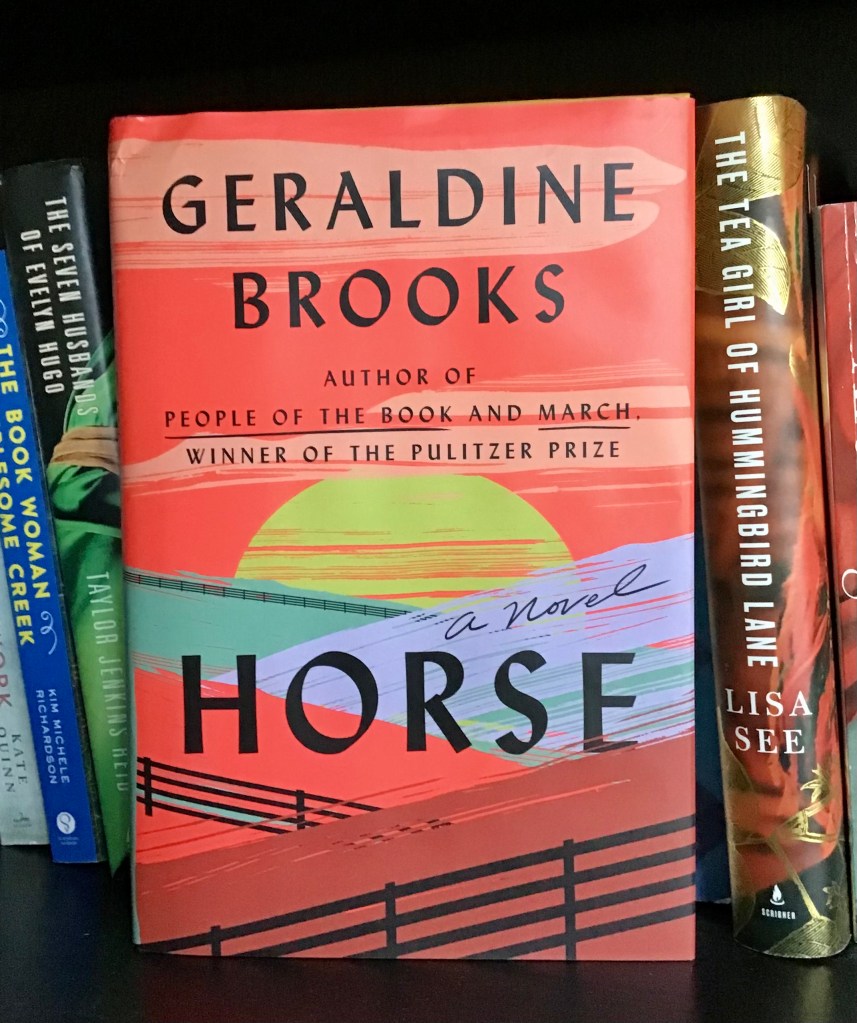
After Tom Lake, I dove into Horse by Geraldine Brooks. This story moves between centuries, from pre-Civil War horse-racing in the slave-holding South to a paleontologist and an art historian at the Smithsonian today. So many moving parts but they are all fitting together (and I’m only about 80% done!). Geraldine Books draws on real people and events in the South to illustrate the world of wealthy, white landowners and enslaved African American trainers. In doing so she illustrates a new view — at least to me — of history and southern culture.

Along the way, I also read Beatriz Williams’ The Beach at Summerly, which starts out as a kind of rich boy/poor girl romance on an exclusive island, but then turns into a plot to capture a spy (who also happens to be a war widow and single mother) passing American military secrets to Russia. Set in the years just after World War II, Summerly is loosely based on real events as the Cold War was taking shape. 

Williams is a thoughtful and entertaining author, who plucks a real life story from the past snd turns it into historical fiction. You may recall I read — and recommended — The Golden Hour here about a newly widowed writer sent to the Bahamas in 1941 to cover the Duke snd Duchess of Windsor. Williams is the bestselling author of Our Woman in Moscow, The Summer Wives, Her Last FlightThe Secret Life of Violet Grant, A Hundred Summers. She has also written a handful of collaborations with Karen White and Lauren Willig. I’m looking forward to going back to her booklist sooner rather than later. 

But wait, there’s more …

The neighborhood book group read Things We Cannot Say by Kelly Rimmer and with it I think I hit my limit on books about women behind the lines in World War II. It’s not that I’m just burned out on this topic (although so many current novels are set then), I just thought it was poorly written. The protagonist was way too naive to be believable as a teenager in Nazi-occupied Poland. Even the language seemed out of step with the time. For example, Rimmer describes the protagonist hurrying to a secret meeting with  her beau, surrounded by the enemy, as “jogging” up a hill. Was “jogging” even a term in 1939 Poland? I certainly don’t think it describes how she would be moving. It just didn’t ring true to me and at least one other member of our group agreed. I actually gave myself permission to stop reading it and move on. Do you ever do that? 

There is, however, a book selection lesson here. It’s fun to read something current, a book that has a buzz. And while I think the recommendations of Oprah, Reese and Jenna Bush Hager are often great, it pays at least sometimes to search out the reviews of literary critics and other authors. Should we limit our reading to what the talk is on social media or should we lean further into the world of publishing? 

Okay, I’ll get off my soapbox and explain my reading binge. 

I broke my wrist.

And this is so totally corny — I broke it playing pickleball! I was reaching for a backhand and toppled sideways. My husband pointed out that as falls go, it wasn’t much. I was a little rattled and sat down for a few minutes, but then I got back in for the next game. Fortunately, it was a quick game because I realized I could not get my fingers to work picking up the ball for serving. So the games broke up and we walked home and took a look at my arm which was now swelling — a lot. You can imagine what came next: Urgent Care, X-rays, a splint, an orthopedist, a soft cast and a lot of Tylenol. 

The resulting temporary handicap explains why I have had so much time to read. I am a one-armed wonder, forbidden to drive with a cast on and unable to cook. In fact dressing myself and drying my hair take significant planning, not to mention wrapping my cast in a plastic bag so I can shower. And all of this is soooo booring.

Thanksgiving is looming and this one-handed blogger may not get another chance to wish you a happy and indeed very thankful day. Lately the news is grim and the headlines are bleak. This is the time to hug family and friends a little harder and count our blessings. And you, dear readers, are the best of blessings.

Thank you for reading along. See you again soon.

Bookshelf dilemmas

My shelves hold a lot more than books, because where else would I put the ironstone pitchers, etc?

This is not a post about what I’ve been reading, or what’s even on my list. Today I’m talking about bookshelves, where most of us keep our books. Call me old school, but I like my books on shelves, where I can find a book to look something up, re-read a portion or the whole book, or find a volume to pass on to a friend. Although I sometimes read on my iPad or Kindle or even listen on audible, I prefer physical books. I have, therefore, always loved cruising library shelves.

At their best, bookshelves can be fairly revealing, highlighting hobbies, travels, professional and other interests. When the shelves hold family pictures, vacation souvenirs, and the like, they are just that much more interesting. I fall into this secondary category, staging favorite books (or at least those I am unwilling to part with) with a mashup of other collectibles. (Where else would I put those ironstone pitchers?)

I learned decades ago that books can be a powerful and profitable decorating tool when a good friend and I chaired a fund-raising book  sale. The sponsoring group was somewhat picky about what we sold (for example, no Readers Digest condensed books or textbooks). So as we collected and priced books, we set aside many that were deemed “unsaleable.” Much to our fund-raising delight we were able to sell them — by the pound — to a company that used them to fill shelves in restaurants, hotel lobbies, model homes, and so on. We laughingly referred to them as decorator dogs and made a tidy sum of money on them.

Refining bookshelf decor

This image is from Chairish, but you can get books by color from Etsy and Ebay.

But, these days books are a big decorative “thing” and you can derive some interesting impact depending on the display you choose. For example, you can just turn all your books backwards, so the spines face the back of the shelf and the muted tones and texture of the pages become a decorative element. Take this a step further and cover your books with a neutral fabric or paper. Same effect, different angle. Have you done either of these ?

If there’s a color story you want to tell, you can buy books-by-the-foot and colors on websites like Birch Lane and Chairish.

For years decorators have used old, leather-bound books to add history/charm/sophistication/warmth to bookshelves and do-it-yourselfers have adopted the same tricks. Take a look at this Instagram post from Farmhouseliving. ig. This home decorator bought volumes on Ebay, then shelved them vertically, horizontally and backwards to get a really unique decorative look. This may not be your idea of a book shelf or mine, but it took this homeowner/designer significant work and more than a little inspiration to achieve this look

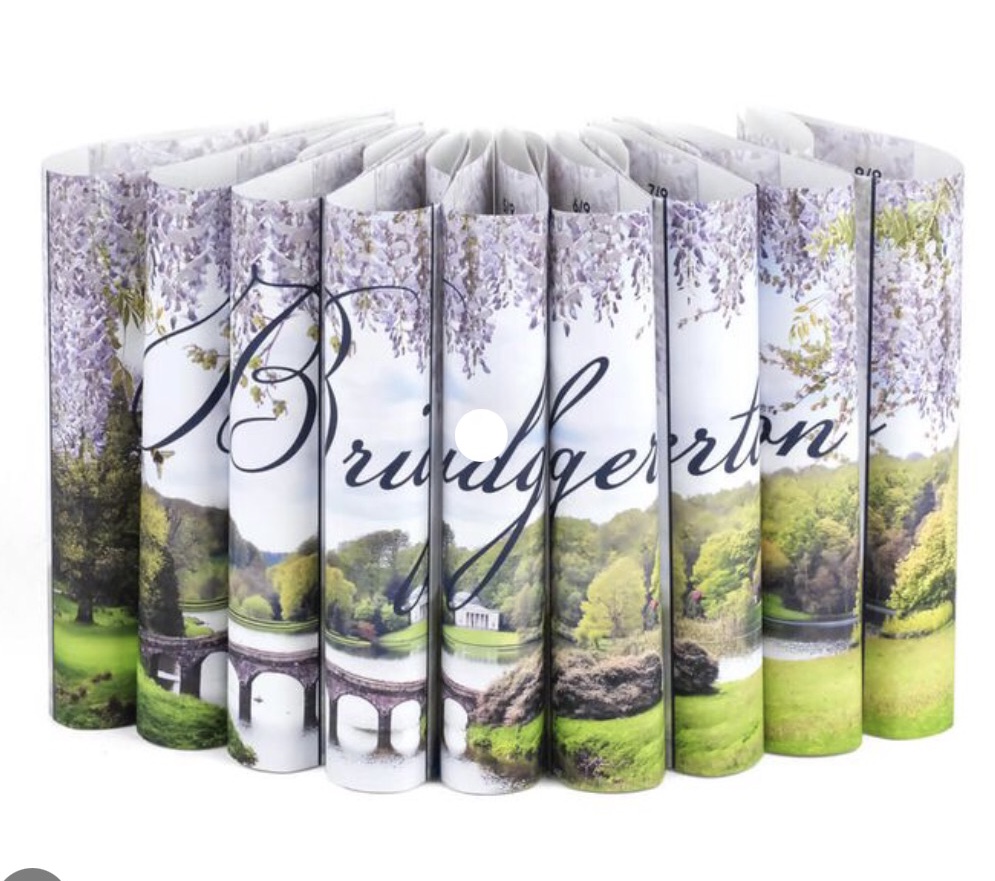
And then there are old books with new covers. I found two companies —Booth and Williams and Juniper Books, and I’m sure there are more — that are happy to supply you with a planned collection, shelf, coffee table or even library display of books in a theme of your choice. Or, you can order custom book jackets to make your own books more appealing.  I am smitten with xxx’s collection of Jan Austen covers, below.

Juniper Books

Or you can opt for a look to match the titles.

Juniper Books

I’m a fairly simple girl; just keeping the books on shelves works for me. Okay, I sort fiction from non-fiction, and biography is a special designation (because it’s my favorite) and, yes, I do now shelve fiction alphabetically by author. Is that weird? I really just do that because I finally have most of our books in one place.

But the design geek in me thinks these other options for the “look” of books is pretty intriguing. What about you? Would you “design” a shelf or two of books just for one of these looks?

Looks, cooks & books

 Yes, I took some blog time off but I have been reading, cooking and looking throughout my “sabbatical” and I’m here to say I am refreshed. I even have several topics tumbling around in my brain, not the least of which is our trip to Dublin, Lisbon, Barcelona and Spain. That would require more photo editing, which I am loath to do right now, so you can probably expect to see it in individual posts in the next few months, rather than one, long-winded travelogue. 

In the meantime, however, I’ve been busy…

New look on the porch

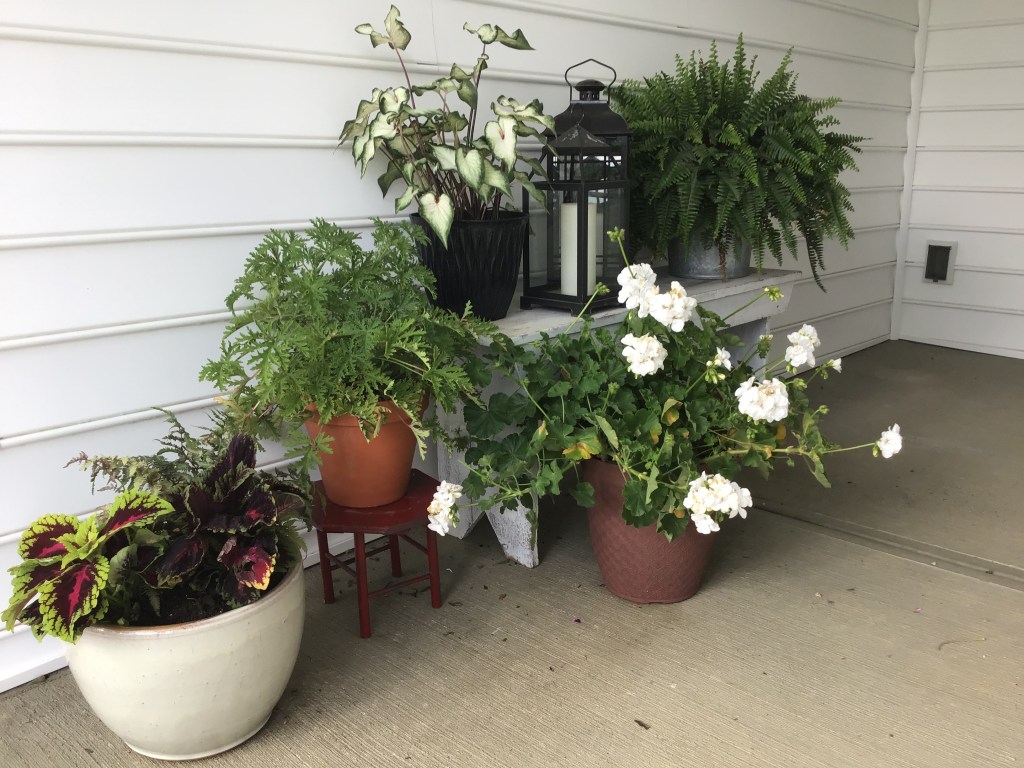
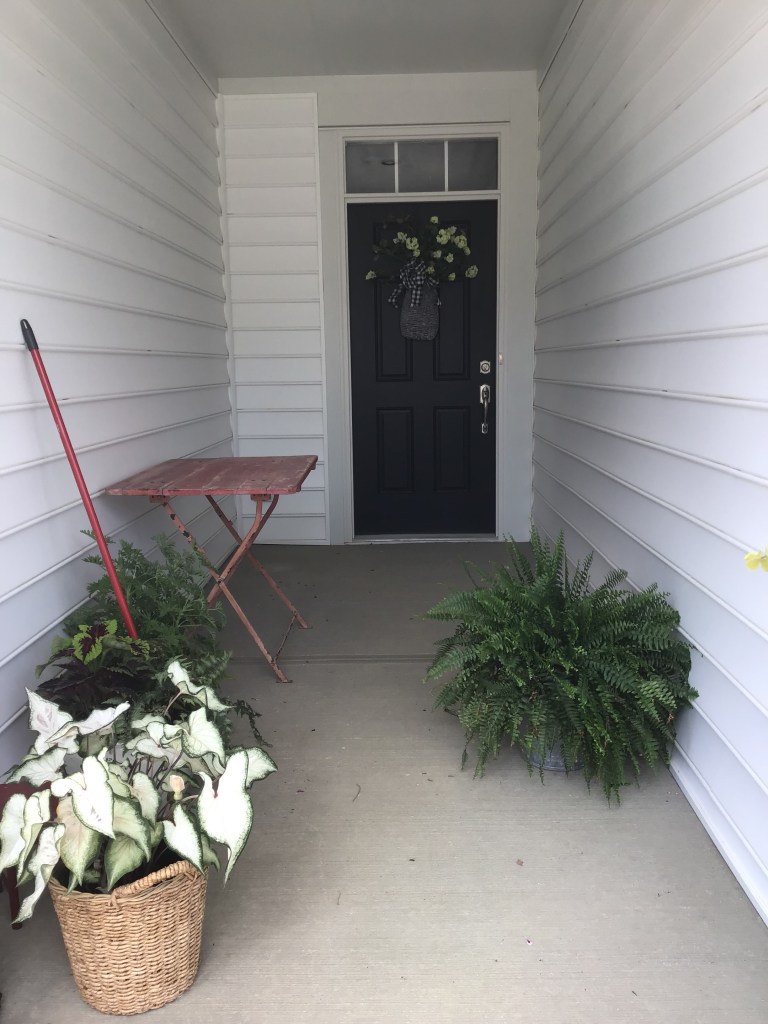
If you follow me on Instagram, you may have seen the “Before” of my summer porch below. I’ve been using this old white painted bench as a starting point, then decking it with a few potted plants and a lantern or two, as well as on the adjacent porch floor. This is a long, narrow spot — 13-feet, 6-inches long snd 5-feet, 10-inches wide to be exact. It’s a fun sport to decorate, because it’s covered; challenging because of the narrow footprint. 

This is the boring before. Okay, but not very imaginative and not really using the space.

I thought it was kind of boring. And, I had this bistro table and chairs stashed in the loft. These pieces belonged outside but in a protected spot. So, I hauled them out to the porch. Next I shopped my house for a few more pieces to use on and around the table.

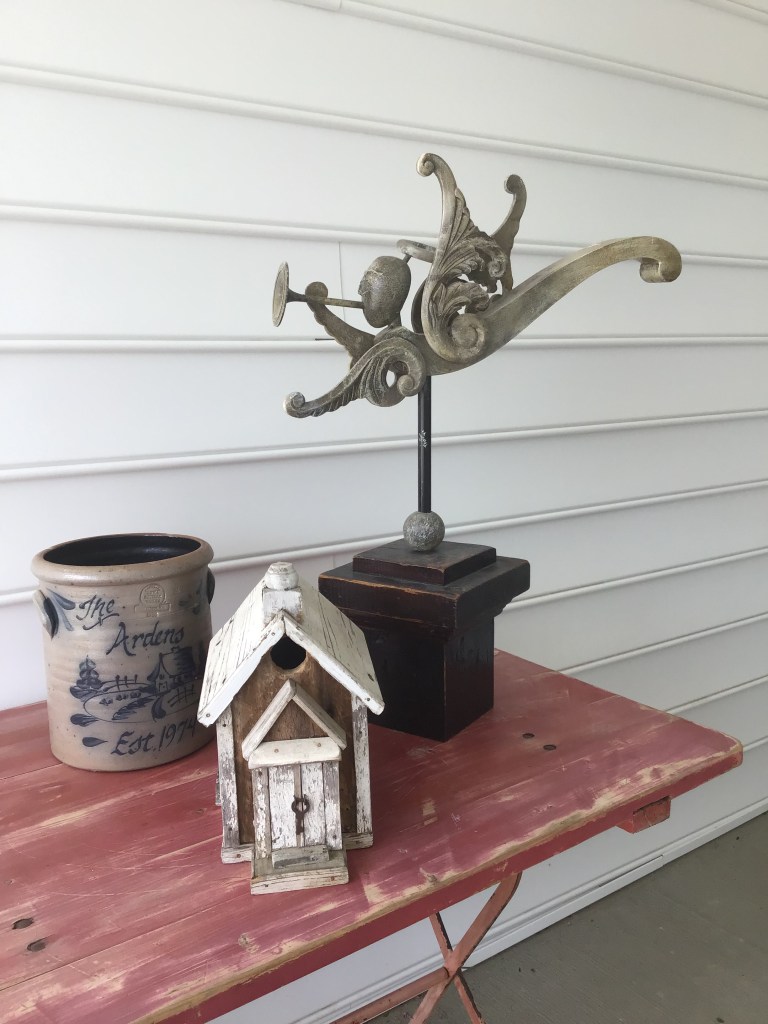
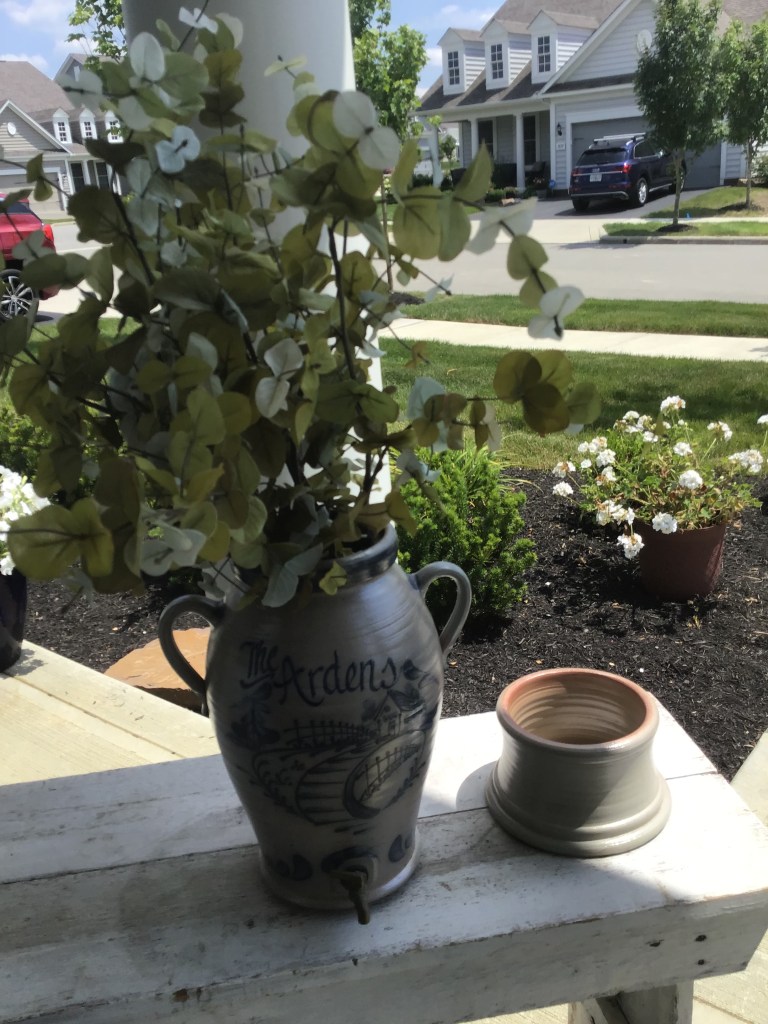
I liked the fact that the table raised plants, etc. higher and by including side chairs I had two additional surfaces to “build” on. Next came a lot of trial and error. One lantern or two, maybe I need three? How about a birdhouse and/or my salvage art angel? I had a lot of possibilities to play with. My stoneware water cooler has the right proportions for the table. but then I remembered the Queen Anne’s Lace blooming with abandon on some nearby vacant lots. I liked the idea of its wispy blooms against the denser foliage of the geranium and fern. The white is also a nice break from the swaths of green.

I tried the Queen Anne’s Lace in the cooler, in a vase, and in a crock before finally hitting on the lantern. I think it’s just just the twist this vignette needed. The bench and the birdhouse are dressing up the patio for now. The water cooler and the crock may make appearances later.

Honestly? This will be a work in progress the rest of this season and well into the fall. I imagine freshening it up with a change in flowers, mums, leaves, twigs and gourds as the months march on. 


The simplest salad

I find it hard to consider dinner complete without some sort of green salad. Lately our favorite starts with a pile of sliced romaine, washed and well-drained. I add this to the bowl with a healthy drizzle of olive oil and a generous pinch of kosher salt. Then I toss and taste to decide if the greens need need a bit more oil or salt. (Sometimes I get it right on the first try, sometimes I toss, taste, & season more than once.) I top it off with a generous shave of parmesan or toss in a handful of parm shards. The salad is good to go. It’s not so complicated that it competes with your meal, but it is fresh, green and crunchy. 

Oddly enough, the strawberries in this photo just happened to be on the counter when I snapped this picture. Although I suggested various additions to this salad, I personally don’t think the berries would work.

With the advent of farmer’s markets and all those fresh vegetables, it’s  easy to dress the same salad up seasonally with diced cucumber, halved cherry tomatoes, diced peppers, whatever suits your taste. Or go Mediterranean with olives or pine nuts. Use your imagination and enjoy!

What haven’t I read lately…

My  neighborhood bookclub recently took a step back from the best seller lists to read — or reread — John Steinbeck’s Of Mice and Men. Published in 1936, the book is based on Steinbeck’s experience as a migrant worker in California in the 1910’s. Despite Steinbeck’s spare language, he portrays a vivid slice of rural American life that is achingly poor, often violent, but also depicting a certain rough camaraderie among men. The book sparked a lot of lively conversation in the group over the role of various characters and the powerful ending. We could not ignore the fact that it has been consistently, repeatedly banned and continues to be even today in these contentious library times. This seems especially interesting considering the lyrics and storylines in today’s popular music and movies. 

If your book club is looking for a different read, I really recommend going back to a classic like this. It’s easy to get caught up in the current releases — there are so many to choose from. But reading or rereading something like this with serious staying power is a wonderful reminder of what we look for in a book and gives you fresh eyes with which to view current releases.

In total contrast to Steinbeck I just finished Elizabeth the Queen by Sally Bedell Smith. This is not a new book. It was published in 2012. However, I knew it was out there and found it on a reduced rack in a local book store. I love biography and I’m a bit of a monarchist when it comes to Elizabeth (not so sure about the rest of them), so I just sank into a comfy chair whenever I could and read to my heart’s content.

Rather than being juicy or gossipy, this bio covers a long stretch of British and therefore world history, from her years when Britain still commanded an empire to today’s greatly reduced commonwealth. The earliest years of her reign were largely guided by Winston Churchill — not a bad mentor — and so many after from Anthony Eden to Margaret Thatcher. Eventually she was the sage and the prime ministers were the newbies, but she handled her a-political position with great care. She first met Eisenhower when he was Allied Commander and she was a princess. She knew and hosted every American president with the exception of Johnson and Carter. 

But what was also fascinating about this book was the private Queen. The media has often featured photos of her riding a favorite horse or cheering one on at Ascot. However, her quiet horse breeding business — which gave her a taste of the country life she would have loved — resulted in close friendships with breeders in England and Kentucky and brought her on quiet, under-the-radar trips to that state many times. Her horses are sought-after champions from covetable bloodlines and her breeding business was very successful. I love that she had that success and those friends apart from castles and commonwealth. 

So, that has been July — not as hot or rainy here in central Ohio as it has been elsewhere. In fact I am finishing this on a  stunning, sunny summer morning on my patio. How lucky am I?

Have a wonderful week and thank you so much for stopping by. I look forward to seeing you again soon.