Florence 2.0: Meeting the Medicis

Florentine rooftops from our room at the Pierre Hotel.

What do you do after all that fun in Tuscan hilltowns? We took a deep breath, braved the tourists, and headed to the historic heart of it all — Florence.

We waited a long time to finally get to Florence. Then we simply fell in love with the city. Steve and I both love London and Paris, but Florence is special. It’s compact and walkable (like Paris), has a seemingly endless supply of history and museums (like London), and it has what I think of as art and attitude.

The art is everywhere. The attitude is a little tougher to define, but I think it’s the total of the food and wine, shopping and sophistication, and most of all the history that ekes out of every corner. Now I can also say it’s even better the second time.

Our first visit to Florence was packed; there was so much to see. We planned differently this time, so we could wander more. In fact, the first afternoon, we did just that. After checking in at the Pierre Hotel we took a walk, found lunch, window-shopped our way to San Marco and back. We returned to the hotel and discovered they had delivered a bottle of prosecco and some snacks as a “welcome back” since we had also stayed there last year. This would be fun!

Getting serious about the Medicis

Florence was, first, a well-established medieval city, until it became the birthplace of the Renaissance and the credit for this goes largely to the Medici family. It’s impossible to spend any time in Florence without running into (and trying to understand) the financial and political power of the Medicis. Starting early in the 15th Century and lasting into the 17th century, the family enjoyed both political power (without holding office) and cultural influence.

The family’s wealth originated with its successful textile trade, which lead to the Medici Bank, the most successful in 15th Century Europe. With money comes power. The Medici’s support of the arts and subsequent impact on the Renaissance is unrivaled, starting with Giovanni di Bicci de’ Medici, who commissioned Brunelleschi for the reconstruction of the Basilica of San Lorenzo in 1419. Cosimo the Elder (another early Medici) commissioned works by Donatello and Fra Angelico. Most significantly Michelangelo accepted commissions from a number of Medici, beginning with Lorenzo the Magnificent, who was also a patron to Leonardo da Vinci (1452–1519) for seven years.

The interior of San Lorenzo is known for its Renaissance architecture, including the integration of the pillars, arches and entablatures and the use of dark stone.

The Medici impact on the church and royal houses in Europe was equally significant. The family produced three Popes of the Catholic Church, Pope Leo X (1513-1521), Pope Clement VII (1523-1534) and Pope Leo XI (1605) as well as two Queens of France, Catherine de Medici (1547-1559) and Marie de Medici (1600-1610). In 1531, the family became hereditary Dukes of Florence. In 1569, the duchy was elevated to a grand duchy and the Medici family ruled the Grand Duchy of Tuscany until 1737

So much for name dropping.

The Medici family, and its money, were behind many of the ionic structures in Florence, and we visited a number of them with a guide from Context Tours who took us through the San Marco Convent and Museum, the Medici Palazzo, Baslica di San Lorenzo, Medici Chapels, and the New Sacristy (designed by Michelangelo).

(Context Tours are perfect for independent travelers. Guides, or docents as Context calls them, have with MAs, Ph.D.s or other terminal degrees in their subject matter, tours are limited to 5 or 6 people. We were the only ones on this tour. We have also used them in Rome and Paris.)

Here is one of the individual cells, with its beautiful fresco.
The convent library. Can you imagine working in this space?

The convent was one of our first stops. After a brief period of upheaval during which the convent (which was really a monastery for branches of the order of Benedictine monks) deteriorated, Cosimo di Medici the Elder commissioned architect Michelozzo to rebuild it. The result is an elegant but spare, Renaissance structure. Like other monasteries, the convent features two cloisters, a chapter house, etc. The friars’ cells are each decorated with a single fresco, many by Fra Angelico in collaboration with other artists. Cells are walled off but topped by a single trussed roof, and the entire structure is finished in white-washed plaster. It’s easy to see how the residents could pray and meditate in this atmosphere.

The convent was home to painter Fra Angelico and preacher Girolamo Savonarola (of the infamous bonfire of the vanities). Cosimo de’ Medici also had a cell in the convent, adjacent to those of the friars, for use as his personal retreat.

The Basilica di San Lorenzo was consecrated in 393 when it was still outside the city walls. Later it became the parish church of the Medici family, as well as the burial place for the family’s principal members. The current basilica is actually the “new” building, completed in 1449 (financed by the Medici family), well after Brunelleschi died in 1446.

The tomb of Giuliano di Lorenzo di Medici in the New Sacristy was decorated with this statue by Michelangelo featuring Giuliano and Night and Day. It is a companion to the tomb of Lorenzo do Piero di Medici and Dawn and Dusk.

The Old Sacristy was designed by Brunelleschi and is the oldest part of the present church. It is also the only part completed (in 1440) in Brunelleschi’s lifetime. The Old Sacristy contains the tombs of several Medici family members.

The New Sacristy was designed by Michelangelo. Work began on it in 1520. The artist also designed the Medici family tombs to be included, but did not supervise the completion of the project. This is a far more elaborate structure. I was especially struck by drawings by Michelangelo, discovered in 1976, on the walls of a concealed corridor under the New Sacristy!

Michelangelo’s drawings, discovered in a hidden corridor. A bad photo and hard to see because the drawings are behind glass, but I am totally fascinated by the fact that they are Michelangelo’s sketches. They seem inherently more personal than all the other works of his that I have seen.

The Medici Chapel, designed by the family working with the architects, and begun in the early 17th Century, reflects a very different aesthetic, featuring elaborate marble mosaics in a domed octagonal space. The octagonal shape is distinctive on the Florentine landscape. Family remains were actually interred in a crypt below the chapel.

After these heady lessons in Medici history, art and architecture, we thought we needed something more light-hearted, so Steve signed us up for a tour of the hidden stairways and spaces at the Palazzo Vecchio. (We did this the next day. Two tours in one day would have been way too much to wrap our heads around!) Most often known as Florence’s city hall, the palazzo was, for awhile, also a Medici Palace. But that’s another history chapter.

Heading up one of the “hidden” stairways. Probably not a great tour with claustrophobics.

The tour begins with an introduction to the Florentine Guilds, or Priori, who ruled the city. In 1342 the existing building was enlarged to resemble a fortress, including the addition of secret stairways allowing guild members to come and go in the night. The tour guide escorted our small group up and down some of these stairways, which, of course, included passing in and out of a number of secret doors. We had toured the building before, so this look at its “inner workings” was especially fun.


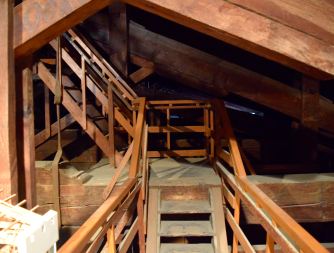
My husband and I loved the idea of these hidden doors. If you have read Dan Brown’s Inferno, or seen the Tom Hanks movie, you undoubtedly recall the crazy chase thru the Palazzo Vecchio. Remember the scene above the ceiling of the Hall of 500? After climbing dozens of narrow stairs, we were up in a corner of it. The space was more cramped than it appeared in the movie, but still very cool to see how the Renaissance building was assembled. Alternating rafters support the roof above and/or hold the ceiling below. What genius Renaissance architects displayed!


Whew! This is not all that we saw or did in Florence, but it gives you a good idea of how we spent our second visit in as many years. We enjoyed the fact that the city was somewhat familiar, we stayed in the same hotel (because we really love it!) and even ate at a restaurant we enjoyed last year. We also found some great new places. We ate lunch one day at the bustling the Central Market and I spent an afternoon at the Bargello. We spent a morning at the Pitti Palace (more Medicis) and found time to explore the tiny streets of the Oltarno.  I think this second visit allowed us to “peel back another layer” on all there is to see in Florence.

What about you? Are there destinations you would happily return to? What about places you could happily say, “been there, done that” and move on? I’d love to hear from you.

Thank you so much for stopping by. See you next time!


More from my miscellaneous file

So, I have been thinking about the pictures of our life lately.

If you follow me on Instagram, this photo of the Chicago River is not new. I took it last week, walking down Madison Street from the train station to the Art Institute. This is workday Chicago, part of what the commuters see (or maybe don’t even see any more) on their daily travels to work or school. It’s not as glamorous as Michigan Avenue or the lake front, but it’s very much the city.

As I was flipping through a week’s worth of photos, I was thinking about how they capture life. We all get cameras (or phones!) out for the big moments: birthdays, anniversaries, graduations, etc. And then there are the vacation photos: the beach, the mountains or even the backyard. But lately I’m thinking about daily life, like this photo of construction at Madison St. and Wabash Ave. My challenge is to capture that.

Last week started on a tough note with the pictures from Charlottesville, Virginia, animated by a sound track my mother would describe as “ugly talk.” Yesterday the country was captivated by the power of Mother Nature and a total eclipse that stretched from coast to coast.

Resilience may be one of life’s most valuable assets.

When I took the shot of the Chicago River, my husband and I were headed to the Art Institute in Chicago to see a current show, “Gauguin: Artist as Alchemist.” (If you’re a regular reader, you know this is my idea of a great day and it seemed like a good antidote to the noise of Charlottesville.)

Most of us think of Paul Gauguin as the painter of vibrant and exotic scenes like “Tahitian Women on the Beach.” But this exhibition took a much closer look at his creative process, especially his ceramics and wood carvings. (I know, who knew he even worked in these mediums?)

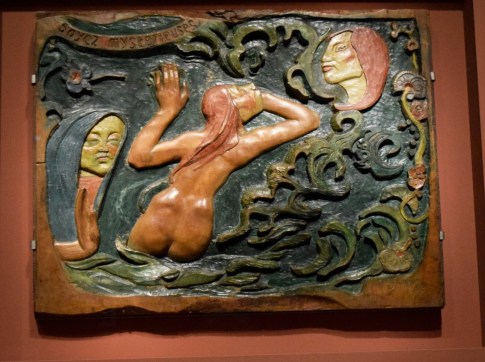
 

Gauguin actually began his artistic expression as a wood carver, something he was easily able to do as a youthful sailor. Before he was a painter, before he was a businessman, before he was a husband and father, he was a commercial sailor and traveled the world more than once. The experience had a significant impact on his artistic expression. This single figure, right, is something a sailor would carve.

A number of the wood carvings in the exhibition  were flat, including some that were applied to pieces of furniture. We were impressed with the way Gauguin married the finished carving with the rough texture of the original wood.


I also think it’s interesting that this piece and the one below both feature figures similar to many of his south seas paintings, but in the carving, below, he has added color.


In addition to working with wood, Gauguin also created several pieces of pottery, though not all remain due to the fragile nature of the material. Doesn’t the design on this bowl reflect the colors and designs in his paintings?


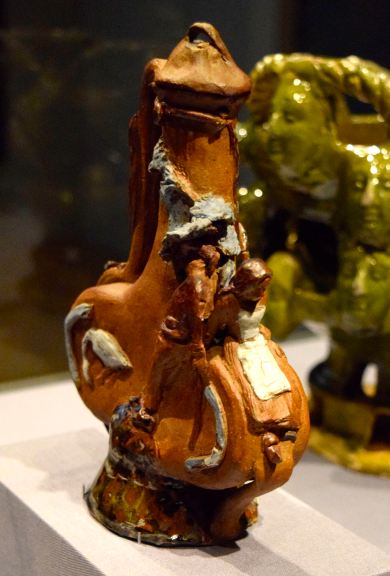
This smaller vessel with added decoration and figures and all done in a free-form manner is representative of a number of ceramic pieces in the exhibition. The amount of color and detail he added is also reminiscent of many of his paintings.


Regrettably, I did not capture images of his printmaking. I really got caught up in the processes he used. Typically woodblock or woodcut prints are made to create identical copies of a single design. However, in Gauguin’s hands process was different. He purposely tweaked each print, with a wash of color, with different papers and inks.  In many cases the prints were displayed as progressions of a design, but not duplicates. Still searching for a better expression.

Steve and I were both struck by how much more Gauguin did than his paintings and about how much more there is to his artistic vision. He tested, experimented, and tried new mediums, always searching for a better way to express himself.

When you think about it, challenging ourselves to progress — in our work, our art, our life — is pretty essential. In this “back to class” season, what are you challenging yourself to do?

Thanks for stopping to read. See you next time!


A hit, a miss, and a tradition rolls on

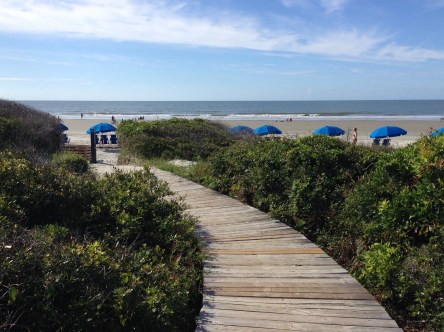
This was my morning walk to the beach on Kiawah Island.

My husband and I, along with our children and grandchildren, spent last week on Kiawah Island, South Carolina. It’s safe to call this a family tradition since we have taken this same vacation for almost all of the last 25-plus years. (Some people might call that a rut, but I like to think of it as a home away from home.)

We look forward each year to familiar days at the beach, bike rides on the island, and favorite restaurants, but each trip also seems to have its own adventures. (On the first morning of the first year my daughter-in-law joined us a baby shark was discovered swimming along the beach. We really worried that she’d never come back!) It’s the kind of place where a waiter in your favorite restaurant turns out to be the boy who lived across the street 20 years ago and an old friend from those mommy-and-me days walks by on the beach where you’ve settled in with a book.

Part of the charm of Kiawah (apart from 10 miles of pristine beachfront, protected dunes and a lush, protected landscape devoid of chain stores or restaurants) is that it’s just 20 miles from Charleston, recently named (again) one of the top destinations in the US. We knew this early on. Charleston is ground zero for American history, foodies, and charm.

I am totally charmed by Charleston’s many gardens, some of them public, some more private, and some completely hidden. At this time of year they are very lush and green.

A hit.

This year my husband and I were in Charleston a day ahead of the rest of the family and stopped for lunch at one of his favorite restaurants. We’d barely settled into our booth when another diner stopped by our table and asked if we were visitors.

Why, yes, we are.

Well, said the diner, I was just given two free passes for Fort Sumter but we’re leaving now. Can you use them? (A bit of history: Charleston’s harbor, where the Cooper and Ashley Rivers merge with the Atlantic Ocean, is also home to Fort Sumter, where the first shots of the Civil War were fired.)

This is one of the tricks of Charleston. The sense of polite, genteel hospitality Charlestonians are known for just starts rubbing off on everyone. And for history geeks like us, the passes were like finding money in the street.

The boat to Fort Sumter offers a good look at the U.S.S. Yorktown, a decommissioned aircraft carrier. It’s another great side trip when you need a beach break.

We had been to Fort Sumter years ago, on one of our first trips. Our kids were in grade school then, and it was a very hot day. The best part was the boat ride out there and back; there was very little left of the fort. This time, our daughter, my husband and I made the trip one afternoon. It was not as hot and the boat ride was still fun, but we also appreciated the fort far more. We could not remember if there was a Park Ranger talk the first time around, but there is now and although it was short, we learned a lot.

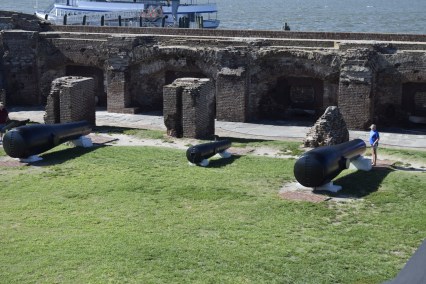
Fort Sumter was actually the site of two Civil War battles. As a result there is very little left of the original fort.

Fort Sumter was built on a manmade island positioned to guard the all-important Charleston Harbor. After the War of 1812 the U.S. Army realized existing fortifications on either side of the harbor could not stop an attack on the city. Despite the fact that there is very little left of the fort, it was originally pretty large — three stories high and designed to accommodate a substantial number of men and even officers’ families. (It was not yet staffed except for Union troops who had secretly moved there from Fort Moultrie after Lincoln’s election.) After those legendary shots were fired April 12, 1861, and subsequent shelling, the Union Army was ultimately forced to surrender. However, this was still a “Gentleman’s War,” so, until he surrendered, U.S. Army Major Robert Anderson was allowed to receive supplies from the city and use telegraph lines there to communicate with his commanders. (This is, after all, Charleston.) After the surrender Anderson and the remaining soldiers were allowed to leave on a supply ship. They went to New York where they received a hero’s welcome.

And that’s how history unfolds…

A miss.

Look at the detail in this brickwork! From our walk around Charleston.

For the last few years, my daughter and I have made a point of going into Charleston early one morning so we can walk and photograph the streets. Last year we did this on a very hot, humid Charleston morning and, after an hour or so, we were desperate for cool air. We turned a corner and there was the Nathaniel Russell House, one of the “house museums” operated by the Historic Charleston Foundation, so we went in and took the tour — again. We are “repeat offenders” because although houses like this are historic, they are not static. Continuing research, based on excavations, paint analyses, or even newly discovered documents or furniture often lead to changes in the house as well as its interpretation. (We really are history geeks!)


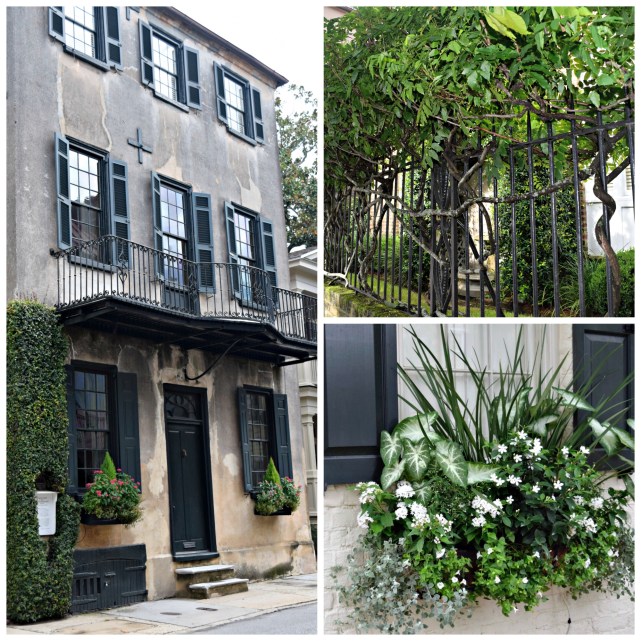
These tiny front gardens, often bordered by boxwood, are so pretty and make the most of small spaces.
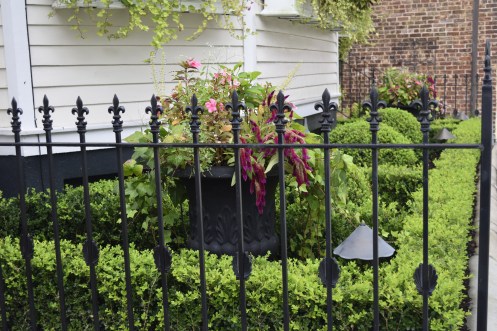
Another garden bordered by beautiful wrought iron fencing. This fence is very elaborate, but it still allows the homeowner to show off her garden.


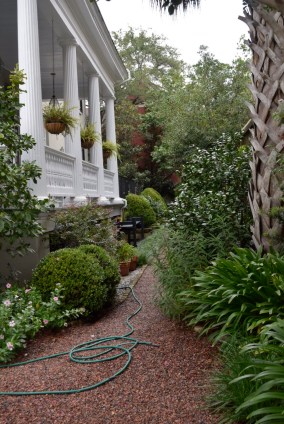
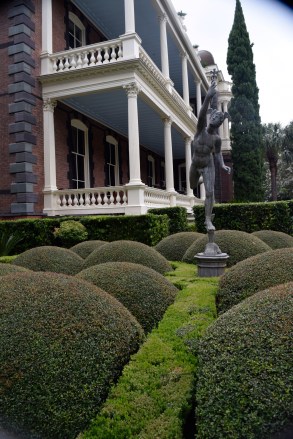
A view of the Calhoun Mansion’s piazzas, or side porches.

Last year we had passed the Calhoun Mansion and decided we should visit it next, so this year, after a walk that was far more comfortable (and at least 10-degrees cooler), we headed down Meeting Street in time for the first tour. We knew the house, built a few decades after the Civil War, was different than others we have toured (all pre-Civil War, often by many years). What we did not realize was just how different it would be.

A bit more history: the 23,000 square-foot house was built in the 1870s by George W. Williams, who had made a fortune as a merchant-turned-Civil War blockade runner. The docent who showed us around said the house was constructed in the early years of the Gilded Age (think Vanderbilt and Carnegie), when building mansions to hold vast collections of art, furniture and collectibles was common among men of certain stature. It became known as the Calhoun Mansion when Williams died, leaving the house to a daughter married to Patrick Calhoun, grandson of John C. Calhoun.

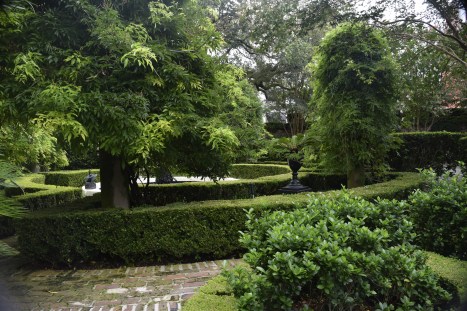
Calhoun House gardens featured beautifully tended boxwoods, brick paths and a number of water features.

I wondered, out loud to the docent, how Charlestonians accepted this mansion in their midst. The city’s residents, once successful landowners and professionals living privileged lives, had suffered terribly during the Civil War and the city had struggled to survive. Post-war society was so polite that those who did have the means to repair or repaint their homes, did so sparingly, not wanting to embarrass friends and neighbors who could not afford to do the same. The docent pointed out that the construction employed hundreds of unemployed citizens for years.

The mansion is packed with furniture and collectibles, but almost none of it is original to the house. Those belongings were auctioned off after Calhoun suffered financial setbacks. The current owner, however, is an avid collector and has filled the house with the same vast quantities of “stuff.” The floors, the woodwork, the Tiffany chandeliers and the glass ceiling in the music room are all beautiful. But I found it hard to focus on most of it, along with the lovely collectibles, just because there was so much stuff. The collection ranges from Tiffany glassware and a Wedgewood-decked chandelier to Kibuki armor and English footstools made from the feet of real elephants. It’s dizzying.

People love it, but I was confused by the clutter and frankly a little “turned off” that a family really lives here part of the time and charges admission to allow tour groups. Am I weird? Probably. Perhaps I just want a “purist approach” to 19th-Century houses.

The gardens were beautiful, but on the whole I’d call this a miss. Interesting, but maybe not for the right reasons.

On the other hand, here are a few more shots from that morning in Charleston.


A lot of Charleston houses are stucco . I especially like the black iron and trim. I know, here I go with fences again, but look at how the vines have woven themselves into this wrought iron. Finally, I love this window box. Nothing fancy, but so lush!

Whether you are traveling or staying close to home this season, I hope your summer features far more hits than misses!

Thanks for stopping by and see you next time!

PS: You can follow me on Instagram here.


At the intersection of bestseller and headline news

Do you have a favorite hotel? I’m talking about a legendary, grande-dame of a place that may or may not be showing its age but remains elegant, with discrete service, a five-star dining room and the requisite, legendary bar. The Ritz in Paris or the Plaza in New York may come to mind. In Chicago it would probably be the Palmer House or the Drake. In Moscow it is the Metropol Hotel.

According to its website, the Metropol was built in “1899-1907 in Art Nouveau style, with contributions from some of Russia’s greatest architects and artists of the day.” Its location between the Bolshoi Ballet and the Kremlin makes it ideal for travelers and as a setting for A Gentleman in Moscow by Amor Towles.

This is my new favorite book. 


It would be a great read at any time (and obviously it has been for many since it spent 20 weeks on the New York Times best seller list since its release in 2016). But now, with Russia dominating our headlines, it seems almost too perfect. Do not, however, expect A Gentleman in Moscow to bear any resemblance to current events. Rather this is a tale from inside Russia in the first half of the 20th century. In fact, it’s a novel set almost entirely inside the Metropol Hotel.
Briefly, the novel tells the story of Count Alexander Ilyich Rostov, a Russian aristocrat arrested by the Bolsheviks in 1922, but saved from execution because as a student he had written an influential revolutionary poem. Instead of the Gulag, he is sentenced to permanent house arrest in Moscow’s Hotel Metropol. The Count had been living in a posh suite in the Metropol, where he had installed a variety of cherished family heirlooms and established a comfortable routine. However, under house arrest, he is forced to move what he can into a garret room in the Metropol’s attic and go from there.

The Count, being the Count, adapts.

That’s the charm and the challenge of the story. I must admit that I knew the premise of the book before I started reading, and I was intrigued about how Towles would handle the limitations of the hotel. Not to worry. The count’s former worldly circle is replaced by a new one within the Metropole: the cook, maitre’d, seamstress, bartender, and even an orphan for whom he assumes a paternal role. Towles deftly introduces hotel guests to bring the world to the Metropole and the Count, whose diplomatic skills and knowledge of history, literature, music, art, food and drink eventually make him a valuable mentor to high-ranking party members, netting a whole new range of relationships.

And then there are the dramas that play out. This is, after all, post-WWI and revolutionary Russia. There is the depression, the party’s struggles, WWII, Stalin’s death, the Cold War. The book spans nearly four decades, giving the count plenty of time to adapt while never losing his dignity or his sense of right and wrong.

Although the focus is on the Count, it’s impossible to overlook the challenges the other characters experience. The cook isn’t just losing access to ingredients in a time of shortages, he’s losing access to the tools of his trade, to his artistic expression. When the hotel manager — “the party’s” representative in the hotel — inserts himself into the daily restaurant meeting, the Count and his cohorts lose their autonomy. The losses may be incremental, but they mount. Life in Moscow is not easy, but these characters soldier on, assuring their guests the Metropol’s traditional service and style, and assuring themselves of their values and traditions.

This is much more than a survival story, it’s about thriving in the midst of adversity, never losing one’s “center” (and in fact, having a moral center). And this is the part that brings me to current headlines. Without sounding too political, what does it mean today to have a moral center? What does it mean to be an American in 2017? I’ve been thinking about that a lot.

This book would be a great read at any time, but right now, I think it’s perfect.

Bonus! Saving — and celebrating — a bit of every book

My daughter is an avid reader. (Hence her blog, What Maggie Read). We talk books a lot: what we’re reading, why, what’s next on our list, what our respective book groups thought about recent reads, and on and on (as my husband would say). One recurring topic of this conversation is documenting what we have read.

Maggie keeps a reading journal. (I’d like to be that disciplined, but I’m not.) She recently told me about a friend who keeps a kind of “annotated” list of books. As Adele finishes a book, she adds the title and the first sentence of the book. Cool, huh? We both think this is a great way to keep a record of what you have read. (Thanks, Adele.)

Do you track what you have read in a journal or a list or just by looking at your bookshelves? I would love to hear from you.

Thanks for stopping by. See you next time!


Losing ourselves in France

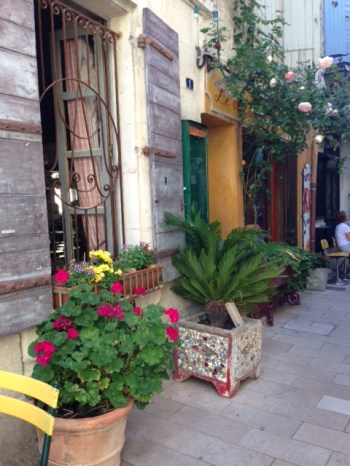
St. Remy, Provence, where every doorway is decked out with flowers and/or greenery and/or cafe tables.

I could not wait to plunge into our recent travels in France to tell you about Castle Sercy, here, and my day at The Cook’s Atelier, here. But then I thought I should backtrack and give you a look at our trip overall. It was more than castles and cooking.

A few years ago we took a river cruise in France that traveled north from Arles in Provence to Salon sur Saone in Burgundy. We had a wonderful time, we just didn’t have enough time in many of the places we stopped. There were other sights like the Pont du Gard, and towns, like Aix en Provence, along the way, that we never got a chance to see.

We knew we would go back — soon. Then my son introduced me to Ina Caro’s book, Paris to the Past, in which Caro and her husband retraced French history by daytripping via train from Paris to various cathedrals and castles. They did this in chronological order starting with the oldest sight. Since we had already visited Notre Dame, Saint Chapelle and Chartres, I wanted to visit a few more sights on the list.

Somewhere on the road from Burgundy to Provence, stopping yet again to re-calibrate Google maps, but just look at these vines!

Burgundy is home to countless small wineries that we could only sample by visiting ourselves, and Steve was eager to do that. I had discovered The Cook’s Atelier in Beaune (a town we loved on our first visit) and was determined to attend one of their daylong cooking classes. If we started in Reims, we could visit the cathedral where centuries of French kings were crowned.

After a few days in Burgundy, we planned to drive south to Provence, exploring more hilltop towns, visiting markets, and, yes, getting lost on more back roads, before dropping the car off in Avignon and taking the train to Paris.

Our travel misadventure adventure begins

We flew into Paris and, on a chilly, drizzly morning with virtually no sleep on the overnight flight, proceeded to drive to Reims in our rented Renault Clio. We paid extra for a GPS system, but never really figured out how to use it, which explains how we ended up heading towards Paris instead of Reims. Fortunately, even my seriously limited French revealed we were going in the wrong direction. Pull over, pull up Google maps, and recalibrate. (This is a little jingle we would oft repeat!)

Here’s what we learned about driving in France: In addition to being in French, the road signs did not indicate direction. Alas, we midwesterners are used to I80 West, I65 North and so on. Not so in France. Keep your eye on the Google map. And here’s what we learned about roundabouts: keep going around until you are sure of the exit you want to take. If you make the wrong assumption and take the wrong roundabout turn off, you can go many kilometers before getting a chance to turn around on these narrow country roads. Tollroads are nice, but not typically very close to the towns you really want to see. (And the country roads are indescribably scenic and fun to travel!)

The day we arrived in Reims was the annual celebration of Joan of Arc’s arrival there with the young Charles II for his coronation. (This cathedral was the sight of French coronations for hundreds of years.) It made visiting the cathedral a little challenging, however you could not help but be charmed by the locals dressed in medieval garb and recreating processions through the town.

After our stop in Reims and catching up on our sleep at a hotel in Troyes, we visited the Abbey of Fontenay on our way to Beaune. Founded in 1118 by Saint Bernard as a Cistercian abbey, Fontenay is one of the oldest in Europe. Cistercians vow to live a simple life in poverty. Their monasteries were self-sufficient. By 1200 the monastery was complete and able to serve as many as 300 monks. Despite its initial success, the abbey was attacked and pillaged in the Hundred Years’ War and the Wars of Religion. The monks left during the revolution and the property was turned into a paper mill by the Montgolfier family (of balloon fame). Today it is privately owned. It became a UNESCO World Heritage Site in 1981.

Abbey Fontenay lived up to the Cistercian principles of simplicity, but did so elegantly.

True to the abbey’s orders, the buildings are remarkably simple, sometimes even stark, but they feature beautifully vaulted ceilings and generous doses of graceful symmetry.

On to Beaune, the wine capital of Burgundy in eastern France. It is also home to the Hotel Dieu, a 15th-century former hospital that is now a Museum. We had toured the Hotel Dieu on our first visit (an intriguing sight), but we were anxious to explore the town, sample the legendary wines, and I would spend a day cooking.

Pommard includes two chateaux, the first built in 1726 by a member of Louis IV’s court. The French Revolution forced the Marey-Mogne to sell the chateau, though they retained the vineyards (known as clos because they are enclosed by stone walls) during their exile from France. After the revolution, the family built a second chateau. Eventually both chateaux and the Clos were united under single ownership.

As we explored Beaune on foot on the day before my cooking class, we stopped by The Cook’s Atelier to introduce ourselves. My husband asked about nearby wineries and Marjorie’s son-in-law graciously arranged for us to visit Chateau Pommard, one of the oldest in Burgundy and just a handful of miles away. (And, yet we got ridiculously lost in this tiny town, so much so that we had to call the Chateau and say “this is where we think we are, how do we find you?”)

Although the estate changed hands a few more times and is now owned by an American, it has remained complete and has benefited from significant improvements to the estate management and the winemaking. Pommard wines are known worldwide for their quality, and the tour and tasting was simply wonderful.


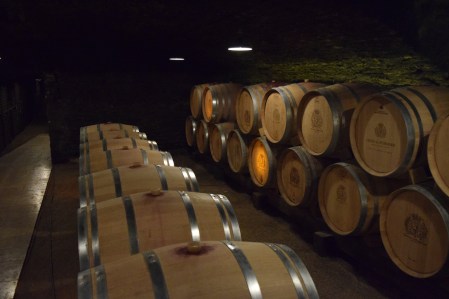
The vineyards, top, and the cellars, above, have changed little in over two hundred years.


By now we were becoming more comfortable with driving in France. We still got lost (often!), but we took it in stride and felt free to stop, take pictures and make impromptu changes to our so-called itinerary. This is what we were hoping for!


When we left Castle Sercy, M. de Contenson suggested we stop at nearly Cormatin, a largely restored chateau, an unscheduled but memorable stop and a testament to the challenges of restoration.
It took a while to realize that the small bursts of red along the roadside were wild poppies. Beautiful!

Now we know why everyone loves Provence…

It’s easy to forget that this part of France was once part of the Roman Empire and the Romans were amazing engineers. The Pont du Gard was part of a sophisticated aqueduct delivering water to a number of Roman towns.

Before we knew it the road from Burgundy led to Provence where we finally saw the Pont du Gard, visited Aix, and fell in love with French markets.  Provence is  absolutely charming and prettier in person that any picture. Really. We just let it unfold in front of us as we traveled.

Unlike a few other towns, the day we happened upon Seguret, the town was very quiet, encouraging us to walk its cobbled streets.

One of the charms of driving on our own was the freedom to stop and explore, as we did here at Seguret, stopping for a leisurely lunch in an outdoor cafe overlooking the French countryside.

Our plan was to stay in L’Isle sur la Sorgue for a few days (so we could attend their big Sunday market which includes antiques) and then move on to St. Remy. Both towns provided a great base from which to visit other hill towns. (And we did a lot.)

L’Isle sur la Sorgue is larger and has a working class vibe. The town owes its early prosperity to the Sorgue River, which served it well defensively centuries ago, and for the industry and trade the river offered. A number of working waterwheels remain in the heart of town

Today it’s home to many antique stores, typically only open on the weekend for the market (though I’m sure they do considerable private business the rest of the time). In the few days we were there, the people and pace seemed to pick up in anticipation of the Sunday market. We stayed a few miles from town and the hotel advised us to arrive in town on Sunday well before the market opened to assure parking. We did, though parking proved not to be a problem (or maybe we were just really early). So, we grabbed cafes and croissants from a boulangerie and enjoyed the activity as the vendors set up their wares.

I was especially eager to see what the antique dealers would offer and was not at all disappointed. There were linens, dishes, knickknacks, books, paintings and prints, and furniture, some of it just barely vintage but much of it centuries old. Centuries! I think the prices were fair and dealers were willing to bargain, I just had no idea how to get a lot of it home in a suitcase!


Stacks of china!


Something for everyone here.
Tables of Majolica. Where to begin?

As much fun as the markets and specific sites were, driving almost daily through the French country side was just as much fun.

Rousillon is postcard-pretty and immediately recognizable for its ochre-colored clay, which nets the ochre pigment so popular with artists.

When we moved on to St. Remy I was reminded of the visit we paid a few years ago to the nearby Asylum of Saint Paul Mausole where Vincent Van Gogh went to recover his health; he improved here, and enjoyed an especially productive period, completing almost 150 paintings and a number of drawings from May 1889 until May 1890.  (You may can read my post on that here.) One of the disappointments in the last visit was not spending time in St. Remy. This time we stayed in a charming, old hotel on the square. (In France, old means no elevator. We counted 69 steps to our room!)

A St. Remy doorway: flowers, shutters, stone.

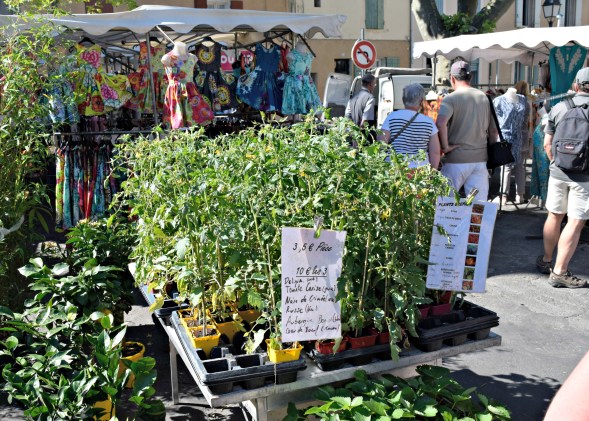
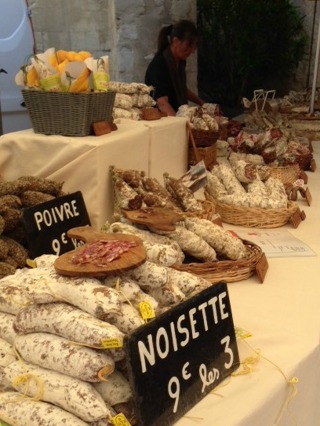
We loved the weekly market in St. Remy. Like the others it was a colorful mix of fruit, vegetables, sausage, cheese, spices, baskets,  t-shirts, linen towels, handmade soap, and local artists. And I’ve probably left out a few categories. Despite the obvious merchandise aimed at tourists, it’s important to remember that most French residents shop these markets weekly for food and to catch up with neighbors. It’s very much a part of the culture.


No French market is complete without fresh herbs and a few vegetable plants.
Sausages are a regular component of the French menu. Here is a market day sampling.


One of the side-trips we took from St. Remy was to Aix en Provence, a scenic drive on a warm day. I expected Aix to be pretty (and it was) and knew it played a role in the art community (you’ll see that), but we were totally unprepared for how big and bustling it was, especially on its market day (unplanned on our part). The traffic was like rush-hour gridlock. We worked our way towards Paul Cezanne’s studio, found parking in a nearby hospital lot, and walked the rest of the way.


The studio was so worth it. Cezanne had many studios over the course of his career, but this was his last and he had it built to his own specifications, a small, two-story structure on a hill in what was then the outskirts of town. The painting studio, above, was on the second floor, and though he worked every day, he often left the studio and worked outdoors. In October 1906 Cezanne was working outside the studio when the weather turned stormy. He worked for awhile anyway, then decided to go home. Unfortunately, the artist collapsed along the way. A passing driver took him home. He died of pneumonia a few days later. After his death, the Cezanne family simply locked up his studio. After a time the building was sold to a writer, who only used the first floor, leaving all of Cezanne’s art materials undisturbed upstairs. Eventually, Aix grew, and the structure was scheduled for demolition and redevelopment. A group of Americans banded together and saved Cezanne’s studio, donating it as a museum to a local university. The easels, paints, palettes, props, coffee cups – everything in the studio – are as Cezanne left them. Amazing!

So many pictures, so little time. I could not resist adding this shot of a road leading out of St. Remy, perfectly lined with clipped plane trees, a familiar sight in Provence.

After our stay in St. Remy, we dropped our car off in Avignon and took the train to Paris for our last few nights in France. I’ll post about that later. We have been to Paris a number of times, so this was more relaxed than earlier visits, seeing a few sights, shopping a little and enjoying French cafes.

Thanks for stopping by and reading and — hopefully enjoying — this loooong post. See you next time!

PS: I love Instagram and post there often. Follow me here. 


We almost had a castle in France

The hoarding tower.

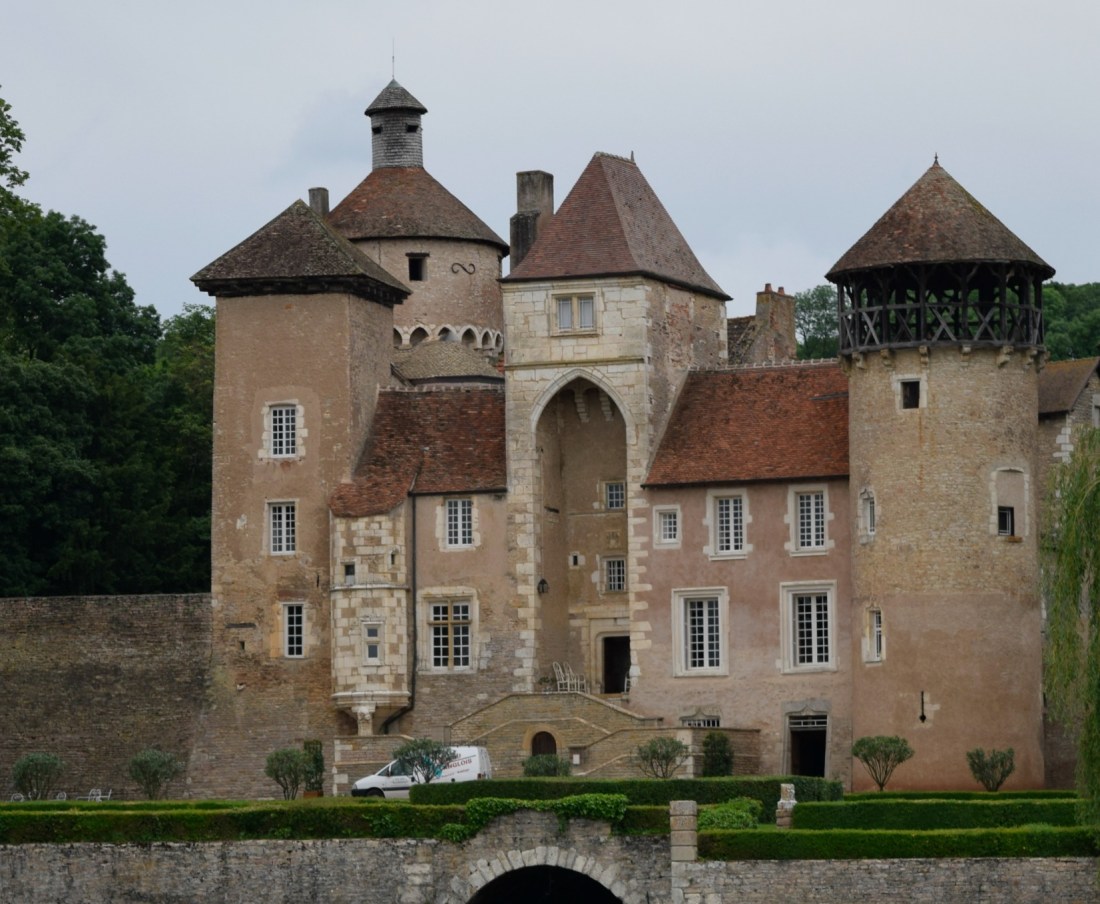
If you follow me on Instagram, you know we recently traveled to France and you also probably saw my post about the French castle that is, sadly, not in our family. But, in sixteen days of wonderful sights, sounds, tastes and people, the morning we spent at Sercy Castle has to be among the best of the best.

A bit of the back story.

Last year I gave my husband an international membership to Ancestry.com so he could pursue his mother’s family roots in Europe. The genealogical research was full of surprises, not the least of which was this castle in Sercy, France. In truth, the Castle Sercy part of the story required a few “leaps of faith” to get to the 12th century, but it was fun to pursue. In reality, our visit here was absolutely wonderful (and, no, these are not the right Sercy’s!).

I’m not sure what I expected. We had seen a few Google pictures on the web, but when we came around the bend in the road on this particular morning and saw the castle in person, I was totally blown away. A stone castle, with turrets and a diminutive lake out front! As one friend noted, it’s just like Cinderella! But of course, it’s very real with a very interesting history.

This is the castle kitchen.

Castle Sercy is a 12th-century structure, in Southern Burgundy near Tournus. Although it is not normally open to the public, except for certain special occasions, Steve had corresponded with the current owner and his welcome was genuinely gracious. The castle’s current owner, a retired naval officer and descendant of several centuries of owners, greeted us warmly and invited us into the small home he & his wife share on the property. (The castle has no running water or electricity, making residence there somewhat inconvnient.) Over coffee he shared some castle and family history.

Start in the 12th century

Construction on the Château de Sercy started in the 12th-century and continued for the next few hundred years. By 1470 the Château had become a fort with ramparts and a moat. The Sercy family owned the Château de Sercy (hence the name) from its initial construction until the 16th century when Philibert Sercy died in Lyon. The Château was subsequently uninhabited for over two hundred years and fell into ruin. It was sold in 1771 to a French army officer and then sold again in 1785 to an ancestor of the present owner.

The Romanesque Chapel is also the burial site for generations of the castle owners.

Those owners were royalists who were beheaded during French Revolution (Really!). Their very young daughter was spared, but the castle was sacked, its furniture taken, its sculptures and fireplaces broken and archives burned. Later, after the daughter had grown and married, a major reconstruction took place from 1811 to 1815 and the Château de Sercy was inhabited once again. Much later, in 1929, a major fire destroyed much of the structure, although some of the best parts of the Château were saved. In 1954 the family began to rebuild, again.

Castle living today

The French government can classify a building or part(s) of a building as historically significant. Castle Sercy’s round, northwest tower with the raised roof supported by a substantial network of wood pillars and trusses, called a hoarding, was built sometime in the 15th century to defend the castle. It’s one of the oldest hoardings in France, making that part of the castle historically very significant.

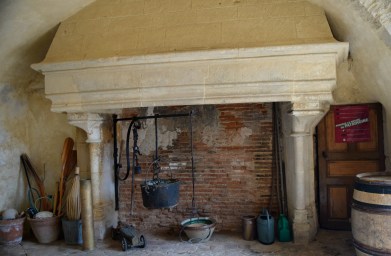
We had access to a limited part of the interior, but the owner did share the original castle kitchen with us, along with the courtyard area which dates to the 12th and 15th centuries. Despite the lack of conveniences like electricity or running water, the owners do use the main salon in the summer, as well as an adjacent room. Interestingly, the fireplace in the main salon is also classified for historical preservation, and has been restored but fires are not permitted per the architect.

We walked the grounds to see where the castle walls had once been and the moat beyond the walls. We also visited the castle’s Romanesque chapel where generations of forebears are buried. The chapel walls and ceiling are beautifully decorated in great detail.

Part of the courtyard dating to the 12th century shows more of the timber framing.
Detail of the restored fireplace in the main salon features remarkably delicate stonework and the owner’s family crest.
Another space awaiting restoration.
The chapel’s interior.


Rather than being disappointed that our family is not related to the castle’s original owners (which really was long shot!), Steve and I were both totally charmed by our time at Sercy and honored to have the opportunity to visit. It was a remarkable look at castle life “then and now” as well as a very personal lesson in one family’s French history.

Thanks for coming along.

See you next time!


Nancy Drew, Louisa Adams & other smart women

Do you ever have one of those times when disparate things start strangely fitting together in the larger scheme? I’m having a week like that, with amazing women stepping out of the shadows to challenge my thinking.
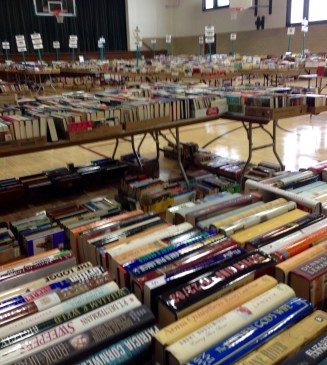
On the first Wednesday in May the Wheaton-Glen Ellyn, Illinois, branch of the American Association of University Women (AAUW) holds its annual used book sale. This is a fund-raising tradition more than 50 years old that supports national fellowships and local scholarships for women. It’s also a true labor of love for the women (and men) who have now spent decades collecting, sorting and storing used books every year in anticipation of the sale, then unpacking and arranging the books at the Glen Ellyn Civic Center for the sale itself.

So, this is the week.

Despite endless box-schlepping, aching backs, associated and inevitable dust, long hours, and often tedious sorting into various broad categories, many if not most of us are happy to dig in. It’s for a cause we deeply believe in, we get to catch up with friends we may not often see, and perhaps even make a few new ones. And, we haven’t found a better fundraiser! We know how to do this, and after 50 years we’re pretty good at it. Book lovers and bargain-hunters know to look for this sale.

Most important, we have met and talked with the women these proceeds help. This is real empowerment.

And then there is Nancy Drew.

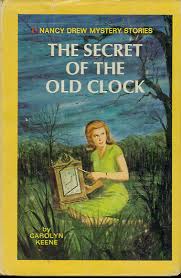
Volume One of the beloved girl detective series, “The Secret of the Old Clock,” was published 87 years ago on April 28, 1930, using the pseudonym Carolyn Keene. The books, ghostwritten by Mildred Wirt Benson and later revised by Harriet Stratemeyer Adams, were “the Depression-era Pokemon cards” says Theodore Johnson in a celebratory essay on the The Mary Sue. “They were collected, traded, bought and sold on both secondary and tertiary markets to the point where any kid, even those who couldn’t afford new books, would very likely get to read every adventure starring their favorite character within a reasonable interval.”
But more important was what the books showed readers that girls could do. As Johnson points out, “Nancy gets into fights, drives a car, packs a gun and relies on herself to get out of tough situations. She is mechanically inclined and at the same time doesn’t act like most people in the 1930s would have expected a teenage girl to act.” Nancy Drew’s heroics were just as important to my friends and I reading in the 50’s and 60’s as they were to the first readers in the 30’s. I’m sure I never realized what a great character/role model she was; I just liked the books.

I encourage you to read Johnson’s essay, here to appreciate his complete examination of the series — including its relationship to subsequent fiction. If you haven’t read Nancy Drew, what are you waiting for? And if you have, you can go back and reread one for fun. That’s what I’m doing.

But wait, there’s more.

I was connected with yet one more really interesting woman this week.
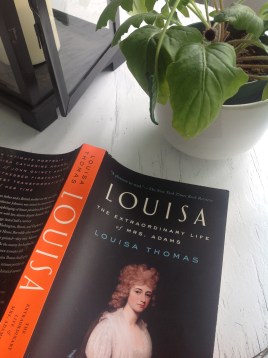
I love to cruise the Recommended, New Releases and New in Paperback shelves and tables in bookstores. I always find something interesting, sometimes a title I have been looking for or an author I especially enjoy. Louisa by Louisa Thomas looked interesting, but I had not heard about it before. Well, it was a great find!

Louisa Catherine Johnson Adams was the the daughter of an American businessman living in London and his English-born wife; Louisa became the wife of John Quincy Adams and daughter-in-law of John and Abigail Adams. After spending the Revolutionary years in France (her father was not especially welcome in British circles during that time), the family returned to London where she met John Quincy, who by then was on a diplomatic mission for the U.S. President.

Though their life, which initially took them to Berlin, Prussia and the court of St. Petersburg, sounds glamorous, it was also outright dangerous and remarkably lonely. She spent years separated from her young sons and her family. The newly established United States was trying to establish its foreign credentials. Louisa and John Quincy were not necessarily welcomed with open arms. If anything, Louisa’s British background and her years in France gave her easier entree into palaces than did John Quincy’s pedigree.

But that’s just the start of the story.

Louisa led a remarkable and challenging life, including a heart-stopping journey from St. Petersburg to Paris to meet her husband and, later, guiding his election as the 6th President of the United States in a “campaign” so remotely different from current politics you will be wondering if it was really in America.

So yes, I am a history geek. And yes, I love biography. But Louisa has the added perk of being a biography of a strong woman who witnessed and played a leading role in the formative years of our country. Win! Win! Win!

And this has been my week. Smart, resourceful women paving the way for more smart, resourceful women.

How’s your week going?

See you next time!

Friendship lessons

vernelillI’ve been thinking abut this post for some time. Last spring I reconnected with two old friends. It made me think about the friendship between my mother and her best friend and what it taught me about friendship.

My mother first met her best friend when she was just 3 or 4 years old. At the time, Mom spoke English, and Lil spoke only German. (Not at all unusual in their pre-depression era Chicago neighborhood.) But you know kids, a doll is a doll and pretend is the same in any language and they became friends. Lil moved away for several years, before moving back across the street in time for them to be high school buddies. They were best friends until my mother died at age 89. Mom used to say that their friendship as adults was helped by the fact that their husbands and kids got along, and I’m sure she was right about that. But I also think it was a long, shared history, a healthy respect for their differences, and their determination to not let the friendship ball drop. (That’s Mom, left, and Lil, in a WWII-era photo. )

I learned an important lesson from them. Friendship has to be elastic to accommodate changes large and small throughout a lifetime.

This spring I had lunch with a high school girlfriend I had not seen in decades. We rekindled our friendship on FaceBook in a group for an upcoming class reunion (it’s a whopper!) and that in itself is amazing since I am terrible at FaceBook. It turns out that we both have adult children and grandchildren living in the same  city. (Which I guess means we also could have run into each other in a Columbus, Ohio, Barnes & Noble!)

As sometimes happens with old friends who knew you best and knew you when, time stopped and we picked up our conversation as if it was never interrupted by husbands, children, and careers. This is someone I went to Sunday school with and to algebra class, we sewed together and worked on the year book, and eventually we began to shape what would become our adult lives.

We didn’t waste time reminiscing; we were too busy filling each other in on the last few decades. As we recounted the joys and challenges of raising children, working inside and outside the home, and negotiating life with our aging parents, we realized we had traveled parallel paths and operated with the same values that had launched us years ago. There are some things that just never change.

So, Pris and I sat in a Panera Bread, talking for four and a half hours. Even then we only stopped because we had long drives home. And it got me thinking about the friends we leave behind however unintentionally because we get busy, move away, have babies, take another job.

Sometimes life just gets in the way of friendship.

A few weeks after lunching with Pris, my friend Barb and her husband were in town to visit family and they met us for breakfast. Barb is my Lil, my friend who lived down the street the whole time we were growing up. We spent as much time at each other’s houses as we did at our own. We have moved off in different directions any number of times, but always manage to reconnect. We just resume the conversation.  (Which sometimes requires a marathon phone call!)

withbarb

(Here we are, in late grade school I think. I’m on the left. And since neither of us has ever had a naturally curly hair on our head, I’m sure that was taken shortly after our mothers had worked their “home permanent” magic!)

Barb and I don’t just know each other well, we know each other’s extended families, and family histories. We understand, without asking questions, the little mini-dramas that play out. We share and laugh over memories that even our husbands can’t appreciate, because after 40-odd years of marriage to our spouses, Barb and I have known each other longer. We mourn each other’s losses as our own (Our breakfast together was all the more heart-warming since our last meeting had been for her father’s memorial service) and share our joys (we became grandmothers at about the same time).

There really are friends with whom you can lose touch for many months, then pick up the conversation as if it never ended.

Friendship is so quirky. Some friends pass in and out of our lives easily. We work together but then one moves on to a new job, or we have kids in the same class or on the same team, but then they grow up. And that’s okay, because I think we are  enriched by any friendship.

But then there are the others, happily, that are with us forever. One of the real rewards of retirement, for me at least, has been the opportunity to spend more time with friends and nurture the friendships old and new that I often just didn’t have time for during those demanding career years. It’s a wonderful and surprising bonus!

See you next time!

Two Weeks

roostersurpriseI feel like my favorite rooster. Yikes!

Just ten days ago Chicagoans were celebrating the Cubs’ magical, improbable World Series win. Though a south sider by birth and therefore genetically destined to be a White Sox fan, my kids and husband won me over years ago. (And if you have ever been to a game at Wrigley, you have some idea why.)

And this was so much fun! A lovable, young-but-talented team falling behind in the series then winning it all with a game-clinching double play. It’s the stuff baseball dreams are made of! No wonder the city went wild, dyeing the Chicago River Cubbie blue and then millions (yes, millions with an “s”) lining the streets and filling Grant Park for a home-grown celebration. Whew!

wrigley

Then, this week, stunning election results no one saw coming. Wow. Again. Quieter, this time.


voted


It takes a while to change course.

I’ve been hiding out, binge-watching “The Crown.” It’s wonderful and I’m loving every minute of it: the Queen, who thought she would have far more time as a wife and mother before assuming the crown; the Prime Minister, who struggled mightily to retain his position; the former King, who relinquished the crown for the woman he loved, exacting personal and public prices for all the family for years to come.


thecrown


I’m having a dinner party.

My husband is making his beef bourguignon (comfort food seems appropriate) and we’ve invited some equally stunned friends to join us for dinner. Hopefully, good food, good wine and good company will nudge us in the right direction.

Maybe next week will be simpler.