Sometimes I struggle for a blog topic…
And sometimes I have too many.
That’s where I am today. Then I realized Mother’s Day really is “just around the corner,” so here I am. And here’s the truth: I have a love/hate thing going with Mother’s Day.
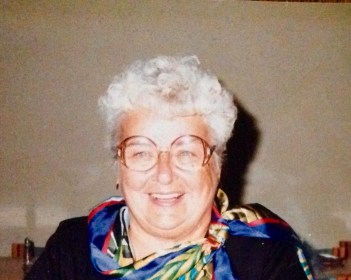
On the one hand, I think it’s wonderful that we stop, take a breath, and think about the impact of all the mothers in our lives. Not just my mom (whom I described at her memorial service as a “great dame”), but also my grandmother, who taught me so much about making room at the table (literally and figuratively) and my mother-in-law, who taught in a rural elementary school to pay her way through the University of Georgia during the Depression.
On the other hand, I think the Hallmark-card, gift-giving, Sunday-brunch side of Mother’s Day can be exhausting, expensive and — yes, I’ll say it — stressful. It’s about expectations, of course, and I’m as guilty as anyone. There were so many years when I was working and hosting a family dinner, buying presents, sending cards, and admittedly also being “feted” by my own kids (the free breakfasts at MacDonald’s really were the best!).
Later, when my kids were away at school and then off launching their adult lives in other cities, a friend expressed regret that they “would not be home for Mother’s Day.” That gave me pause; was she serious? Was it a “coming home” kind of holiday or a “don’t-forget-to-call-Mom-Sunday.” I vote for the latter. Let’s not get crazy about this. (As a mother, I was pretty proud of the fact that my son and daughter were out there succeeding on their own in the world.)
One of the really great things about my mom was that she was more than happy to dial back expectations. I took this lesson to heart. She understood how tough and “unnecessary” (one of her favorite words) some of this “fussing” could be.
Mom had a demanding career running a major department in a hospital. She was very, very good at what she did. She took her responsibilities seriously and often worked weekends and holidays. And she did it starting in the early sixties, when most women did not work outside the home. My dad always backed her up, but I think it was often a somewhat lonely stance. It took years for her friends and family to really understand and appreciate her professionalism. Mom, Dad and I learned years ago how to “bend” a celebration around other circumstances.
Celebrating the mother, not the day
I offered a glimpse into my mom, here, where I talked about her example of a lifelong friendship, and now you know a little about her career. Mom’s experience as a working woman was a huge support to me throughout my working life. She understood the ying and yang between family and work. She understood the pride in a job well done and the flip side, when you were having a truly horrible day.
One of my favorite memories of my mother’s work advice came on just such a day for me. I cannot even remember all that was going wrong, just that my day was totally off the rails and she happened to call me. I was pretty abrupt about what a bad day I was having and she sympathized. “Oh, I’m sorry,” she said, then added, “Maybe you could just crawl under your desk and hide for awhile.”
Looong pause.
We both burst out laughing, and suddenly I had my perspective back. A little Mom wisdom, a little Mom humor, then get back up, put one foot in front of the other, and move on.
I’ve remembered that afternoon call so many times since, especially the laugh that followed. It still makes me smile. Thanks, Mom.
Wishing you a wonderful Mother’s Day and a few quiet moments to remember the mothers in your life.
See you next time.
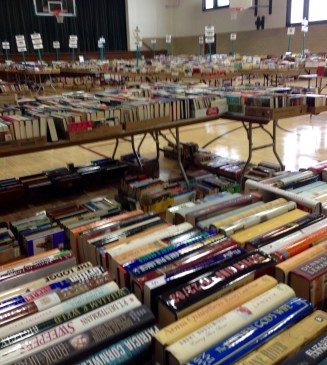 Do you ever have one of those times when disparate things start strangely fitting together in the larger scheme? I’m having a week like that, with amazing women stepping out of the shadows to challenge my thinking.
 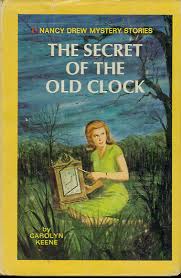 Volume One of the beloved girl detective series, “The Secret of the Old Clock,” was published 87 years ago on April 28, 1930, using the pseudonym Carolyn Keene. The books, ghostwritten by Mildred Wirt Benson and later revised by Harriet Stratemeyer Adams, were “the Depression-era Pokemon cards” says Theodore Johnson in a celebratory
 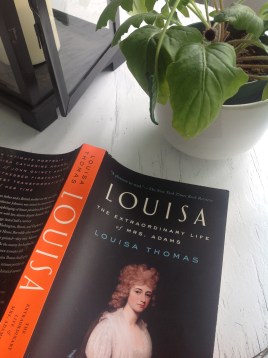 I was connected with yet one more really interesting woman this week.
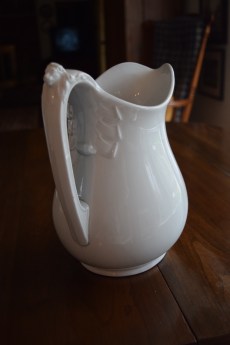
 These nineteenth-century pottery pieces can be chunky (like the large bowl at the left) or delicate (like the brown-stained pitcher), detailed or simple. Some pieces retain their glazed finish, others are crazed and stained. Ironstone lovers accept those imperfections as part of the package.
 Like many collectors, I had this vision of a long line of white pitchers marching across a shelf (or shelves). And then there were my decorating muses, like Mary Emmerling (remember my
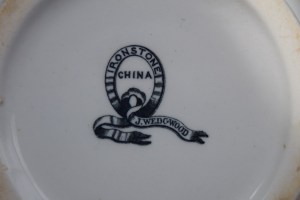 Antique pieces invariably show signs of wear on the bottom, around the top lip of a pitcher or bowl, or the edge of plate. The glaze wears off in places where it was repeatedly handled, maybe set down on a rough surface or pushed aside on a shelf. So those areas feel rougher, and sometimes discolor or even chip. Antique pieces also have a distinct, softer luster. I always check new finds for a manufacturer’s mark on the bottom. (Full disclosure: I do this with all kinds of dishware, a throwback to my days as a giftware buyer.) The mark identifies the maker and often the city and/or country of origin. Contemporary marks are just that — much more modern.

 I have recently come to a de-cluttering decision: I am keeping all of my books.
 It’s been a year since I wrote “Ivy and Ironstone is the name of this blog because neither ‘Antique Silver & Zinnias’ nor ‘Hostas & Transferware’ had the alliterative cachet of ‘Ivy & Ironstone,’ and I am a writer at heart.” That was the introduction to my first
  My kitchen is one of my happy places. I like to cook. I like to eat. I like to read cookbooks and food blogs and try new recipes. And once in awhile I strike what I think of as recipe gold, a dish worthy of adding to our regular repertoire, serving to guests and sharing with friends.

 My gift this Christmas was this mini dessert whip. So much fresher than cream in a can and easier than using the Kitchen Aid to whip cream. With this you add a cup of cream, a little powdered sugar and vanilla, screw down the mini gas canister and presto, change-o you have cream! Okay, there are a few tricks, the first being careful where you aim. (Yes, I sprayed myself with cream in setting up this photo.)




 This blue and orange plate is a more recent find. It’s proof that blue and white transferware rocks the orange/rust shades of autumn. Unfortunately, it has no identifying mark on the back, but it shows significant age.

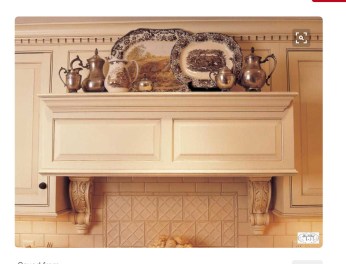
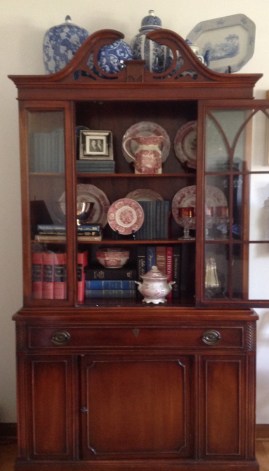 After I snapped this photo of a number of pieces I show off in the living room in my grandmother’s china cabinet, I realized that whether I consciously intended to or not, I continue to channel those photos I’ve saved. Compare this image to the one from Nell Hills at the opening of this post!
 Or, let the good times roll (but it sounds so much better in french!). Fat Tuesday — the culmination of Mardi Gras for the uninitiated — is this week.
  I am cooking up a pot of gumbo and we have a genuine King Cake (Google is a wonderful thing!).
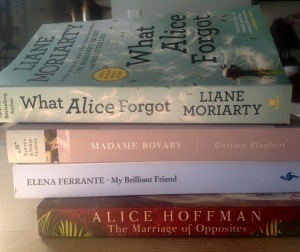 Despite my angst (see my last post
 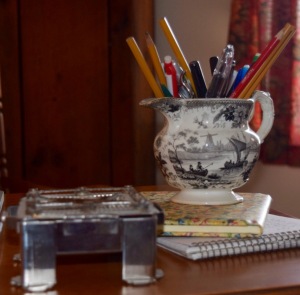 Bullet journaling. Have you heard of this? I read about this first on
  “Victoria,” the new PBS series on Masterpiece. I have already admitted I love history and London (I binge-watched “The Queen”), so I was excited to see “Victoria,” and I have not been disappointed. Though we often think of Queen Victoria as a frumpy dowager dressed in black, mourning the loss of Prince Albert for decades, this is a young, flirtatious Victoria who suddenly finds herself on the throne. And, she is determined to be queen on her terms.
 Last week one of my oldest friends, one I never get to see enough of, suggested we meet in Elmhurst (another Chicago suburb) to check out exhibits at the local art museum and historical society. What a great day she planned for us!

 We both loved this oil on canvas, Best Medicine, by Cassandra Swierenga. Did we like it because it was a familiar medium, great color, a happy, loving moment between a mother and three daughters? Probably all of the above. It seems reminiscent of a time and place you have experienced and hope to again.
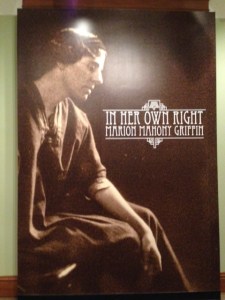 After the art museum, we stopped for lunch at a wonderful restaurant, then walked over to the Elmhurst History Museum to acquaint ourselves with Marion Mahony Griffin (1871-1961), one of the country’s first female architects and a central figure in the Prairie School of Architecture. It’s impossible to overlook the impact of architecture on Chicago, particularly the Prairie School and Frank Lloyd Wright, but Marion Mahony Griffon was a revelation to us.
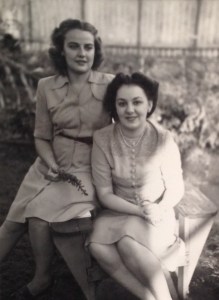 I’ve been thinking abut this post for some time. Last spring I reconnected with two old friends. It made me think about the friendship between my mother and her best friend and what it taught me about friendship.
 Ivy & Ironstone