One book, two pillows, and 500 postcards

I’m really hooked on watercolors. Lately I’’ve filled my sketchbook with dahlias.

Life is such a funny ying and yang.. We have had crews here working on a plumbing issue discovered earlier this summer. The fix was quick but complicated, and so we are now waiting on new flooring in the guest room while that furniture is on sabbatical in the garage. It could be worse. On the plus side, a good friend from my working days will be in town this weekend, and I am really looking forward to catching-up over dinner.

When I wrote about my summer reading here, I totally blew past one of the best reads of the season: Doris Kearns Goodwin’s  An Unfinished Love Story, A Personal History of the 1960s. Goodwin is an historian whose dogged research and deft voice bring history to life for her readers. She won a Pulitzer Prize for Unfinished Love Story, as she did for No Ordinary Time: Franklin and Eleanor Roosevelt: The Homefront in World War II (another favorite of mine). Her other books including Team of Rivals (Abraham Lincoln) and The Bully Pulpit (Teddy Roosevelt) have been equally honored. 

But let me tell you just a little about this book. Goodwin was married to Richard “Dick” Goodwin for forty-two years. About a decade older than Doris, Dick was one of the “bright  young men” that helped get Jack Kennedy elected president in 1960. He named and helped design LBJ’s Great Society and was a speechwriter and close adviser to Robert F. Kennedy. Doris was a White Housed Fellow during the Johnson administration and worked directly for LBJ. Both Dick and Doris lived and worked behind the scenes at the seat of power during some of our country’s most turbulent times, including the Civil Rights movement and the  Vietnam War. The book is part memoir, part biography and part history based on the more than 300 boxes of papers, memos, notes, diaries, and memorabilia Dick had saved over more than five decades of his career. It lends remarkable insight into many memorable public times. This is a wonderful, “inside” look at the events that unfolded and shaped my high school, college, and early adult years. And maybe those of many of you? If you like history, especially an insider’s view, you will enjoy this read.

What was I thinking?
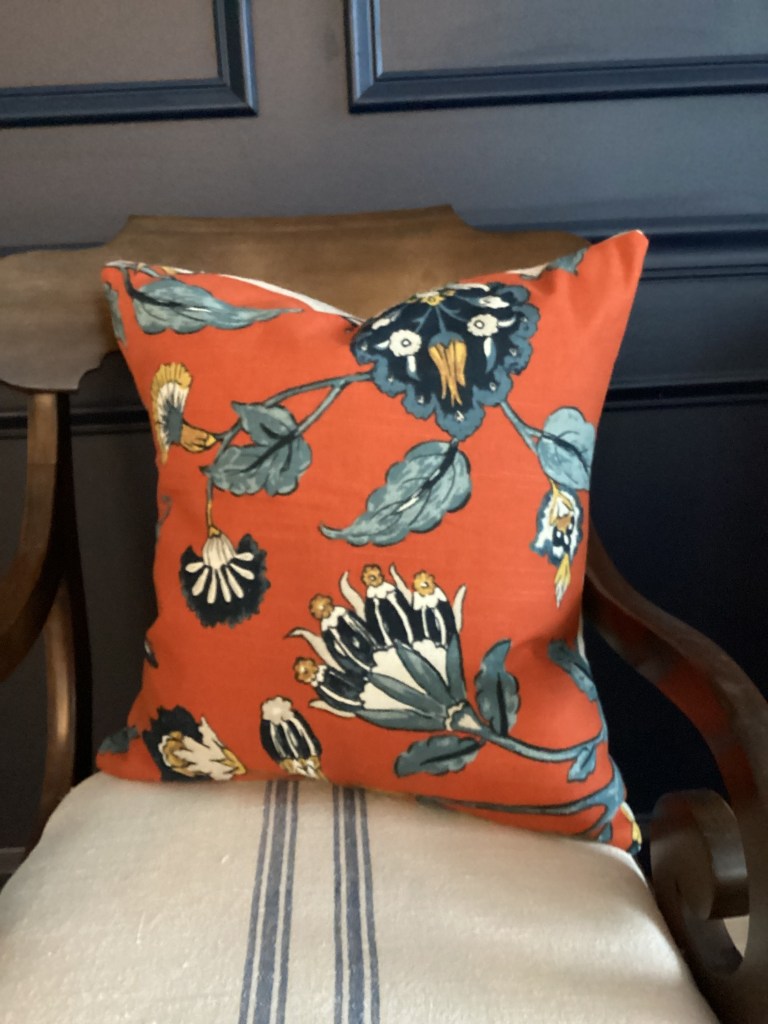
Here’s one of the pillows. See how greets it looks with the navy wall?

Orange is not my favorite color. Not for my house, not for my wardrobe. It feels dated to me, too reminiscent of my mother’s late sixties rust-colored sofa. So, the question is why on earth did I buy these pillows? A few weeks ago, I joined some neighbors in a shopping expedition in search of fall decorative merchandise. I’m not at all sure what I was thinking when I snatched up these very orange pillows. Yes, they are seasonal, which us what I wanted, and, yes, they have that navy print which looks fabulous against the navy accent wall in our great room. ( And truth to tell, I can spot a good navy from 50-feet.)  But they are very orange.

I imagined them on a pair of chairs in the great room, and my neighbor enthusiastically agreed.  What I was not thinking  is that the rug in that room is a very traditional red and navy Turkish design. Trust me when I say red is by far the dominant color .To be fair, there is some green and gold. No orange. 

So then I began thinking about what orange I do have in the house and guess what? There is none, unless you count this blue and white transfer ware plate with some orange flowers, a photo my daughter took in my old garden, and this rooster. That’a it. I have moved the pillows to the sunroom, which is pretty beige. The orange is a nice pop of fall color. And after Halloween I’ll put them away until next fall.  

500 Post cards

This is what 500 postcards look like.

You may recall that I wrote as few posts back about the postcard project, contacting individual registered voters with a personalized, handwritten postcard encouraging them to vote in the coming election. The project provides the  brief, non-partisan message, the postcards, and address lists. “Writers” complete and address the postcards, then mail them on a specific day in mid October. The project does not endorse specific candidates or a party, but it is sponsored by the Progressive Turnout Project whose mission is to rally Democrats to vote. Statistically, the project knows this personal contact significantly improves voter turnout. 

Like a lot of people, I felt helpless this year in the midst of a messy campaign and an election that could completely alter our lives. In fact all of this would give me a monumental headache if I did not feel as though I at least did something. So, I volunteered to write and mail 500 postcards. I finally finished writing & stamping them last week,; and they’ve been mailed on schedule. Whew!

Wishing you plenty of chocolate in this Halloween month and pumpkins in your choice of color. Thanks for stopping by. I hope to see you again soon.

Summer reading

While I have not been blogging this summer, I have been reading furiously and widely, so I have a “something for everyone” kind of book report for you. In fact, it’s a smorgasbord, from history to mystery …Let’s get started. 

Eric Larson takes on the Civil War

Almost twenty years ago my then bookclub read Eric Larson’s Devil in the White City. It was a perfect read for us. We were living in metropolitan Chicago, and the book is based on events surrounding the 1893 World’s Columbian Exposition held in Chicago, focusing on two major characters: Daniel Burnham, a legendary Chicago architect charged with designing and building the fair venue; and H. H, Holmes, a criminal believed to have been the first serial killer in the country. For a lifelong Chicagoan, the streets and people who crossed paths, especially with Burnham, the story really came alive. 

Larson writes about historical events with what i think of as a novelist’s voice; he’s a great storyteller. Each if his works is factual and documented in an extensive appendix. If you like fiction and history, his work is the best of all possible worlds. I have since read Dead Wake, capturing the last ocean crossing of the Lusitania; In the Garden of the Beasts, the story of the American Ambassador to Germany and his family in Berlin from 1933-37 when the city was falling under the spell of Hitler. I also read The Splendid and the Vile, recounting Winston Churchill’s first year as prime minister amidst the initial horror of WWII.

Larson’s most recent book, The Demon of Unrest, details the tensions between North and South in the weeks following Abraham Lincoln’s election in November 1860 and the Confederate attack on Fort Sumter the following April. This book does not have quite the same pseudo-story quality to it. It reads more like a history book, albeit a well-researched one, Demon was a tougher read for me. It focused on the key military players at Fort Sumter as well as in the new Confederacy. Perhaps it was just me, but I had a hard time keeping the various officers and military installations straight. Larson zeroed in on the chivalric code of the South Carolina gentlemen/plantation owners who led the secession charge. (A new angle on the Civil War for me).) Mary Chestnut, a devoted diarist from Charleston who documented much of the activity of the time is the only female with a recurring role.  So, yes, this book suited my nerdy history bent and I’m glad I read it. But I don’t think it stacks up to many of his other titles. 

A favorite reading spot, on the beach on Kiawah Island, South Carolina.

Ruth Reichl as novelist 

Ruth Reichl is a well-known food writer and was the restaurant critic for the New York Times for several years, I first discovered her when I read Save Me the Plums, a biography of her nine-year tenure as editor of Gourmet magazine. Published in the early 2000’s, when my interest in cooking — beyond feeding a family or presenting an appropriate party spread — was seriously piqued. Plums was a fun read, about the challenges of balancing family and career (very familiar) and editing (how I was in fact making a living). I knew she had written other books and I should look them up, but you know how that goes — there’s always another book to read. 

However, earlier this summer, I discovered Reichl’s latest book, The Paris Novel. It sounded light and perhaps a bit fluffy, but the Paris setting intrigued me and after Demon of Unrest I needed something lighter. I downloaded it to my Kindle and promptly devoured it (Pun intended). It was full of familiar Paris landmarks (the heroine lives for a time at Shakespeare and Company!), yummy food, legendary restaurants. It also has an appropriate amount of intrigue, hints of romance and a cast of quirky characters. 

That was so much fun that I staked out an earlier Reichl novel, Delicious!, published in 2014. In it the main character, Wilhemina “Billie” Breslin, takes a  job as assistant to the editor of a prestigious cooking magazine, (Again, food and publishing.) Delicious! (a.k.a. Gourmet? Who knows!) with a quirky staff and housed in a legendary New York mansion. It’s a charming setting until the owners decide to cease publication, fire the staff, and sell the mansion. While the former staff are left to nurse their wounds and find their professional way, Billie is charged with shutting down the substantial archive and library before the building is sold. Along the way she solves a mystery, finds love, and discovers her own food talent. Yes, it’s light and fluffy and what I suspect Reichl does best as a novelist, but like The Paris Novel, it’s wonderful story telling and the food is glorious! 

Have you met the Thursday Murder Club? 

I’m currently working my way through Richard Osman’s four-book (so far) series of mysteries solved by a quartet of septugenarians living in a senior community outside London. The fun begins when four otherwise unlikely friends begin meeting weekly to discuss unsolved crimes and how they would solve them. They are a decidedly quirky group led by the charming Elizabeth, long-since retired from Britain’s famed MI6. Then, a developer working on the expansion of their community is found dead, and the Thursday Murder Club sets out to find the killer. They drag reluctant family members and a local police detective into their quest.

I’ve finished book two (a diamond heist) and am well into book 3. Caution: You really need to start with book one and read them in order. Characters come and go at this age, relationships blossom and fade.. 

Reading this I realize that I have gone from an historic book (or paper weight depending on how you view it) to romance to a totally unexpected group of mostly amateur sleuths. Something for the many moods of a reader.   And I that’s one of the joys of reading — there is always something appropriate to your mood or the moment.

I hope your summer is ending on a note of grace; I’ll be happy with cooler temperatures. Thank you for reading this “book report.” I’ll see you again next time!

Recent reads: all about the women

I am embarrassed to realize that my last post was months ago. I suppose the blog police could get after me, but the truth is I really needed a sabbatical. My broken wrist took longer than I expected to heal (which I’m sure says something about my age ) and the cough and cold virus that had plagued the area all fall eventually caught up with me, compounded by a mild case of Covid and another run at the cough. I was this close to being a “frequent flyer” at Urgent Care before the virus finally left. But…

I’m diving back into the blog with some recent reads. 

Have you ever noticed that sometimes your reading seems to inadvertently fall into a pattern? Three recent reads by my neighborhood book club have done just that, and I don’t think it was at all planned. 

None of This Is True by Lisa Jewell starts with the unlikely meeting of plain, quiet Josie and effervescent podcaster Alix as they each celebrate their 45th birthday on the same day in the same restaurant. It seems at first as though Josie has a crush on the glamorous Alix. Despite their many differences, she works herself into Alix’s life, then conspires to be the subject of Alix’s next podcast series. As Alix struggles with her husband’s growing alcohol addiction, she also begins to question Josie’s murky family situation. But Josie is great material for Alix’s podcast — until she becomes physically threatening. Some of this storyline was increasingly hard to read, as violence and possible pedophilia worked their way into the story, but Jewell handles psychological thrillers well. I won’t reveal the stunning ending, which includes a series of crimes and revelations, but it was hard to stop reading. 

Our next read was The Silent Wife by Kerry Fisher. This story is told from two points of view — Maggie and Lara — in alternating chapters. In some respects their lives are very similar. They are the second wives of brothers, each parenting a troubled child. But there are differences — Maggie is a working class woman married to Nico, who lost his first wife to cancer a few years ago. Maggie is struggling to develop a relationship with his still-grieving daughter and live up to his late wife’s reputation as “the perfect woman.” Massimo divorced his first wife who didn’t want a family to marry Lara, who is determined to be the perfect wife and mother.  If this sounds a little soap-opera-ish, it should. Despite likable characters (especially Maggie’s plain-spoken “Mum”), the fact that they are neighbors living across the street from Nico and Massimo’s controlling mother (and able to jet off to an Italian villa for annual vacations), secrets like adultery, an illegitimate child, and financial hi-jinks make the storyline less than credible. I read to the end because I wanted to see how Fisher was going to resolve all this, but don’t confuse this with a critical success. 

Trust by `Hernan Diaz tells the story — from four different points of view — of (1) the life of Andrew Bevel, a financial baron during the 1929 stock market crash, then (2) his attempt to write his own story, then (3) his secretary’s memoir, and finally, (4) the journal left by his deceased wife, Mildred. If this sounds a little confusing, it is until you get the narrators straight in your head. Each version puts a different spin on the story of Bevel’s great wealth: how he got i9t and how he used it. The title “Trust”implies a lot: financial stability, faith in financial markets, and, perhaps most importantly, trust as in truth. Each telling of the Bevel story peels back another layer of skin (and cover-up), leaving the reader in a totally different place at the end. Critics call this a literary and a financial mystery and it is. And the evolving role of Bevel’s wife is pivotal.  

If Trust minimized a woman’s role to the point of erasing her history, The Women  by Kristen Hannah celebrates the untold but harrowing story of army nurses in the Vietnam War. Let me start by saying I am not among the legions of Hannah’s fans. I read her WWII novel, The Nightingale, and I thought it was good but for me it had a bit of the “magical thinking” of a romance novel. (I freely admit that no one else I know agrees with this observation.) I also read The Four Winds about Elsa Martinelli and her two children escaping the Dust Bowl of the 1930’s and their harrowing travels to California. I realize Elsa was impossibly challenged by her missing husband and the masculine dominance of that world; I just think John Steinbeck wrote the ultimate Dust Bowl novel in The Grapes of Wrath. I’m not sure it needed to be re-told. 

On the other hand, The Women, which begins with a young, painfully naive Frankie McGrath on the beach on Coronado Island (a romantic setting to be sure), then drops her into an army field hospital in Vietnam where she learns surgical nursing literally under fire. The unspeakable working conditions — including enemy fire and round-the-clock surgery sessions — along with the devastating injuries suffered by the soldiers, are just one part of her Vietnam story. There were also the nurses and surgeons she loved and lived with, the pilots who delivered casualty after casualty, and those who survived and those who died. And that’s just the first half of Frankie’s story.

After two tours in Vietnam she came home to a country — as  did all the other vets — that was so tired and discouraged by the war, it simply turned its back. When crippling flashbacks and nightmares made work impossible and alcohol and drugs became her escape, Frankie looked to various veterans organizations for help only to learn that they insisted no women served in Vietnam. This is the heartbreaking story we have heard from Vietnam vets for decades, but I don’t think we have heard it from a female perspective. It is, however, the heart of this novel. Vietnam was a prelude. The second half of the book was tough to read. Despite her best efforts, Frankie’s life spiraled out of control more than once. 

Hannah says she had the idea for this book years ago, but simply felt her writing was just not mature enough to tackle it.I believe her. Am I a convert to her fan club? I’m not sure. There were some elements reminiscent of the romance genre (i.e., rescues courtesy of a handsome doctor or pilot), but I it’s a good read — if you can get past the blood & guts. And it’s a heartbreaking up-close and personal look at a seminal time in American history, one we have yet to truly resolve. Hannah really did her research.

I’;d love to know if you have read any of these and if so what you thought. In the meantime, my to-be-read list continues to grow. I have added The Sweetness of Water, The Soul of America, and The Heaven and Earth Grocery Store to name a few. What about you? What’s on your list? 

Thank you so much for stopping by and staying to read. I appreciate your support so much.

So many books & a break

Lately I’ve been holding on to the last glorious days of Fall before launching into the traditional holiday mayhem. I realize that commerce depends on sales depends on inspiring us to buy and make for the celebration ahead, but this has been — at least so far — a beautiful blue-sky November. And I for one love
Thanksgiving — just family and friends around the table
. In fact, this year I could say I’m thankful for a month or more of good reads.

I  recently finished Ann Patchett’s Tom Lake. What a great book! Read it when it comes your way. First, the obvious: Tom Lake is a place not a person. When Lara’s three adult daughters return to the family farm to wait out the pandemic, they convince Lara to tell them the story of her fling at Hollywood stardom, a run on Broadway, her romance with a handsome matinee idol and how she came to marry their father and live on an orchard in Michigan. As if those points of interest aren’t enough, Thornton Wilder’s classic play, Our Town, has a recurring role. Sound good? It is. 

Ann Patchett never lets readers down. If you read The Dutch House (a finalist for the Pulitzer Prize) you know how adept she is at crafting a family saga spanning decades. When I read Bel Canto (winner of the PEN/Faulkner Award) I was frustrated as the story began to drag — until I realized the hostages felt the same as their isolation dragged on .  

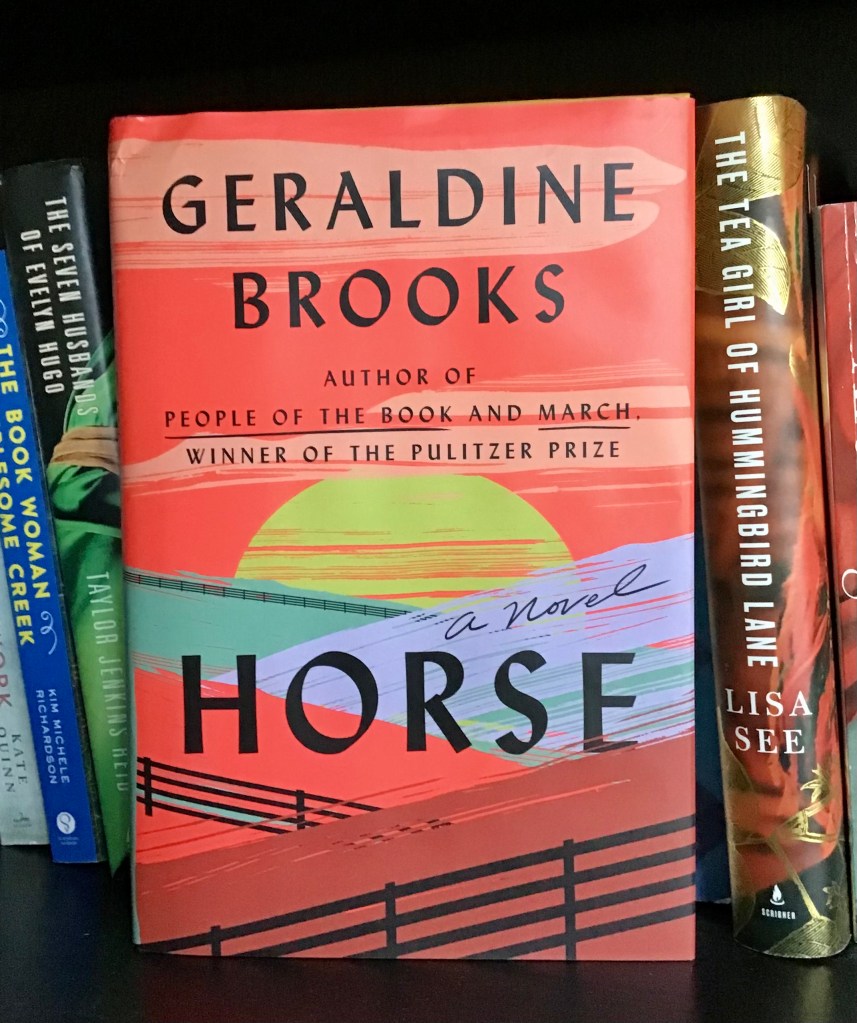
After Tom Lake, I dove into Horse by Geraldine Brooks. This story moves between centuries, from pre-Civil War horse-racing in the slave-holding South to a paleontologist and an art historian at the Smithsonian today. So many moving parts but they are all fitting together (and I’m only about 80% done!). Geraldine Books draws on real people and events in the South to illustrate the world of wealthy, white landowners and enslaved African American trainers. In doing so she illustrates a new view — at least to me — of history and southern culture.

Along the way, I also read Beatriz Williams’ The Beach at Summerly, which starts out as a kind of rich boy/poor girl romance on an exclusive island, but then turns into a plot to capture a spy (who also happens to be a war widow and single mother) passing American military secrets to Russia. Set in the years just after World War II, Summerly is loosely based on real events as the Cold War was taking shape. 

Williams is a thoughtful and entertaining author, who plucks a real life story from the past snd turns it into historical fiction. You may recall I read — and recommended — The Golden Hour here about a newly widowed writer sent to the Bahamas in 1941 to cover the Duke snd Duchess of Windsor. Williams is the bestselling author of Our Woman in Moscow, The Summer Wives, Her Last FlightThe Secret Life of Violet Grant, A Hundred Summers. She has also written a handful of collaborations with Karen White and Lauren Willig. I’m looking forward to going back to her booklist sooner rather than later. 

But wait, there’s more …

The neighborhood book group read Things We Cannot Say by Kelly Rimmer and with it I think I hit my limit on books about women behind the lines in World War II. It’s not that I’m just burned out on this topic (although so many current novels are set then), I just thought it was poorly written. The protagonist was way too naive to be believable as a teenager in Nazi-occupied Poland. Even the language seemed out of step with the time. For example, Rimmer describes the protagonist hurrying to a secret meeting with  her beau, surrounded by the enemy, as “jogging” up a hill. Was “jogging” even a term in 1939 Poland? I certainly don’t think it describes how she would be moving. It just didn’t ring true to me and at least one other member of our group agreed. I actually gave myself permission to stop reading it and move on. Do you ever do that? 

There is, however, a book selection lesson here. It’s fun to read something current, a book that has a buzz. And while I think the recommendations of Oprah, Reese and Jenna Bush Hager are often great, it pays at least sometimes to search out the reviews of literary critics and other authors. Should we limit our reading to what the talk is on social media or should we lean further into the world of publishing? 

Okay, I’ll get off my soapbox and explain my reading binge. 

I broke my wrist.

And this is so totally corny — I broke it playing pickleball! I was reaching for a backhand and toppled sideways. My husband pointed out that as falls go, it wasn’t much. I was a little rattled and sat down for a few minutes, but then I got back in for the next game. Fortunately, it was a quick game because I realized I could not get my fingers to work picking up the ball for serving. So the games broke up and we walked home and took a look at my arm which was now swelling — a lot. You can imagine what came next: Urgent Care, X-rays, a splint, an orthopedist, a soft cast and a lot of Tylenol. 

The resulting temporary handicap explains why I have had so much time to read. I am a one-armed wonder, forbidden to drive with a cast on and unable to cook. In fact dressing myself and drying my hair take significant planning, not to mention wrapping my cast in a plastic bag so I can shower. And all of this is soooo booring.

Thanksgiving is looming and this one-handed blogger may not get another chance to wish you a happy and indeed very thankful day. Lately the news is grim and the headlines are bleak. This is the time to hug family and friends a little harder and count our blessings. And you, dear readers, are the best of blessings.

Thank you for reading along. See you again soon.

To be like the Queen

I suppose it helps to have dressers and ladies-in-waiting, but she looks so pretty and perky here.

Have you been watching the reports from Scotland & London on the farewells to the Queen? I can’t tear myself away. I know it sounds a bit silly, but it’s such a slice of history. (And I am an avowed history nerd.) On one hand, so much pomp and circumstance, on the other tradition. And monarchs in the United Kingdom are one of the oldest of traditions. 

I haven’t always been a huge fan of Queen Elizabeth. She often sounds very stiff and formal, and for years she toed the most conservative line about marriage and divorce, well after society had clearly moved on. But, we soften with age. The Queen sure did, and I guess I have too. 

Queen Elizabeth’s life was pretty much unlike any other and probably not what she would have chosen, but there she was, at the center of history. Can you imagine a weekly meeting with Winston Churchill when you’ve just assumed a new job? Trying to sum up the Queen’s ninety-six years in just a few words, even a few paragraphs, is impossible. And all kinds of really smart people have been doing it beautifully for the last several days. Look them up.

So, yes, when I grow up and grow old — like into my nineties — I’d like to be like the Queen. I’d like to be stylish and wear pretty colors and matching hats. I’d like to still be wearing lipstick to highlight an impish smile. I’d like to be current with what’s happening in the world. I’d like to have a cheeky sense of humor a la James Bond and Paddington Bear. I’d like to savor the antics of my children, grandchildren and great grandchildren. And I’d like to still have my prince at my side to share it all.  

It’s not about the crown or the jewels, the power or the palaces (although given the choice I would likely choose palaces over all of the above). I would just love to be the ninety-six-year old matriarch sharp enough to be current with what’s happening in the world and wise enough to view it from an historic perspective. I would like to be gracious enough to privately manage familial trials, failing health, and whatever other ill winds blow. In essence, that’s keeping the proverbial stiff upper lip. 

So now that I’ve written this all down in black and white, so to speak, I have to wonder: Am I asking too much? I hope not. I’m sure going to try.

Thank you so much for stopping by. I hope I see you again here soon,. 

It begins with a trip to the museum…

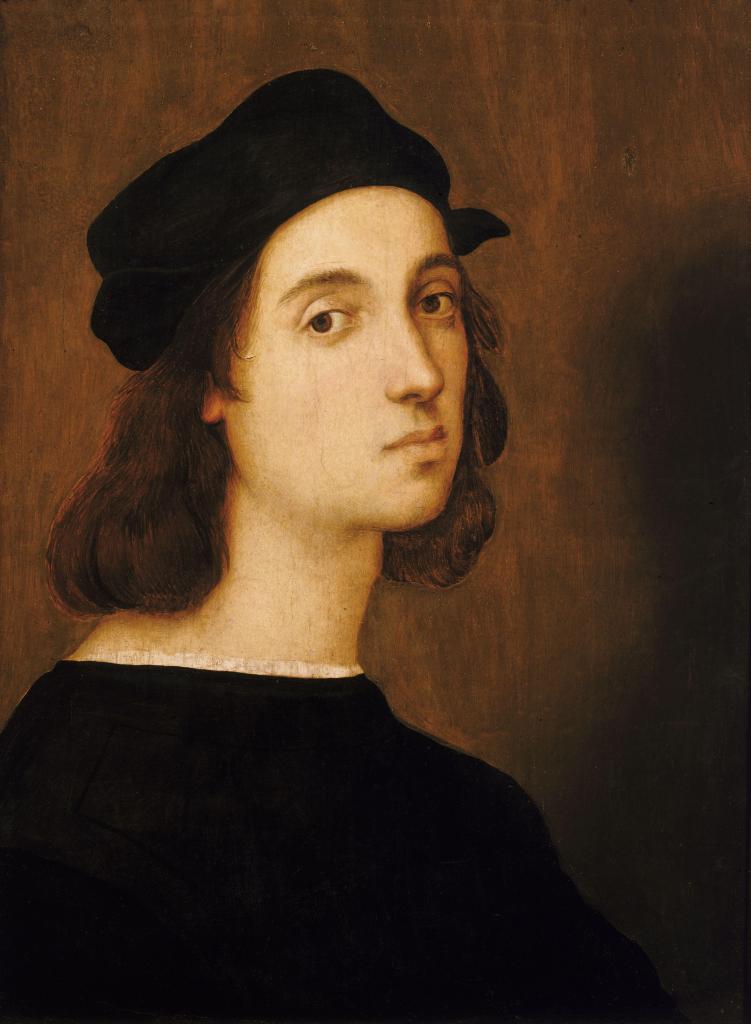
Rapgaello Sanzio

Last week we took a cultural field trip, visiting the Columbus Museum of Art to view the Dresden Tapestries, based on cartoons by Raphael in 1515-16 and commissioned by Pope Leo X to hang in the Vatican’s Sistine Chapel. Although we had seen tapestries in French chateaux and other European museums, this was our first opportunity to get a little closer and to learn more about how they are made. The bottom line: they are really art times two, the artist’s initial cartoon and the fiber art of the tapestry produced from it.

What is a tapestry?

The more intimate setting of the Columbus museum and the quiet weekday timing offered a perfect opportunity to view the tapestries more closely. A docent gave the group we were with a basic overview of tapestry weaving as well as the history of these particular pieces. Tapestries are a unique fabric art, woven to portray a scene, story or event, often biblical or historic. These tapestries focus on the ministries of Saints Peter and Paul. But more about that later. 

This is the cartoon by Raphael for the tapestry “Christ’s Charge to Peter.” This is just one in a series of ten cartoons.

In essence the tapestry subject is a woven copy of a drawing (known as a cartoon) created by an artist. Tapestries are painstakingly handwoven — most often by European workshops specializing in this art form — with the design on one side of the fabric. To do this, the cartoon is copied (by hand!) and the copy laid face-down on the fabric. The finished tapestry becomes a complete reverse of the original cartoon. The cartoons for the original set of these tapestries were sent to Brussels to be woven in the workshop of Pier van Aelst. They were probably completed in 1520.

About the Raphael tapestries

My knowledge of Raphael was pretty sketchy, so after the museum visit I delved a little more into his life and his role in the Renaissance art world (Of course, it would have been even better if I’d done this homework first!). Along with Michelangelo and Leonardo da Vinci, Raphael is considered one of the three architects of the High Renaissance, a period from as early as 1495 to as late as 1530 of exceptional artistic accomplishment in Rome and Florence, Italy.

Artistic temperaments played a part in Renaissance art. Historians point out that Michelangelo was no fan of Raphael and openly critical of his work. Raphael was generally thought to be more agreeable and charming, traits that may have played a part in his success in acquiring significant commissions. In developing the cartoons for this series of tapestries, Raphael was very aware that they would be in close proximity to Michelangelo’s famous ceiling in the Sistine Chapel; however, the subject matter — Christ turning over the church to Peter and Paul — was different.

Like many artists, Raphael got an early start; his father was a court painter and Raphael was apprenticed at a young age to another master. After time spent elsewhere in Italy, he found his way first to Florence and eventually to Rome. His reputation firmly established, one biographer noted that Raphael had a workshop of fifty pupils and assistants, many of whom later became significant artists in their own right. This was arguably the largest workshop team under any single master painter. The workshop included masters from other parts of Italy, probably working with their own teams as sub-contractors, as well as pupils and journeymen. There is little evidence of the internal working arrangements of the workshop, but this was the artistic custom of that time. Raphael died quite young (at age 37 in 1520). He is perhaps best known for the frescoed Raphael Rooms in the Sistine Chapel. The series of 10 cartoons for tapestries representing the lives of Saint Peter and Saint Paul was commissioned by Pope Leo X in about 1516. 

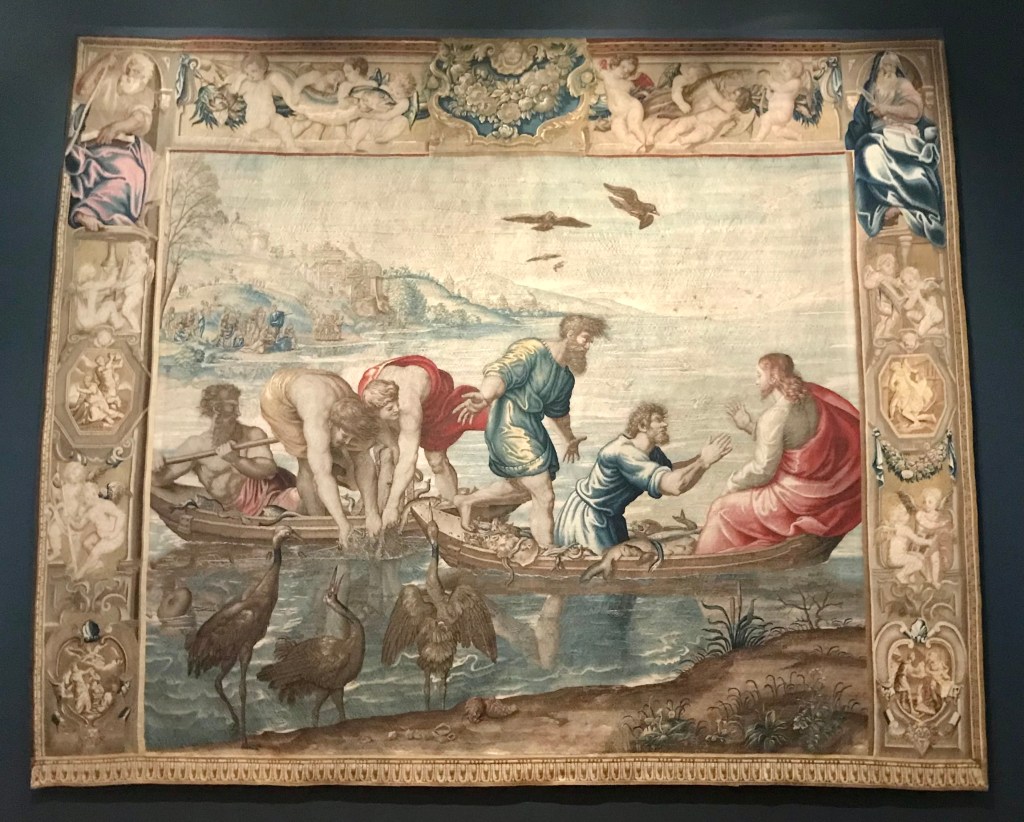
“The Miraculous Draught of Fishes.” Like all the tapestries in this series, the subjects refer to Christ turning the church h over to Peter and Paul.

The Dresden tapestries are one of numerous sets woven from these cartoons after Raphael’s death. Seven of Raphael’s original 10 cartoons for the series have survived and are now in the Victoria and Albert Museum in London. The tapestries woven for the Vatican no longer hang in the Sistine Chapel but are displayed on a rotating basis in the Vatican Museum. They returned briefly to the Sistine Chapel in 2020 in honor of the 500th anniversary of the artist’s death.

This is the cartoon for the tapestry above. Note the images are reversed.

The impact of the tapestries and Raphael in the art world is evident in the second part of the exhibition, which includes drawings by Raphael that were studies for his cartoons. Numerous other works—paintings, prints, drawings, and sculpture—were created by artists influenced by Raphael’s designs. The artist’s style and in some cases entire images were lifted from the much larger tapestries to become art on their own or to be worked into other pieces. Noted renaissance and baroque masters such as Rubens and Poussin are among the artists who incorporated Raphael’s work into their own.

The Columbus exhibit is comprised of six works from the duplicates ordered by the Prince of Wales (later King Charles I) about 100 years after Raphael’s death. (Here’s where the world history kicks in.) They were produced by tapestry makers in Mortlake, England. Augustus the Strong, elector of Saxony and king of Poland, brought the tapestries to Dresden, Germany in the 18th century. The tapestries were restored in the late 20th and early 21st century. The Columbus exhibition is the first time they have been displayed outside Europe. 

Two lessons in one

I think I always looked at tapestries as works of art, but certainly without appreciating the entire process. First, the artist creating the cartoon has to plan the scene, starting with a series of rough sketches that are refined into final drawings to be included in the cartoon. These are huge works with significant detail and background scenery. This is where the other artists in the master’s workshop came into their own, copying the master artist’s style and intent. This is the first art lesson. The artistry of the tapestry weavers is the second lesson. Perhaps time for more research?

I don’t know about you, but I love when a “field trip” of some sort sets me off on subsequent pursuits. I’d like to know more about the lives of Raphael and Michelangelo. Can you imagine these men elbowing their way for favor among the papal and royal interests of their day? I know Francis I lured Leonardo da Vinci to his chateau in Amboise, France, where da Vinci (and the Mona Lisa) remained until his death. What story lines would you pursue?

Thank you so much for stopping by for my impromptu art history class. See you again soon!

Guns & fireworks

This week, on our first July 4th in Ohio, I was feeling a little nostalgic. For most of our 40 years in Wheaton we celebrated the 4th at least in part with the community’s traditional, homegrown parade, which always began with a few dozen firetrucks blasting their sirens and waving to the crowds. Then came the local politicos, the high school band, the boy scouts and girl scouts. The local VFW usually showed up, as did the Shriners in their mini race cars and Uncle Sam on stilts handing out candy.

For several years, beginning when my son was a toddler and my daughter a newborn, we attended the parade with a handful of neighborhood families, always gathering on the same corner. As with all things, time marched on. The kids grew up. Some of us moved away. But these memories remain a part of the fabric of our family.

Yesterday, on our way home from our first July 4th celebration in Ohio, I heard what had happened in one of those other Illinois communities, hosting their Independence Day parade. A young gunman sat atop a downtown building and used a powerful weapon of war to shoot and kill at least six parade attendees and injure more than two dozen more.

Please re-read that last sentence. I can hardly believe it. What have we come to?

This isn’t just about Illinois or the 4th of July. In days, it seems, we have moved from Buffalo, New York, to Uvalde, Texas, to Highland Park, Illinois. How did a mass killing we once would have thought of as a frightening aberration become a weekly occurrence?

If you have followed this blog at all, you know it isn’t political (Okay, sometimes personal bias does seep in.). It’s books and cooking, decorating and some travel. But the reality is too heartbreaking to ignore. Thoughts and prayers are not enough. We must also admit that recent legislation, though well-intentioned, would not have stopped this shooter. (Another heartbreak — finally one step forward and now back again.) How does this country separate our fundamental belief in a militia from this love affair with weapons of war?

What will become of us if we don’t?

I have no answers, but I believe it’s time to put my money where my mouth is (my vote is already there) and now I’m lending my modest financial support to Everytown for Gun Safety. You might want to check them out. And thanks to Julie at Creating This
Life
for suggesting it.

I’d love to hear your thoughts on this. And thanks for listening.

June reading: history, mystery & gossip

 Wow! How did it get to be almost-July already? For me, June begins like a sweet promise — long, sunny days strung out for months. Then that image is interrupted by the flash, sparkle, and bang of July. It’s hotter, and the beach seems like a really good idea, but if you don’t act fast August is here and summer is waning. It’s back-to-school time and hay fever. Yikes! I’m making myself older just sitting here on my laptop. 

Forget the calendar, what I really meant to report on today are some books I’ve read over the last several weeks. My reading life has finally moved on from a seemingly endless stream of Stephanie Plum mysteries. I was just digging into London: The Novel by Edward Rutherford (a slow start but it does get better) when I was side-tracked by Tina Brown’s The Palace Papers. The hoopla surrounding the Queen’s Jubilee got me started on this. (I’m a sucker for the Queen, the rest of the royals not so much.) I’ll be honest — it begins with Camilla and Diana and ends with Kate and Megan. And the Queen is always at the center because, well, she is the Queen. Charles, Andrew, William and Harry play their respective parts, because no soap opera is complete without the men.  There is definitely a soap opera quality to the book. 

Brown draws from credible sources, though she rarely ever names them relying instead on her reputation as a journalist. What did I glean from this besides a lot of juicy gossip? First, power is everything in royal circles. If you have it, you need to keep it; if you have no power, you need to find some. It’s pretty simple. Second, a lot of this power is granted to secretaries, schedulers and PR teams (and, yes, everyone has one of them too). In fact it seems the royals often communicate via secretary to secretary. And if you have ever played telephone, you know how that goes. What a complicated life!

After that read I needed a bit of a palate-cleanser, so I picked up A Flicker in the Dark by Stacy Willingham. My daughter-in-law gave me this book for Christmas, along with a membership to the Book-of-the-Month Club, but then I got so focused on moving I put it aside. It was the perfect read! The story focuses on Chloe Davis, whose father was jailed 20 years earlier for a series of murders of young, teen-age girls. Now, after two decades and just as Chloe is about to marry, two more young women die in the same way. Chloe is oddly connected to these victims and forced to revisit the earlier murders to resolve the current ones and clear her own name. Solving the crime isn’t simple, and the mystery takes a number of twists and turns. I thought the unexpected ending was a stunner — when I finally got there. If you love a good mystery, this is for you. 

Looking ahead, this is my to-be-read stack, above. I’m really looking forward to This Tender Land by William Kent Kruger. I read and loved his earlier novel, Ordinary Grace, more than a few years ago. It’s one of those books that just stays with you. Read it if you can. My daughter gave me The Book of Longings by Sue Monk Kidd. It’s one of her recent favorites. We both loved The Invention of Wings, also by Kidd. Finally, I’m looking forward to All That She Carried by Tiya Miles, a true story of an enslaved woman in 1850’s South Carolina and the bag she prepared for her nine-year-old daughter before they were separated. The bag continued to be shared thru subsequent generations. This may not be a “summer read,” but I’m looking forward to it. 

And that’s my summer reading plan for now. How about you? Any recommendations?

I’m so glad you stopped by & wish you a star-spangled July 4th holiday. 

See you again soon. 

A day at the (art) museum

BisaDetailHi. Before I say another word, I need to apologize for my last post. “Good Stuff” probably arrived in your inbox riddled with typos and crazy mixed up type. I can’t believe this happened, but I hit publish instead of review. And out it went. I’m so embarrassed. I realized my mistake immediately, but it was too late. I did clean up the mess on my website, so if you read the post at ivyandironstone.com, you saw the corrected version. 
On with today’s post. I’m so excited to share this. 

Earlier this week I met two of my best-ever friends (the kind from the first day of high school!) downtown at Chicago’s Art Institute. Our goal was to see the Obama presidential portraits and then hopefully take in another exhibit on quilts. It turned out to be quite a day. 

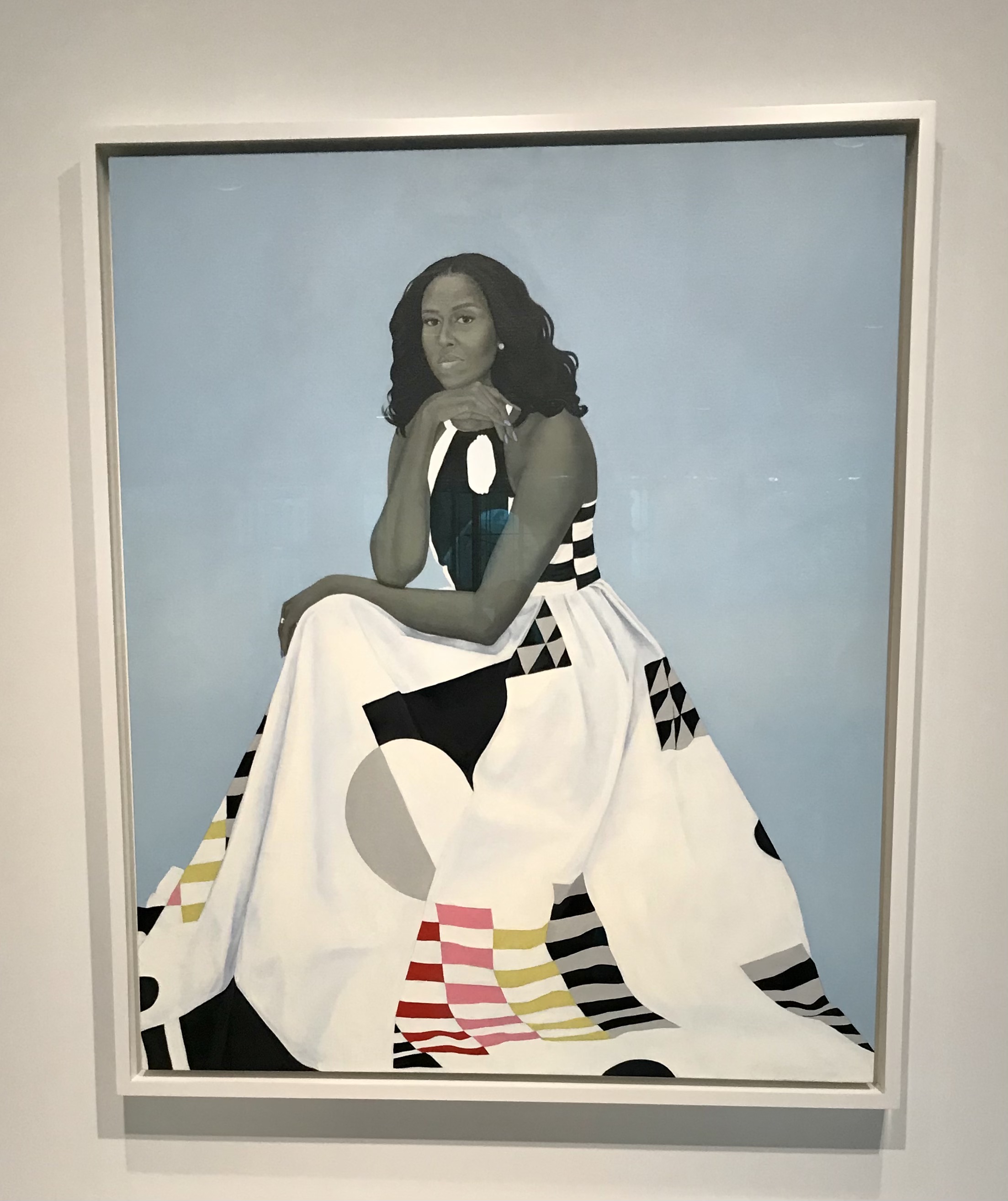
The Obama portraits were more interesting in person that we expected. Like us, you have probably already seen them in the media. They are not typical presidential portraits. The artists — Kehinde Wiley for former President Barrack Obama and Amy Sherald for former First Lady Michele Obama — are the first African Americans commissioned by the National Portrait Gallery to create official portraits of a president or first lady.  

Mr. Obama’s pose was familiar — seated, leaning forward with his elbows on his knees, as if he’s ready to engage with the viewer. The portrait is really large, commanding even, and maybe a little imposing. I’ve been curious about the leafy background since the painting was revealed. The artist used it to work in flowers representative of places in the president’s life, including Chicago, Hawaii, and his father’s native Africa.

IMG_2361

Mrs. Obama’s portrait is also non-traditional. I imagine most viewers are initially struck by her gray skin, a trademark of the artist. According to the Art Institute, Sherald  does this “as a nod to these historical photographs and a reminder of the relative absence of African Americans in the history of painted portraits, but also to relieve her subjects from the internal and external limits imposed by the construct of race.” Interesting, huh? The hair, the expression, and the African-inspired fabric of her dress are all very much Michelle Obama. And purposeful. Interestingly, the background on her portrait is just blue. The blank but colorful background is another hallmark of artist Sherald.

IMG_2363

Chicago was just the first stop for these portraits.  They’re traveling on to the Brooklyn Museum, Los Angeles County Museum of Art, High Museum of Art, and the Museum of Fine Arts, Houston.

Bisa Butler’s portrait quilts

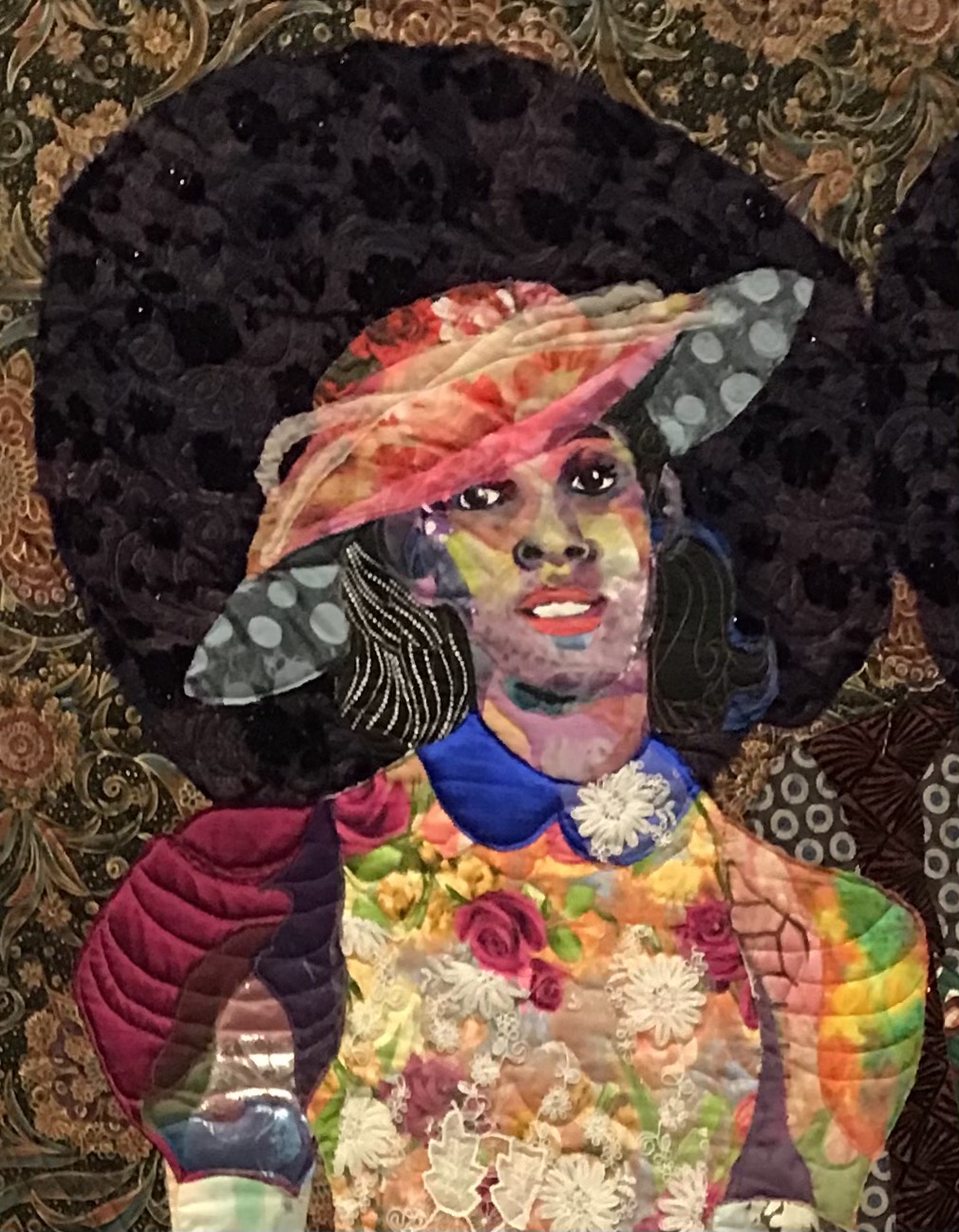
I’m not sure what we expected from this exhibit, but it wasn’t close to as extraordinary as these quilts proved to be. Artist Bisa Butler constructs her quilt portraits from bits and pieces of fabric, from the finest details of a facial expression to the puffiest sleeve on a dress. I tried to show some of the detail in the first photo, above. 

Although each work is strictly fabric, she approaches each piece as she would a painting, often working from a found photograph and selecting fabrics as an artist selects paint pigments. Butler incorporates kente cloth and wax-printed African fabrics in her quilts, using bright jewel tones rather than more traditional shades to depict skin tones. She believes this conveys the emotions of her subjects —who may be everyday people or historical figures. Look at the range of expression on the faces of the children in this quilt, Safety Patrol, which opened the exhibit (and knocked our socks off from the start.). 

IMG_2366

This quilt is based on an old photograph. The tulle on the hats is a three-dimensional addition. I love how naturally the women are posed.

IMG_2372

We were struck by the detail on the mother’s dress. Once again, the pose is so natural. Look st Dad, holding his daughter still

IMG_2370

I love the fabric layering and detail in each quilt and the remarkably life-like poses. (Look at the feet in each quilt!) I have always considered quilting as a precious part of our American heritage: a necessity for frugal homemakers to use what they had and an evolving craft reflecting historical moments as well as an art form. Bisa Butler’s work redefines the medium.  I’ve spent a lot of time studying these images, trying to grasp both her vision as she approaches each quilt and then the skill and artistry to select and assemble the fabrics.

That’s all I have right now. I hope you are having a good week. Thanks for stopping by and I’ll see you again soon.