Lately I’ve been holding on to the last glorious days of Fall before launching into the traditional holiday mayhem. I realize that commerce depends on sales depends on inspiring us to buy and make for the celebration ahead, but this has been — at least so far — a beautiful blue-sky November. And I for one love
Thanksgiving — just family and friends around the table. In fact, this year I could say I’m thankful for a month or more of good reads.
I recently finished Ann Patchett’s Tom Lake. What a great book! Read it when it comes your way. First, the obvious: Tom Lake is a place not a person. When Lara’s three adult daughters return to the family farm to wait out the pandemic, they convince Lara to tell them the story of her fling at Hollywood stardom, a run on Broadway, her romance with a handsome matinee idol and how she came to marry their father and live on an orchard in Michigan. As if those points of interest aren’t enough, Thornton Wilder’s classic play, Our Town, has a recurring role. Sound good? It is.
Ann Patchett never lets readers down. If you read The Dutch House (a finalist for the Pulitzer Prize) you know how adept she is at crafting a family saga spanning decades. When I read Bel Canto (winner of the PEN/Faulkner Award) I was frustrated as the story began to drag — until I realized the hostages felt the same as their isolation dragged on .
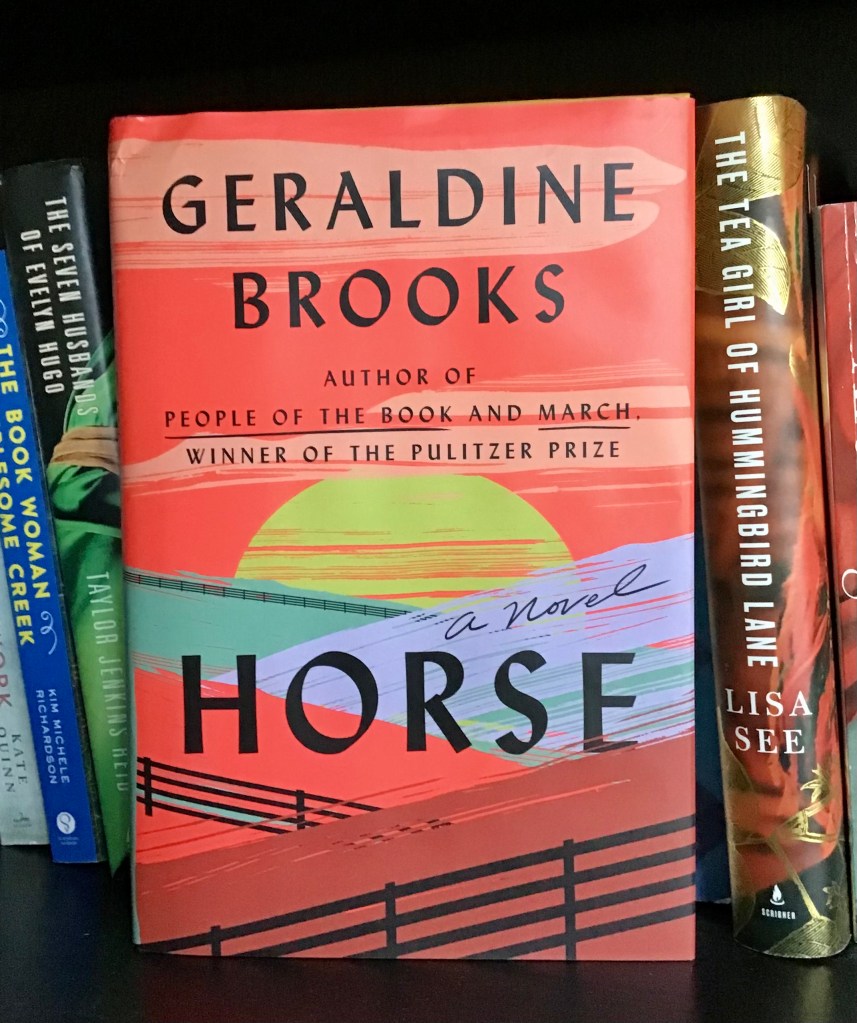
After Tom Lake, I dove into Horse by Geraldine Brooks. This story moves between centuries, from pre-Civil War horse-racing in the slave-holding South to a paleontologist and an art historian at the Smithsonian today. So many moving parts but they are all fitting together (and I’m only about 80% done!). Geraldine Books draws on real people and events in the South to illustrate the world of wealthy, white landowners and enslaved African American trainers. In doing so she illustrates a new view — at least to me — of history and southern culture.
Along the way, I also read Beatriz Williams’ The Beach at Summerly, which starts out as a kind of rich boy/poor girl romance on an exclusive island, but then turns into a plot to capture a spy (who also happens to be a war widow and single mother) passing American military secrets to Russia. Set in the years just after World War II, Summerly is loosely based on real events as the Cold War was taking shape.
Williams is a thoughtful and entertaining author, who plucks a real life story from the past snd turns it into historical fiction. You may recall I read — and recommended — The Golden Hour here about a newly widowed writer sent to the Bahamas in 1941 to cover the Duke snd Duchess of Windsor. Williams is the bestselling author of Our Woman in Moscow, The Summer Wives, Her Last Flight, The Secret Life of Violet Grant, A Hundred Summers. She has also written a handful of collaborations with Karen White and Lauren Willig. I’m looking forward to going back to her booklist sooner rather than later.
But wait, there’s more …
The neighborhood book group read Things We Cannot Say by Kelly Rimmer and with it I think I hit my limit on books about women behind the lines in World War II. It’s not that I’m just burned out on this topic (although so many current novels are set then), I just thought it was poorly written. The protagonist was way too naive to be believable as a teenager in Nazi-occupied Poland. Even the language seemed out of step with the time. For example, Rimmer describes the protagonist hurrying to a secret meeting with her beau, surrounded by the enemy, as “jogging” up a hill. Was “jogging” even a term in 1939 Poland? I certainly don’t think it describes how she would be moving. It just didn’t ring true to me and at least one other member of our group agreed. I actually gave myself permission to stop reading it and move on. Do you ever do that?
There is, however, a book selection lesson here. It’s fun to read something current, a book that has a buzz. And while I think the recommendations of Oprah, Reese and Jenna Bush Hager are often great, it pays at least sometimes to search out the reviews of literary critics and other authors. Should we limit our reading to what the talk is on social media or should we lean further into the world of publishing?
Okay, I’ll get off my soapbox and explain my reading binge.
I broke my wrist.
And this is so totally corny — I broke it playing pickleball! I was reaching for a backhand and toppled sideways. My husband pointed out that as falls go, it wasn’t much. I was a little rattled and sat down for a few minutes, but then I got back in for the next game. Fortunately, it was a quick game because I realized I could not get my fingers to work picking up the ball for serving. So the games broke up and we walked home and took a look at my arm which was now swelling — a lot. You can imagine what came next: Urgent Care, X-rays, a splint, an orthopedist, a soft cast and a lot of Tylenol.
The resulting temporary handicap explains why I have had so much time to read. I am a one-armed wonder, forbidden to drive with a cast on and unable to cook. In fact dressing myself and drying my hair take significant planning, not to mention wrapping my cast in a plastic bag so I can shower. And all of this is soooo booring.
Thanksgiving is looming and this one-handed blogger may not get another chance to wish you a happy and indeed very thankful day. Lately the news is grim and the headlines are bleak. This is the time to hug family and friends a little harder and count our blessings. And you, dear readers, are the best of blessings.
Thank you for reading along. See you again soon.


I JUST finished “Commonwealth” by Ann Patchett, so I am anxious to read more of her books. (Considering my Mom has many of her books on their bookshelves, that was surprisingly the first Ann Patchett novel I have read.) Thanks for the recommendations!
LikeLike
I am so sorry you broke your wrist, but pickleball?! It is a joke all by itself. I always enjoy your book reviews. Thanks.
LikeLike
Hi Janet,
<
div>I always enjoy your updates, and I feel your pain, lol. I can’t imagine a worse time to break your wrist. ‘Tis the seas
LikeLike