(More than) a few thoughts on Labor Day

I’m always a little hesitant about making plans for Labor Day. My husband is a hayfever sufferer and this weekend is often the pinnacle of his misery. I’ve learned not to make big plans for this holiday, at least for the two of us.

So, I was really excited when my daughter found a new flea/antique/vintage market for us to explore Saturday. It was an easy hour-or-so drive south of Wheaton, and a beautiful day (as in notably cooler and without significant humidity), really perfect for this kind of an outing.

Our destination was Wilmington, Illinois, a small town on the Kankakee River and right on the original Route 66 (a route I fantasize about road-tripping on). Although a lot of the vendors along the street were focused on crafts and vintage toys (as opposed to the furniture, ironstone, etc. that we might prefer), it was still fun to look. And, behind the vendors, was one antique shop after another. We spent a lot of time looking!

We found a few things (and I passed up a really neat brown transferware platter because I got distracted looking at all the other stuff!). But Maggie had the best find, this cool, divided tin tray. It’s not an antique, but it definitely has that Joanna Gaines/Fixer Upper vibe.


TinCenterpiece2


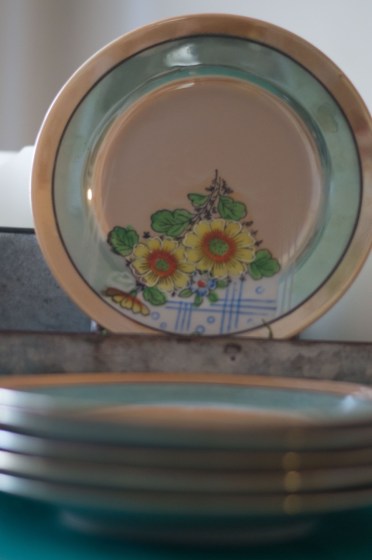
After all this shopping, we rewarded ourselves with burgers, fries and onion rings at a local diner before heading for home. On the way back we tossed around different ways to accessorize the tin tray. This lead to a “shopping” expedition in my basement storage boxes and cabinets, which led to these pretty plates from my mother’s best friend, a vintage tablecloth with matching napkins, some craft store pumpkins, and two old wood boxes all going home with Maggie.
LilsDishes


And on day 2

But this was just the beginning of the three-day weekend. I had accepted an invitation to a late-season cookout Sunday afternoon. The hosts are two of the nicest people I know. They share a the “gracious gene,” warmly welcoming guests to their beautifully restored Victorian home. Elizabeth is a fabulous cook and loves cooking for others. (Are her friends, family and co-workers lucky or what?) We don’t get to see them often enough. If my husband felt truly awful, it would not be the first time I went to an event alone and made his apologies.

Happily, thanks to a new prescription regime, my husband was able to join me for a wonderful evening catching up with a few old friends as well as some engaging conversation with new acquaintances. Our hosts’ home is surrounded by gardens and patios, clearly designed for entertaining as well as a setting for their home.

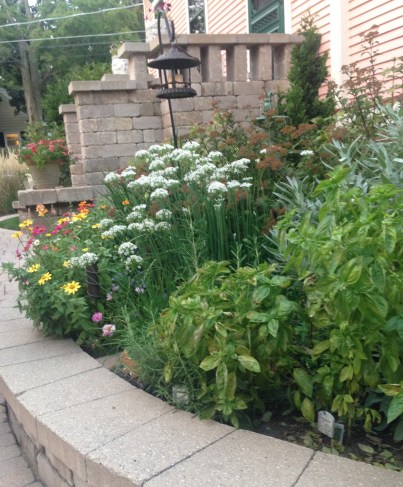
Enough talk, look at their garden! All I had was an iphone and dwindling light, but I think I was able to get a sense of the color and abundance of the garden beds genuinely overflowing with blooms and herbs. Not to mention the garage with the roofline that mimics the house, the lantern and the clock. The best designs are always about details.
LambertGarden

LambertGarage


That brings us to Labor Day itself

While we we driving to Wilmington on Saturday, a friend texted to ask if we’d like to join them to cookout Monday afternoon. Once again, hoping Steve would feel better, I said yes. It was a lovely, low-key time with just six of us sitting around the table on the hosts’ porch talking travels past and future and what the grandkids have been up to. At some point late in the evening I walked into the kitchen (which looks this pretty after dinner) and snapped this picture, the best evidence I know of time well spent with good friends.

PostDinnerKitchen

And thinking about Labor Day

My maternal grandparents (the only ones I knew) raised my mother and uncle, along with a niece and nephew, in a small house in a working class neighborhood on the south side of Chicago in the 1920’s and 1930’s. They knew only too well the value of having a job to go to every day, because they also knew people who weren’t that lucky. When I was a little girl and would sometimes spend the day with them, Grandpa would ask at the dinner table what I did to earn my dinner that day. And I would report that I dusted or I helped Grandma bake pies or maybe I washed my doll’s clothes while 
Grandma did laundry.

As an adult I have often thought of those dinner table conversations. I did my homework, did the laundry, took my kids to the library, got the magazine to the printer, wrote a blog post. What I do in a day matters. And the work that we do matters a lot. When I was in the business world and someone was really ripped by a co-worker or a superior or even a client, invariably another co-worker would say, “it’s not personal, it’s business.” But, you know what? Our business — the work we do — is personal. It defines us and makes us who we are.

FlagBench

This is my salute to workers past and present. Wishing you a week with lots of good work.

See you next time!

August is for antiques & tomatoes

A recent Instatgram post by Delores Arabian of Vignette Design (one of the first blogs I followed) said, “August is like the Sunday of summer.” So true. The routine changes, no matter what your routine is. August just feels different. The light is shifting. People seem to move a little more quickly and with more purpose.

I’ve spent the last week deciding what to do with a bountiful harvest of tomatoes and looking for fall inspiration in a few antique stores.

Start with a bucket of tomatoes

First, a little background. A few years ago, we took our kitchen down to the studs for a much-needed renovation. Thanks to a great designer, who took the time to understand what Steve and I each wanted in a kitchen, we got all that and more. It looks great; more importantly, it really works! I can easily spend an entire day puttering around in my kitchen. In fact, yesterday I did. I started with a five-gallon bucket of fresh tomatoes from my husband’s garden (I think you could easily call this “high tomato season”), and things just kept going from there.

VegetablesSweetgrass

This is not the first bucket of tomatoes this season. Despite a slow start, the garden plot has been prolific. It began with radishes and beets, then moved on to cucumbers and beans. Lots of cucumbers and beans. I gave them away, there were so many. Now we have buckets of tomatoes.

I think everyone has their own favorite ways of dealing with tomatoes. We love fresh tomato bruschetta and have been serving it to everyone who’s come to dinner in the last month. BLT’s are a regular feature on the menu. My grandma used to can tomatoes, in glass jars in a water bath. It was a hot, labor-intensive process. Instead I drop the meatier tomato varieties, like Romas, into boiling water for just a few minutes to facilitate skinning. After letting them cool briefly, the skins slide off and I slit them to seed them, then crush this “tomato meat” with my hands (As Ina Garten always says, clean hands are the cook’s best tool!) and pack in quart containers for the freezer.

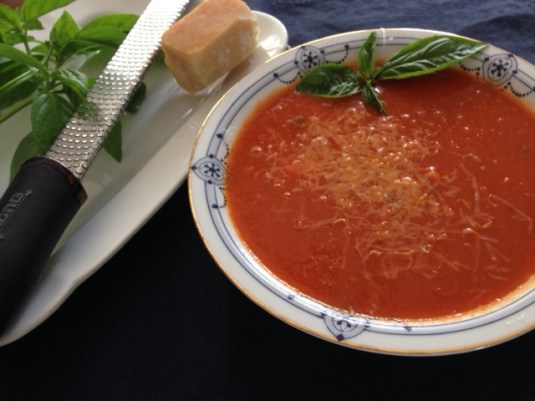
Then, because there were more tomatoes, I made this fresh tomato soup recipe from The Cafe Sucre Farine (A delicious food blog; if you’re not into cooking, just enjoy the pictures!)  It was super easy. No skinning or seeding the tomatoes! Blending at the end takes care of that. (Hint: I did it in batches with my immersion blender.) It’s so yummy, I wanted to lick the bowl. You can find the recipe here.

TomatoSoup

And, as long as I was in the kitchen, I made a pot of chicken stock. I know this sounds crazy, but I was using my last carton in the tomato soup. I knew I had the ingredients to make more stock, so what’s another pot going on the stove? Now I have cartons of fresh tomato soup, chicken stock, and tomatoes in the freezer.

Tomorrow I’m baking a cake!

When in doubt, go antiquing

Every so often I feel the need to spend some time shopping a few local antique malls. Sometimes I come away empty-handed, sometimes I find a new treasure, and sometimes I come home with inspiration to use what I already have in a new way. But the bottom line for me is that antiquing always fuels my creativity. And I’ve been looking for ideas for a bit of a “fall refresh” around the house.

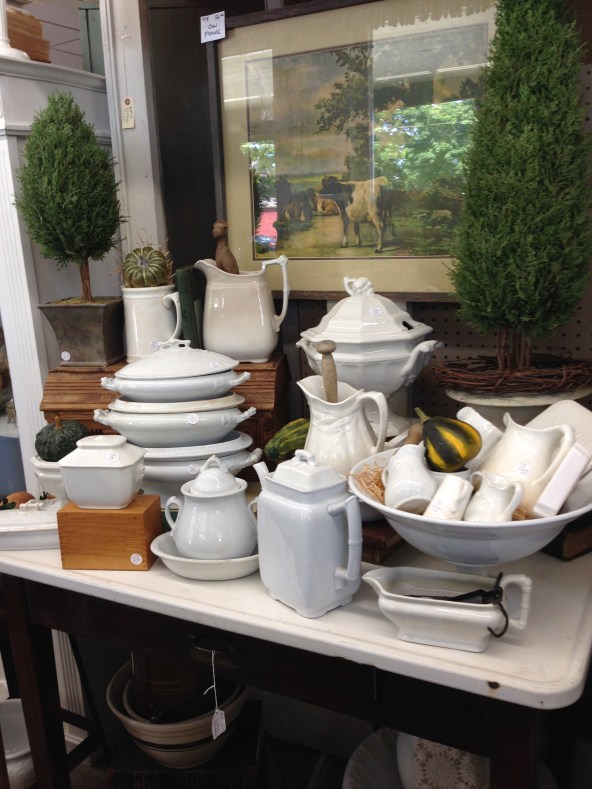
IronstoneAntiqueShop1

This display in one booth (above) stopped me in my tracks. My love for ironstone is “well-documented” so I studied this carefully. I have a number of similar pieces, but it was hard to tear myself away (and I’m not at all convinced I don’t need that stack of covered dishes). I did come away with this small ironstone tray and a few hand-painted pieces. (Full confession: I gave the footed bowl and saucer to a friend. It was made for her collection!)

AugustAntiques

In another another booth, I found a few new blue and white transferware pieces. I’m especially excited about one plate, since a previous owner added this information on a small strip of tape to the back: “from C.C. Penney This came to America is 1830 Given to me May 4, 1969 (from Peggie)”. Isn’t that amazing? Now I’m wondering if I should do the same with a few of my favorite things.

What’s inspiring you this August?

See you next time!

A sweetgrass story

DSC_0411I suppose there are people out there who don’t like baskets, but honestly, I don’t know who they are or what they are thinking.
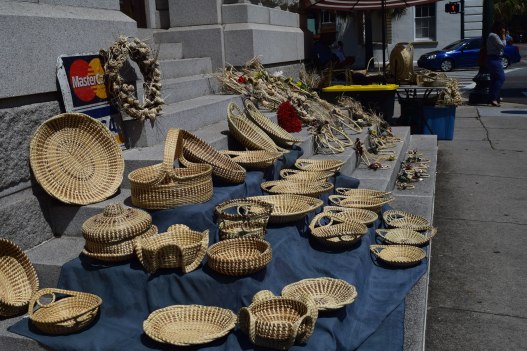
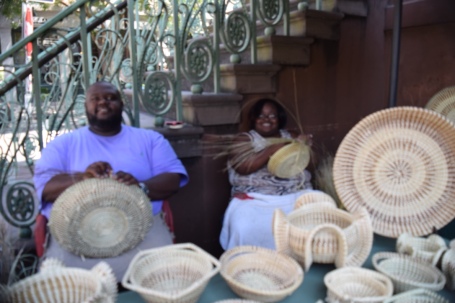
I began collecting baskets because they are an attractive, useful means of gathering and holding a variety of things. (Remember my post about Mary Emmerling?) Things like plants, onions, and sewing projects. Next, I acquired a few antique baskets, which I treasure. They are often fragile, but I find ways to use and enjoy them, like on top of cabinets where they can be seen but not touched. Then I found new, hand-crafted baskets. They’re pretty sturdy. I especially like large, utilitarian ones that can hold magazines or paper trash beside my desk. That way I can enjoy the basket maker’s artistry every day.

However, my sweetgrass baskets from South Carolina are the rockstars of my collection.

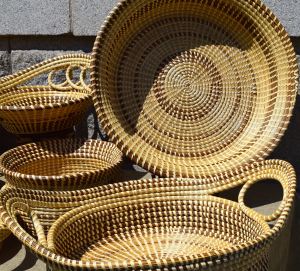
SweetgrassCollection

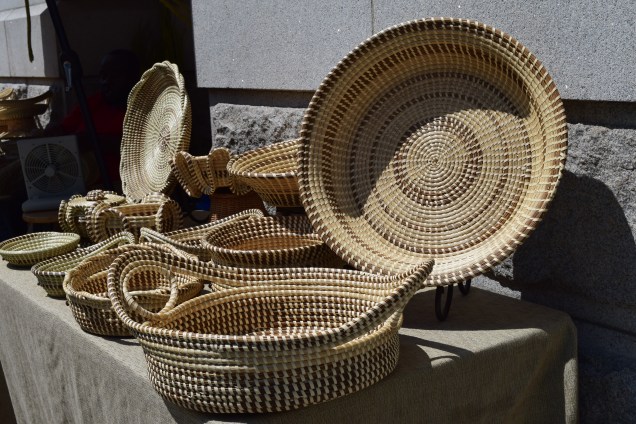
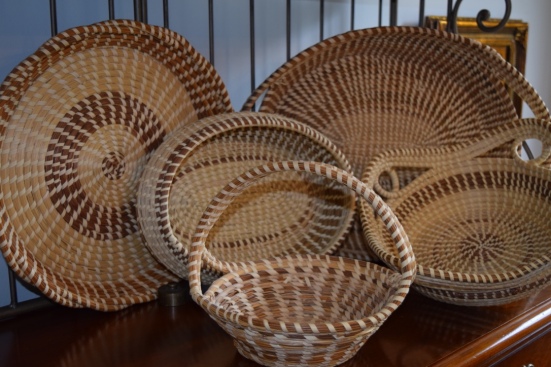
Sweetgrass baskets are fashioned from tightly coiled grasses and long-leaf pine needles at the hands of a small group of artisans. Each basket is one-of-a-kind. They are beautiful and functional on their own, but more importantly to me, they are an art form that has been passed down from generation to generation for more than 300 years.

A bit of history

In eighteenth-century South Carolina, the prosperous plantation lifestyle and its urban counterpart in Charleston owed much to the booming rice economy. And the rice economy depended on the labor and expertise of West African slaves, many of them rice planters in Africa before their captivity. They arrived in this country without personal belongings but holding close to the traditions and culture they had left behind, including basketmaking.

Originally made of bullrush and palm, which were prevalent in both Africa and in the South Carolina lowcountry, the basketmaking tradition allowed the West African slaves to continue an important cultural connection to their past. In addition, the baskets, like their knowledge of rice planting, were in high demand in the agricultural community. Flat, fanner baskets were used for winnowing rice. Large work baskets were used to store and transport a variety of materials.

Soon these baskets were incorporated into more domestic uses and new designs, like covered sewing baskets and bread baskets, began to appear. Basketry was an important skill in the slave community. There is evidence to suggest that some slaves were allowed to make and sell some of their wares.

CharlestonBasketsMeetingSt

Despite the eventual decline of the plantation economy, the basketmaking tradition continued, though the products were smaller and more suited to household use. Sweetgrasss began to replace the bullrush and long leaf pine needles were added to make the coiled designs more interesting. In the early thirties, when increased car travel brought more tourists to the Mount Pleasant area just north of Charleston, interest in the craft increased and the first roadside basket stands appeared. Many of them remain today. Contemporary basketmakers also sell their wares at the Charleston City Market and at the “four corners of the law” at Meeting and Broad Streets (above). I’ve probably bought most of my baskets at this last location.

Putting a value on tradition

There are no written instructions for making a sweetgrass basket. This is a tradition handed down from generation to generation, and the basketmaker’s wares are distinguished by his or her expertise and personal style. Each of my baskets was handmade by someone who learned her craft from a mother or grandmother, who learned it from her mother or grandmother and so on. This is what makes them so valuable to me. Watch a basketmaker at work (and they are always working on another basket) and you can see what a painstaking project each basket is and the skill required. Even the simplest designs can take a dozen or more hours to complete. Larger designs take much more.

Although many basketmakers make what seem to be the same styles (probably dictated by what buyers want), the closer you look, the more differences you see. Some are woven tighter than others, some have little knots as embellishments, many are clearly designed to hold popular casseroles or baking pans.

I tend to favor simpler designs, that will still offer some utilitarian use. My first pieces of sweetgrass were actually two trivets. (Twenty-plus years later, we continue to use them almost daily, which I suppose says a lot about their sturdiness and usefulness.) This year I spent some time at the City Market (at the Meeting Street end) talking with basketmakers Corey Alston and his sister Charlene. They pointed out some of their work with newer, “fancier” designs and a few much more traditional pieces, including an almost flat fanner that I continue to dream about but just could not afford.

Sweetgrass1

Sweetgrass baskets are what my mother would call “pricey.” Few fall in the $50 range and many designs are hundreds, even thousands of dollars. I looked at baskets for years before I bought anything beyond my trivets. Eventually I set aside birthday money and added to it to purchase one of the designs I had been eyeing. (It was all downhill for me after that!)

In addition to the time and skill necessary to make each basket, the sweetgrass (which really has a distinctive, sweet or fresh smell when you “stick your nose into a basket” as my husband says) itself is harder to come by. Once plentiful in the lowcountry marshes, the plants have been threatened by growing development, although now I believe it is somewhat protected.

Many basketmakers are willing to negotiate prices for serious buyers, especially on expensive pieces. While I always negotiate (it’s part of the fun), I do so when I am committed to a purchase. I don’t negotiate a lower price, then walk away to “think it over.” I am very conscious that I’m not just buying a basket or even a significant African-American craft. I’m investing in a one-of-a-kind, hand-crafted piece of art, part of a tradition that will hopefully continue indefinitely.

I’m also aware that I’m very, very lucky to collect these woven “rock stars.” Do you have a “rock star” collection or one you would like to start? I’d love to hear about it!

See you next time!

Charleston snapshots

We just returned from what has become our annual week on Kiawah Island, just 20 miles from Charleston, South Carolina. We love the broad sandy beach and the quiet pace of the island, which is a private, planned community committed to preserving its natural setting. I have always thought of it as the ideal respite from our otherwise busy suburban life. We also love Charleston — the history, the architecture, the gardens.  And although today it is a top travel destination in the U.S., I think my family believes that after 25 years of summer visits we have a more personal claim on the city.

This year our visit came in the midst of a record-setting heat wave (which is saying a lot since any summer day here is typically hot and humid). However, my intrepid daughter and I still managed to take our own walking/photography tour of Charleston. I thought I would share some of what we saw.

Charleston2016YellowHouse

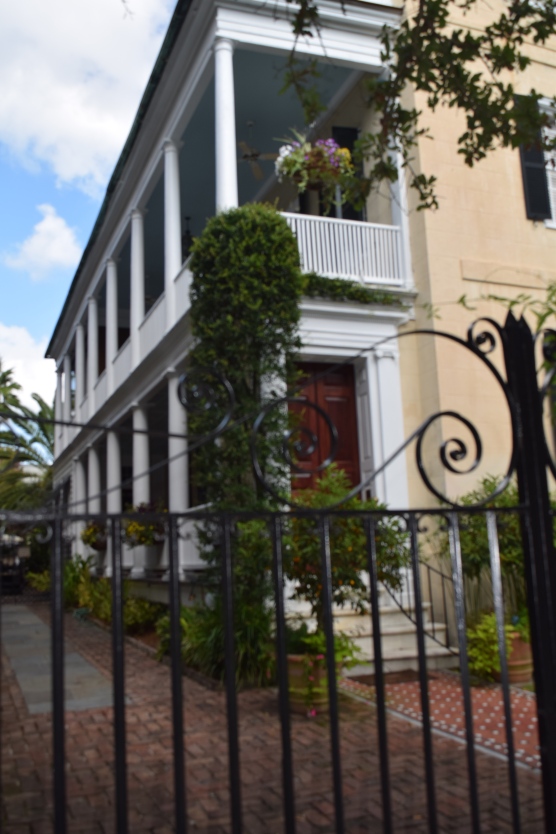
It’s easy to get caught up in the genuinely grand houses along Charleston’s Battery, but this may be more typical. It’s a little more modest and obviously well cared for. I love the piazzas and those beautiful doors!

Charleston2016Greensoverwall

More piazzas, this time behind a brick wall topped with greenery. I’m sure there’s a wonderful garden behind that wall!

More brick walls. The walkway on the left was “calling my name,” but it clearly went to private property. I love the detail, all done in the same simple brick, in the wall on the right.

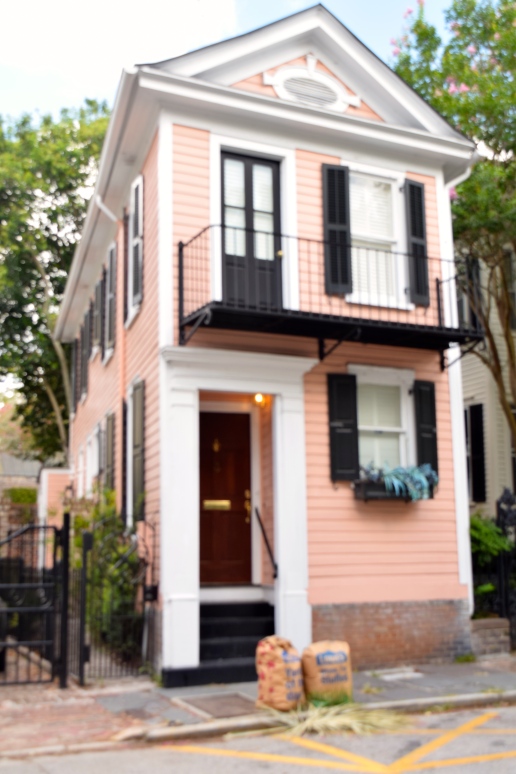
CharlestonTinyHouse

This image is a little fuzzy, but I had to share. Isn’t this charming? I imagine it may have started out as a kitchen house on a larger property. Today, it’s the perfect “tiny house.”

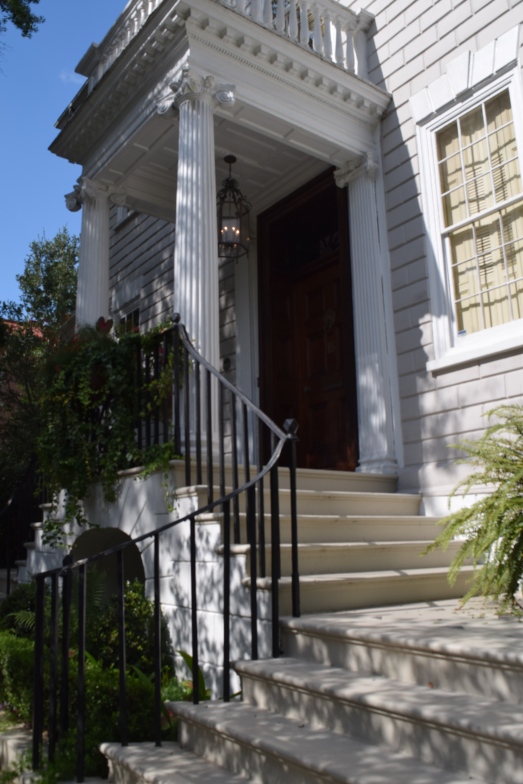
CharlestonHouseGaslight

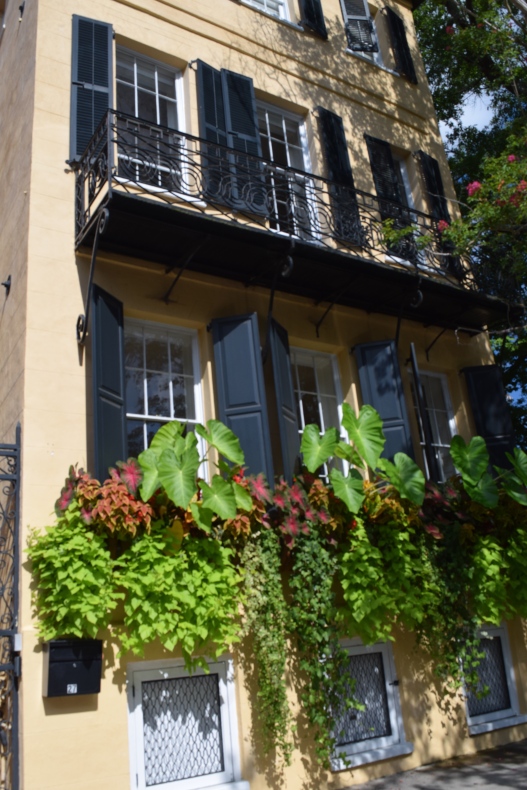
Look at the gaslight on this porch. Many homes have them. I think it’s just one of the details that sets these homes apart. And it’s the details that matter in Charleston. Look at the window boxes below.

Charleston2016Wondowbox1


CharlestonAlley2

The good news/bad news about wandering in Charleston is that there is always another alley or lane that beckons! Love this green “wall” backed by palmettos.


CharlestonBaskets1

No walk through Charleston south of Broad Street would be complete without stopping to admire the sweetgrass baskets for sale on Meeting Street. The baskets are woven by hand from local materials using techniques that have been passed down for centuries. Stay tuned for a separate post on these beautiful collectibles.

I hope you’ve enjoyed this little walk thru Charleston. It’s really more eye-candy than a history/house/garden-loving photographer can take in!

See you next time!

Loving Instagram

When I launched Ivy and Ironstone, my daughter suggested I join Instagram as a way to promote it. Oh, yuck, I thought. More social media. I’ve already admitted I’m not very good at FaceBook, (which I pretty much think of as a place to view pictures of my friends’ children and grandchildren). I still have so much to learn about blogging and now I need to learn Instagram?

However, this is what Maggie does for a living, and she’s good at it, so I started scouting some of the Instagram feeds of the bloggers I follow. I fond lots of great photos, and I could choose the kinds I wanted to see: gardens, travel, decorating, entertaining, food. This is like putting together your own, special-interest, electronic magazine.

Like other social media, Instagram intuits what you like and sends you more of the same in a separate search feed. So, I started following (on Instagram) some of those bloggers, a few designers, and so on.

Now I’m enjoying it so much, I’m spending way more time on Instagram than anything, and definitely more than I should. Of course, it helps that I now have a few (very few) “followers” and “likes” (what a boost for my ego!).

So, as they say, without further ado, here’s just a small sampling of my Instagram feed.

I love missmustarseed.com. She likes blue and white transferware and white ironstone (sound familiar?).  I also really admire her keen business sense.


Frances Schultz is the author of The Bee Cottage Story and blogs at francesschultz.com. Her Instagram is loaded with images from her homes, travels, and much more. Her wide-ranging interests make her feed especially interesting.


The French Tangerine was one of the first blogs I found and followed, below. (You can see her attention to French detail in this image of nesting birds beside her door!) Then came  Sharon Santoni’s My French Country Home and The Enchanted Home both favorites not just for their style, which is beautiful, but because of how their love of home and blogging has led them into remarkable new directions.

Babies grew up and are leaving the nest!

A photo posted by 🍊 jan vrana (@thefrenchtangerine) on Jul 19, 2016 at 5:51am PDT


Travel. Instagram is loaded with travel photos, domestic and international, funny and breathtaking, but I don’t think anyone captures Paris (though we all try) like Georgianna Lane does. And I enjoy getting a regular Paris “fix.”

Focusing on the long view today. Peace and love to each of you. 🙏💕🌎 More @aparisianmoment and @photosbydcp

A photo posted by Georgianna Lane (@georgiannalane) on Jul 18, 2016 at 9:22am PDT


Because a part of me would secretly like a bit of a farm, and I love his approach to gardening, I’ve been following P. Allen Smith. Aren’t these chickens wonderful? His gardens, flower and vegetable, are gorgeous.


Finally, in a world in which the news has lately been so bad, so often, words to live by from Ted Kennedy at Watson Kennedy He is witty, wise, and always, always gracious.

It so often comes down to the basics… This is always such a simple reminder that I come back to time and time again.

A photo posted by Ted Kennedy Watson (@watsonkennedy) on Jul 19, 2016 at 6:17am PDT


I could go on and on, but you can link to my Instagram on the left so see more of what I follow. If you are on Instagram, please share. If you aren’t, give it a try.

See you next time!

My miscellaneous file: gardens, a geeky book and crepe-y skin

This point in the summer seems a bit of a lull to me. The flush of spring is past. The fourth is behind us. Our trip to the beach is still a few weeks away. And it’s finally getting hot, which always makes me feel a little foggy at first. So today’s post is a bit of this and a bit of that from what I think of as my miscellaneous file.

Stalking my garden

Although I love spending time puttering in the garden, my skills often seem a bit sketchy. Or maybe it’s just that gardening is so dependent on weather, water, bugs. There really are a lot of variables. However, my daylilies are awesome this year. I honestly don’t know the names of these, but this is one of those times when a picture says it all. Aren’t these grand?

IMG_0566-1

I have also been nurturing a white garden in one area. I have never done one with a theme before, but I am really enjoying this.

Whitegarden

When one book leads to another

I’ve been reading Max Perkins, Editor of Genius by A. Scott Berg. Yes, I realize this is a geeky read. But I was an English major in college, concentrating on 20th century American literature, so a bio of the venerable Scribners editor who introduced the world to F. Scott Fitzgerald, Ernest Hemingway, and Thomas Wolfe, to name just a few, holds a particular place in my literary heart.

This is the flip side of reading these novels, learning how Perkins struggled to focus Fitzgerald to complete The Great Gatsby, how he convinced Thomas Wolfe to cut thousands of words (and hundreds of pages) from Look Homeward, Angel to make it readable. However, Perkins was much more than an editor. He was a friend, counselor and financial planner to his remarkable stable of writers. Most importantly, by nurturing their talents he introduced some of the most important literary voices of the century.

Now that I’ve read the backstory, their works are on my “to read” (or in some cases re-read) list. I’ll let you know how that goes…

In the meantime, if you are looking for a fun beach or back porch read, pick up White Collar Girl by Renee Rosen. Jordan Walsh is a recent j-school graduate (from a family of writers) who goes to work at the Chicago Tribune in 1955.  These are  heady times (Richard Daley has just taken office as mayor), but women like Jordan are relegated to the society pages. Of course, she is determined to change that. This is a fun and fast read, especially if you are familiar with Chicago or the pre-feminist workplace.

All the talk about “crepe-y” skin

As I was puttering around in my kitchen this weekend, cutting, chopping and dicing to make potato salad for a pre-Fourth barbecue, I realized that I was listening to a 30-minute infomercial on the plague of “crepe-y skin,” the dry, finely wrinkled dermis of women of a certain age and the lengths to which they will go to cure it.

Well, as much as I hate to admit it now that I’ve made light of it, I too am afflicted with this condition. Somehow my mother’s finely crinkled, crepe-paper textured arms and hands have become mine. I’ve been aware of this for some time and have just pretty much looked the other way. (Although it’s getting harder.) If you pay attention to the informative television presentation, this same condition impacts the skin on our necks, chests, legs, etc!

Apparently there are some treatments (endorsed by the likes of Dorothy Hamill and others). My question is this, have any of you tried this? Does it work? The cure seems a bit pricey, but if I get my own arms and hands back, I’m willing to try.

What’s in your miscellaneous file?

See you next time!


London lite

BigBenI drafted this post before the Brexit vote, but now that the UK is on everyone’s mind, it seems more timely!
When I wrote about our recent travels, I did not add anything about the last few days of the trip that we spent in London. This was our third stop in London in eighteen months. Yes, we like London. A lot. It has been very easy to stop there on the way from other European cities and then fly back to Chicago.

Several years ago on our first trip, we tried to do as much as possible: the Tower, changing of the guard, the British Museum, etc. On subsequent stops we have enjoyed London on a slower pace, taking in a few new things (Kensington Palace, Hampton Court, and Greenwich) each time and revisiting a few favorites (The War Rooms, The British Museum) and, I think, savoring all of it. This is definitely not another travelogue, but I do want to tell you about a few places we have returned to more than once. And, interestingly, they are all evening stops.

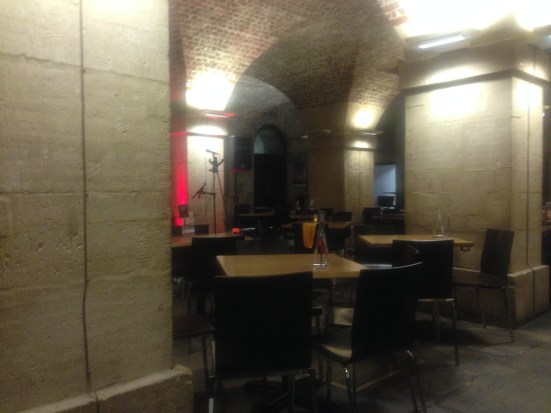
The first is Gordon’s Wine Bar. This is not even remotely fancy, but it is fun and “atmospheric.” Established in 1890 and owned by the same family since 1975 (conveniently also named Gordon), the bar is in Kipling House, home to Samuel Pepys in the 1680’s. Rudyard Kipling was a tenant in the 1890’s. (Yes, history is everywhere.) The bar is located in the brick cellar and decorated with mismatched chairs and tables, all wobbly thanks to their age and the uneven stone floor. It’s lit by candles. The wine list is legendary, as are the cheese plates.  Once you have navigated the steep stone steps into this cave-like setting, order at the bar.

123 Gordons Wine Bar

Gordon’s is very popular with locals. So much so that you will have to search for seats, ducking your head as you go, around old, awkward brick walls and pillars. If you find a table, grab it or perhaps share with another group. You may have to look around for chairs too. Sometimes you find a table without chairs. It’s just that kind of place. I think one of the things we like most about Gordon’s is this casual, friendly atmosphere. And, of course, everyone seems to be having a great time.

Another favorite stop is St. Martin’s-in-the-Fields for Jazz in the Crypt on Wednesday night. St. Martin’s in the Fields is a stunning church on the North-east corner of Trafalgar Square (and not at all far from Gordon’s). There has been a church on this site since the medieval period, but the present neoclassical building dates to 1722. St. Martin’s is known for its architecture and its concert series in the sanctuary. It’s also known for its long-established mission. An early-twentieth century vicar began programs here for the homeless, and that commitment continues today, supported by a cafe, the London Brass Rubbing Center, and a gift shop in the crypt. But that’s not all…

125 St Martins Crypt

Jazz in the Crypt offers live music by professional performers in a fun setting (as in more brick vaulted ceilings, this time accompanied by three- and four-hundred year-old memorials under foot!). Tickets are very modestly priced. The entertainers we have seen here have been wonderful and the crowd enthusiastic (inevitably breaking into dance). There is even a simple buffet dinner available, as well as wine and beer throughout the evening. The audience seems to be largely local, although we have heard American performers. This is a fun way to end a day of London sight-seeing.

Finally, although this does not fit into the category of nightlife, it is an early  evening event. Most London tourists eventually find their way to Westminster Abbey, home of the Church of England and sight of coronations and burials, weddings and funerals, since 1066.

Somewhere along the line a few years ago, in a travel guide, we read that anyone can attend Evensong, a short, daily church service at 5:00 pm. On our next visit, I asked one of the guides about this and he explained that we just needed to return to a particular door at the appointed time. Evensong turned out to be one of our favorite London experiences. When you are admitted for Evensong, you are directed to take a seat (no wandering about to look at things and, alas, no photos), but just think. You are sitting in the same sanctuary where Queen Elizabeth and all those before her were crowned, where Diana’s funeral was held, where William and Kate were married! And that’s just the last several years of history!

Eventually, everyone is seated and the service begins. There are readings, but much of it is sung by the men’s and boys’ choirs. These are very select groups and the boys, in fact, attend school at the Abbey while they are choir members. I’m not a musician, but the music is stirring. I’m not especially religious, but the setting and the service are genuinely moving.

Most of all, like Gordon’s and Jazz in the Crypt, this is an accessible slice of English life. Isn’t that what we look for when we travel?

The tale of my traveling wine glasses

Glassestable2People who know me know that I love to host a party — a birthday party, a graduation party, a retirement party. We often have friends for dinner, and I’m more than happy to host a book group or one leg of the annual church progressive dinner. For almost every one of our 40-plus holidays together my husband and I have hosted a holiday open house. I just like to celebrate the large and small moments in life, and sometimes even the non-moments.
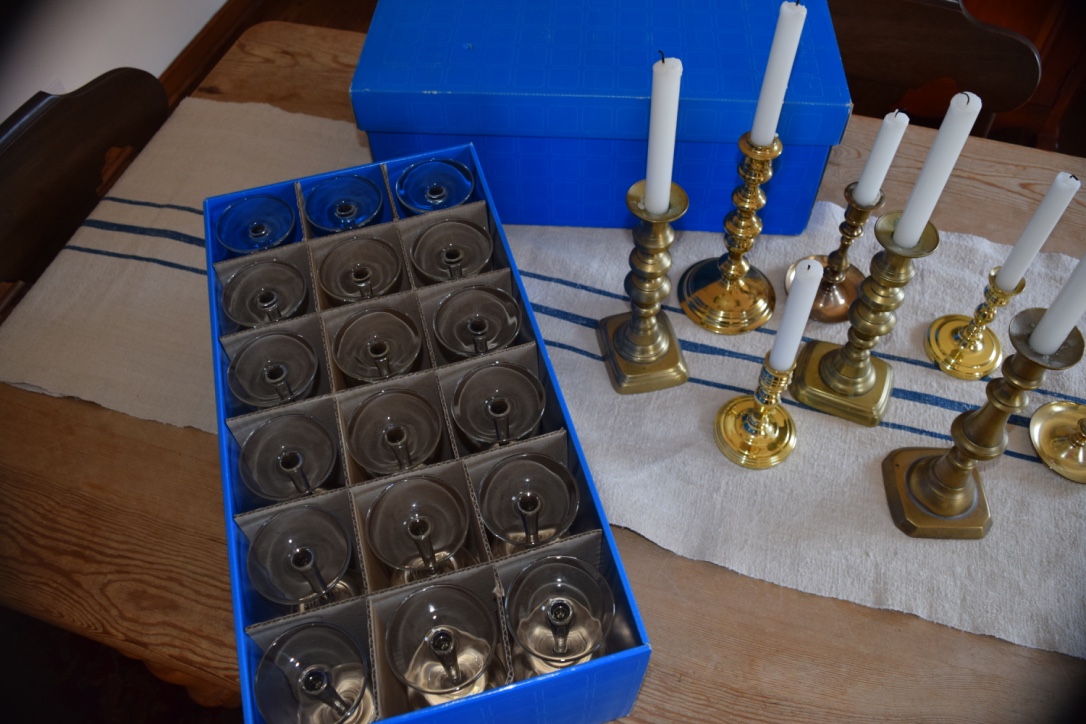
All this partying has lead to a substantial cache of entertaining gear, not the least of which are “the traveling wine grasses.”

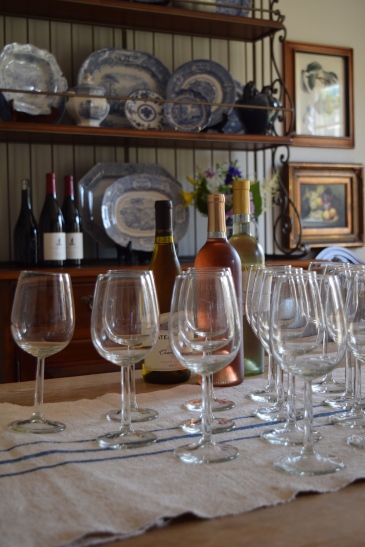
Technically, I only own half of them; 36 to be exact, acquired one fall more than 10 years ago when my husband found inexpensive glass wineglasses in their own storage crates. He bought one crate of 18. When I pointed out that our holiday party typically has more than 30 attendees, he agreed to pick up a second crate. Before he got a chance to accomplish that, my friend Sherry (another enthusiastic hostess) heard about his “find” and asked him to get two crates for her. Now, between the two of us, we had a total of 72 wine glasses! (The possibilities, we thought, were endless.)

These are not fancy glasses. They are stemmed, and they are glass, but they are on the small side, making them less desirable for true oenophiles or serious wine tasting. On the plus side, they eliminate paper and plastics or renting glasses for a large group.

Even if a guest grabs a second or third glass, the hosts aren’t likely to run out. These glasses are dishwasher proof, making post-party clean-ups that much simpler. The self-storing boxes they came in are just as easy to pop into a car to deliver to the next event. (This is what Sherry and I were always doing!) They stack easily on a shelf in my basement party closet.

WGlassesBoxes

Hence the name, traveling wine glasses…

For awhile Sherry’s husband (also a writer) and I fantasized a bit about short stories we could write about the events the glasses “attended.” Perhaps the glasses would overhear some juicy gossip about a local politician or they could be serving wine at a family event where the entrepreneurial young nephew meets the host’s venture capitalist friend and together they end up launching the “next big thing.”

Could one of the glasses stray — along with a party guest — into a more remote room of the party house to steal jewelry from the hostess’s dressing room or perhaps critical files from a computer? (Hardly a possibility at my house where there are no dressing rooms, jewels or crucial computer files, but perhaps if I were writing a detective novel…)

I do know the glasses have attended family reunions and toasted 90th birthdays. At my own holiday open house they have overheard tales of family vacations, teen-age speeding tickets, and the angst of aging parents. They have commiserated over lost jobs, long-distance moves and health crises and then celebrated with us when careers and good health were restored.

I’d like to think they enjoy a good party as much as I do.

And so the traveling wine glasses have been merrily rolling along, until this summer’s tragic breakup. This spring my friend Sherry and her husband decided to downsize and move 600 miles to be closer to their daughter and new grandson! This move made a great deal of sense for them and they love their home and proximity to family, but they took half the glasses with them! (I feel a lot like my two-and-a-half year-old grandson, who readily traded all of his “binks” at the toy store for a shiny new fire engine, then at bedtime realized the enormity of what he had done and wailed, “My binks! She kept my binks!”)

So, I’m sure Sherry’s half of the glasses will attend plenty of parties in her new home. (In fact, I think they have already traveled to her daughter’s for a welcome party.) I’ll make do with what I have and rent what I need. But I’m really glad that all 47 appetizer plates are mine!

See you next time!

My first design crush

EclecticCountryCoverDisclaimer: Not everyone takes decorating their home as seriously as some of us. You may read this and think, “Oh, Janet has really gone ’round the bend.” Or, you may see yourself. I love this part of making a home: what goes on the mantle, how bookshelves are arranged, how to show off a collection of whatever it is you collect. That’s just me!

As soon as I discovered last fall that Mary Emmerling had a new design book out, Eclectic Country, I clicked on Amazon and ordered it. She was my first design crush, and I still love her evolving style.

Emmerling turned the design world on its heels in the late 1970’s when her New York loft furnished with rustic country tables and baskets alongside white slipped sofas was featured in House and Garden. From there she went on to become the decorating editor at House Beautiful and to write her first book. American Country, published in 1980. My design taste went right long.

Although I was not initially equating this style with one specific designer, I carefully studied this new country style that was so much fresher than my mother’s traditional Early American. (Sorry, Mom.) I was a young married with no budget but plenty of imagination. We lived in Central Illinois then, and garage sales and estate sales yielded a treasure trove of oak dressers, copper boilers, and old dishes. I hung quilts on the wall and used them as tablecloths (I still do this). I started collecting baskets.

Eventually I found the pages of Mary Emmerling’s Country Magazine and Country Living that featured her look and her first books told me how to use my early finds. I made curtains out of sheets and a shower curtain from a quilt top. I started collecting vintage tablecloths and fabrics, turning them into valances and pillow tops. I convinced Steve to cut down an old oak kitchen table to re-purpose as a coffee table.

I have no doubt that my family and friends found my style to be “quirky” at best, but I was learning a lot about scale and balance, about which pieces could be refinished and which couldn’t, about the power of paint and wall paper, about quality and trading up for something better. Some of those early pieces are still part of our household, like the coffee table and the quilts. Others I sold in favor of something I liked even better.

So, when her book came, I settled into my favorite chair and proceeded to enjoy the story of her evolving style, from the 70’s until now. Since then I have gone back more than once to enjoy her insights. When I started his post, I started re-reading some of her other books. Her ideas and insights are just as fresh today. In Quick Decorating Emmerling broke down her approach to arranging shelves. I have to admit I have read this many times and used her advice. It always works. The same can be said for her take on creating tabletop vignettes.

HowToPage
This is a spread from Quick Decorating, describing how these shelves were arranged to be interesting, balanced and useful.

This is not furniture store or showroom decorating. It’s personal, and that’s the appeal for me.

One of the things I really appreciate about Mary Emmerling’s style is her willingness to blend both high- and low-end pieces, like the gilt-back chairs below next to wicker trunks. I realize this would be tiresome throughout a house, but the tension between the two is eye-catching. And I think occasionally pairing rustic pieces with formal makes the formal pieces more approachable. It also “classes up” the less formal. A silver pitcher of garden flowers on a pine table not only looks pretty, but allows you (me!) to use the silver pitcher!

Sample ME page
I love the gilt chairs and the candelabra on the dhurrie rug, with the wicker chests. From Quick Decorating.

Another thing I love about Mary Emmerling is her practical side. She shares her lists, not just of furniture and accents, but of practical tools, too. In Quick Decorating she describes her stylist’s kit, which includes pins, tape, scissors, etc. (In mine I keep various picture hangers and hardware, a tape measure, plate holders, and those foam pads to help you move furniture around. If you are going to start arranging or rearranging, you need to be prepared!) In Romantic Decorating her lists range from romantic fabrics (toile, velvet, etc.) to architecture (half-timbered walls, French doors) to movies (The African Queen, Brief Encounter, Casablanca).

But Mary Emmerling’s practical approach goes beyond tools. It’s about the way she has adapted her style to meet her changing taste and locations. She’s made her country look work in New York City, the Hamptons, Florida and Arizona. She tweaks it, adds and subtracts pieces, and keeps her “basics.” And I think it’s this versatility that her many fans appreciate. This is a personal look, with beloved collections, genuine pieces of Americana whether they are Navajo blankets or advertising tins, hay forks or crosses and Santos. It’s certainly not dependent on square footage.

If you’re a decorating geek like me, like country style, or just want to see what I’m talking about, try one of these books (or one of her others!). And have I mentioned that the pictures are always awesome? These are the titles i have in “my library.” There were more, but I have “loaned” a few out.

  • Mary Emmerling’s American Country South, text by Carol Sama Sheehan, photographs by Langdon Clay, 1989
  • Mary Emmerling’s American Country Cottages, text by Carol Sama Sheehan, photographs by Joshua Green, 1993
  • Mary Emmerling’s American Country Details, text by Carol Sama Sheehan, 1994
  • Mary Emmerling’s Quick Decorating, text by Jill A. Kirchner, photographs by Michael Skott, 1997
  • Mary Emmerling’s Romantic Country, text by Jill Kirchner Simpson, photographs by Michael Skott, 2004
  • Eclectic Country, text by Mary Emmerling, photographs by Reed Davis, 2015

What about you? Is there a design personality out there inspiring your living space? I’d love to hear about it!

See you next time!


Dressing Downton

Violet
Violet Crawley, the Dowager Duchess, and Martha Levinson, Cora’s mother.

I spent so much time talking (and talking and talking) about Italy, that I did not get a chance to tell you about this wonderful exhibition of costumes from Downton Abbey. The last Downton episode may have aired a few months ago, but the magic continues. In Chicago this spring, it has been especially easy to indulge our English country house fantasies with a wonderful exhibit, “Dressing Downton: Changing Fashion for Changing Times,” featuring more than 35 costumes from the award-winning series.

Last week one of my best fashion- and Downton-loving friends and I were finally able to visit this exhibit. (And not a minute too soon because it was about to close.) We’re so glad we went! Seeing the clothes that played such a huge part in the series was wonderful, but the setting at the Driehaus Museum and the production quality of the exhibit itself were both spot on.

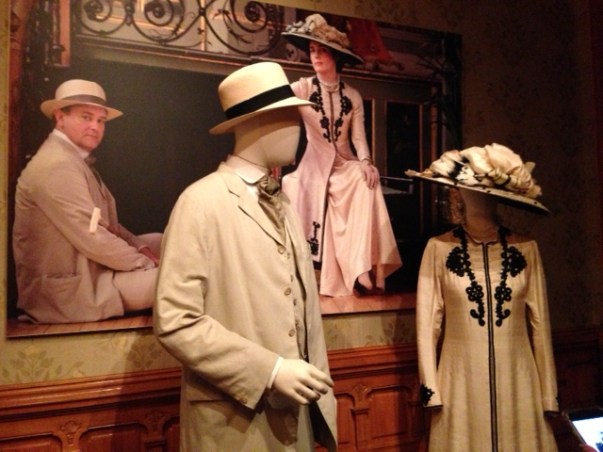
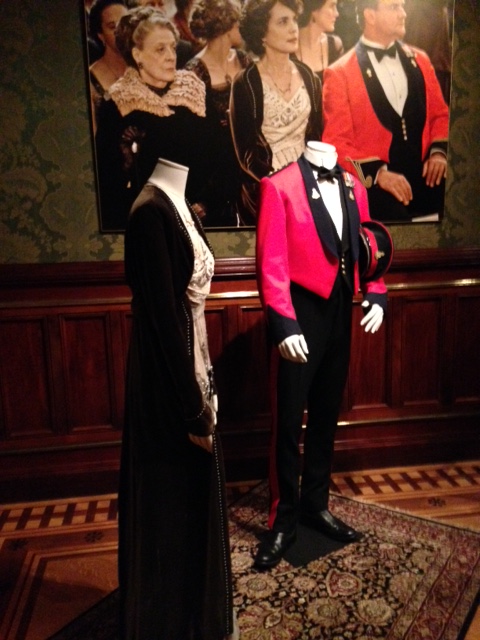
First let me say that the setting for the exhibition, Chicago’s Driehaus Museum, provided a perfect backdrop. The museum was the “Gilded Age” home of banker Samuel Mayo Nickerson. It has been restored by philanthropist Richard H. Driehaus and today showcases both original furnishings and pieces from the Driehaus Collection of Fine and Decorative Arts. Although it’s nothing like the grandeur of Highclere Castle where Downton Abbey was filmed, the time period was perfect. So was the staging. Each costume vignette was paired with an oversized still photo of a scene in which the costume was worn. We relived moments from the show as we viewed the costumes!

CoraRobert

This image of Robert Crowley, Earl of Grantham, and Cora Crowley, Duchess of Grantham, is from the first season, I think. They are dressed for the Downton Village Flower Show. I loved Cora’s dress here, the detail in the black faggoting was wonderful! (Okay, I do have a soft spot for black and white dressing.) And look at how beautifully the silk drapes on the mannequin and in the photo.

CoraRobert2

Another vignette features Robert in his military uniform, invented for the story but based on actual uniforms worn at the time. Cora’s dress features a piece of vintage fabric beaded with glass diamonds, pearls and seed beads. Clothes from that time were made to last and were well cared for, so re-making new clothes from old, using dress panels, lace and even ribbons was common. I know my grandmother was adept at doing that, largely out of necessity in the Depression, but I haven’t thought of it myself. Perhaps I should? But first I’ll need to get something with hand beading.

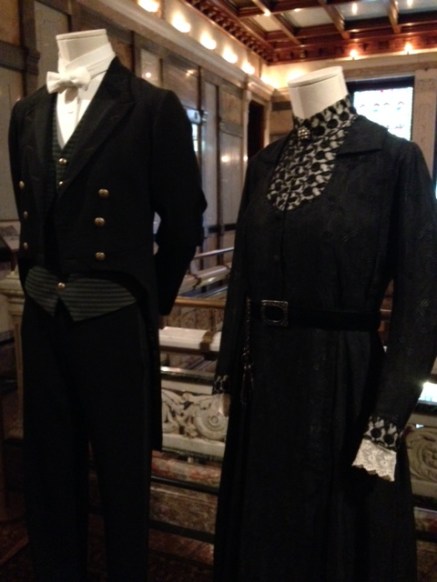
MrsHughes

The servants’ side of the Downton storyline was well-represented by these outfits worn by Barrow and Mrs. Hughes: formal, proper, severe. Pick an adjective. This is the way they dressed all the time!

Edith

I admired the way Lady Edith Crawley embraced the changes and opportunities WWI and the post-war years brought to women’s lives. Here she is wearing trousers, but so elegantly with boots, gloves, velvet-trimmed coat, etc. You may recall she also learned to drive and even drove a tractor on the estate to help with farming chores while the men were off at war.

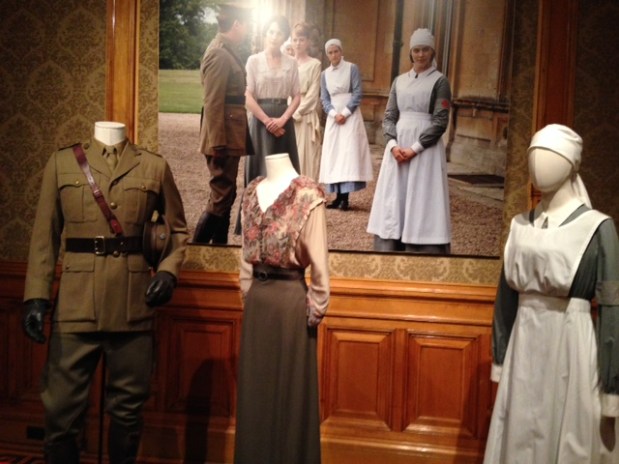
DowntonasHospital

The skirt and blouse, center, worn by Lady Mary, is an interesting example of how the show’s costumers put the outfits together. Many pieces of clothing are original to the period, and therefore fragile. In this case, the chiffon print used on the blouse front was “rescued” from an unwearable garment and sewn onto the front of another blouse.

CoraDebutante

Cora’s velvet dress, worn when she escorted Lady Rose for her presentation at Court, has original lace and beadwork from the 1920’s. Interestingly, I read that the three white ostrich feathers were a requirement for both the debutantes and their escorts at Court! I have no idea why, but it’s worth investigating.

LadyRose

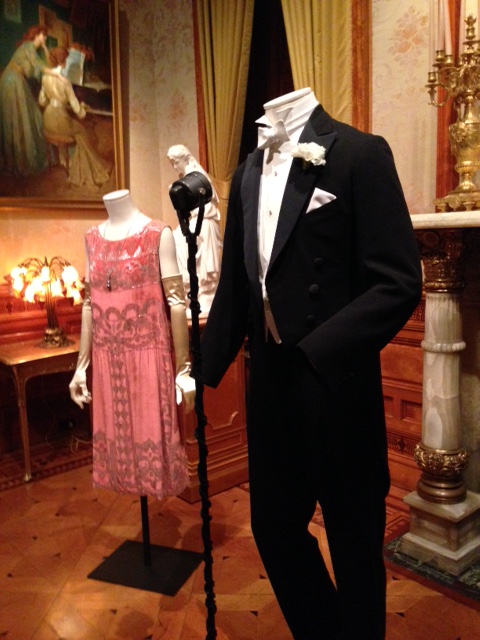
This may have been my favorite! Lady Rose’s dress is reminiscent of the “flapper” style and is also original to the period. It’s silk velvet with glass beads and sequins and also much shorter than what everyone has been wearing. She’s portrayed here with the American jazz singer and musician Jack Ross. Together they caused quite a stir, which pretty much describes Rose most of the time!

You can see why we loved this exhibit. It gave us a wonderful opportunity to step back into the world of Downton Abbey. As I have gone back over the photos, I have been thinking about how much we count on fashion to set the stage, good or bad. So, now I’m wondering, what are people going to say about our clothes in 100 years?

See you next time!