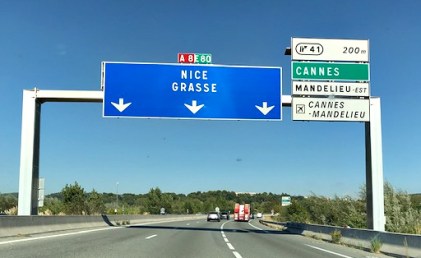
In thinking about this blog post, it occurred to me that though I never thought of myself as a “French Riviera kind of girl,” after our visit there last fall, I’d go back in a heartbeat.
The French Riviera is incredibly beautiful. Blue skies, even bluer Mediterranean water, sunsets that defy any camera to adequately capture them. Turn away from the water and there are hilltops covered in the tiled roofs of villas and, beyond that, mountains.
We included the Riviera on our “great French road trip” because getting that close and skipping it would be foolish, and we wanted make at least some some stops on the “art trail” in the South of France. (You may recall we had been making our way along the western coast of France, beginning in Rouen, then Normandy and Mont St. Michel, before heading to the chateaus in the Loire and then wine tasting in Bordeaux.)
After a beautiful cruise thru the French countryside, with the occasional walled chateau or abbey along the road, we found ourselves navigating in bumper-to-bumper traffic on ridiculously narrow streets, lined with parked cars on each side and street vendors selling everything from sunglasses to take-out dinners. Bikes and pedestrians criss-crossed our paths. What had we done?
But wait, it gets better.
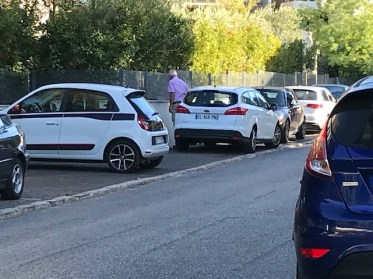
As we motored our way thru the congestion (it was Friday afternoon, the last Friday on the last weekend of the season as it turned out), we were trying to follow Google’s directions to our hotel in Juan les Pins, across the street from Antibes. Google meant well, but when she said turn left, she meant at the intersection we passed 20 yards ago. After a series of ridiculously convoluted detours, we finally pulled into a “parking space” on a sidewalk among a number of other cars and walked to the hotel. Then, having a somewhat better grasp of where to go, Steve moved the car to the underground garage where we happily left it until Sunday morning! (This park nd walk maneuver is one of our best tips. Sometimes finding someplace on foot is easier.)
Our room was large and lovely with a tiny balcony from which we could see the Mediterranean. We would be here for four nights. I don’t think we’d fully appreciated how much we had been “on the road” until now, stopping only for one or two nights along the way. And what a place to take a break. We walked down to the beach, found an empty cafe table, a glass of wine and just enjoyed the sunset. The next morning, after a leisurely hotel breakfast, we walked — yes, walked — about eight blocks, a little uphill and then down, and we were in Antibes!
The French Riviera is a string of cities like Nice and Cannes, and smaller cities and even villages along this lovely coast. We chose Juan les Pins/Antibes as a base because it was smaller than Nice and not as “high end” as Cannes. We could stay close to the water for a reasonable price. All of these cities are connected by a train line than runs frequently throughout the day, like a commuter rail. In fact on Monday, we walked to the station and took a short train ride to Nice.
This is Picasso country
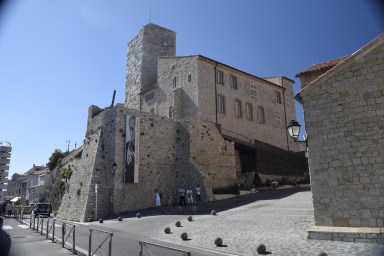 Antibes was a fairly busy place on a Saturday morning, but we easily found our way to the Old Town with the usual tangle of charming, narrow streets and interesting shops. Our destination was the Picasso Museum. (Actually, there are Picasso Museums all over France it seems. I have also been to one in Paris.)
This was on a Saturday morning and we had been taking our time, ooh-ing and aaah-ing over the Antibes waterfront and wandering thru the old town. We arrived at the ticket office just before noon. We walked up to the ticket wndow along with some other visitors only to have the ticket-seller (who on this day was apparently also the ticket-taker) announce to all those around, that it was his lunch time and he would be closing until 1:30.
This is so quintessentially french, you just have to go with it.

So, we wandered back to a food market complete with a cafe, ordered a light lunch, and did some people watching. I checked out a brocante market and we got sidetracked by two wedding parties celebrating along the way. Back to the museum.
This particular museum is housed in the Chateau Grimaldi, a 14th Century Roman Fort turned museum in which Picasso enjoyed a work space in 1946. His time in this space was short, from September until mid-November, but his artistic output was remarkable. He produced 23 paintings and 44 drawings during this short time. Interestingly, he donated all this work to the museum, which eventually acquired much more, including sculpture and ceramics.

About Picasso. Although I am not a huge Picasso fan, I have come to genuinely appreciate his work and its evolution, as well as his influence on generations of artists. The range of his work extends from painting, drawing and sculpture to include set design and ceramics. I wish I pictures of his ceramics, they were stunning. (This is what happens to me. I get so busy looking that I forget to take photos!)
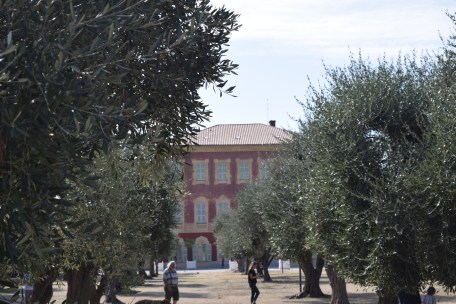
The next day we dared to take the car from the garage to the outskirts of Nice to visit the Musee Matisse.

After a predictably adventurous drive, we arrived at the museum, where interestingly (ironically?) there was a substantial exhibit recalling the friendship and rivalry between Matisse and Picasso. (Did I say this is Picasso country?) Matisse and Picasso met sometime in 1906 at Gertrude Stein’s Paris salon. (Americans Gertrude Stein, her brothers Leo and Michael and Michael’s wife Sarah were important collectors and supporters of Matisse.) Picasso, who was 11 years younger, and Matisse were artistic contemporaries. One of the most interesting displays in the exhibit was a pair of black and white films of each of them at work on similar pieces.
Matisse was 48 and a successful artist when he first came to Nice in 1917. Initially he wrote that it rained every day for a month. He was about to leave when the sun came out and he was hooked by the light. He never really left.
After Matisse we headed further inland to St. Paul de Vence, hoping to at least have a drink at La Colombe d’Or, the restaurant where so many artists paid their tabs by offering a painting or drawing in lieu of money. Did I mention this was a Sunday? On the last weekend in September? Everyone in France goes out to lunch on Sundays, especially beautiful September Sundays. The views on the drive were breathtaking, the town was packed, and the restaurant was unapproachable even for a drink without a reservation.
We knew better, but in our “carefree vacation” mode we just assumed they would throw open the doors for Janet and Steve. Happily, we found a table in an outdoor cafe and enjoyed a delicious lunch and some serious people watching. But we found the town too crowded to enjoy. C’est la vie.
On our last full day on the Riviera, we took the train from Juan les Pins to Nice to explore the old town. It took less than 30 minutes and, once in Nice, there is a handy tram a block from the train station that runs down to the water, making several stops along the way. This was a day to walk and enjoy. Nice is very old and so close to Italy, that the influence is striking. Look at these pastel hued buildings, so different from the neutral stone in the rest of France.

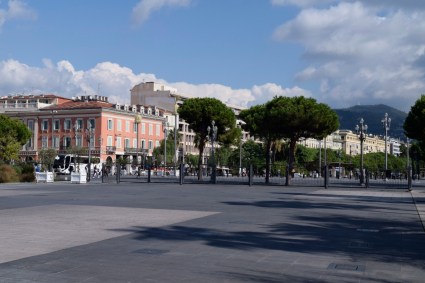
This streetscape of fountains and park amid more substantial buildings is in the heart of the town near the water. Note the clouds: a change in the weather was on the way. Although the sun shone all day, it was much cooler by the time we went to dinner.

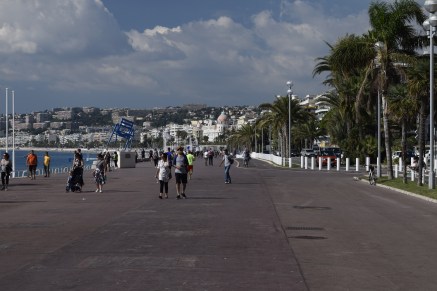
This is the Promenade des Anglais. We walked here for several yards before I realized this is the idyllic spot where terrorists drove a huge truck into the crowds celebrating Bastille Day on July 14, 2016. Today the promenade is lined with bollards, but the horror of that night is hard to imagine in the midst of sun and sea.
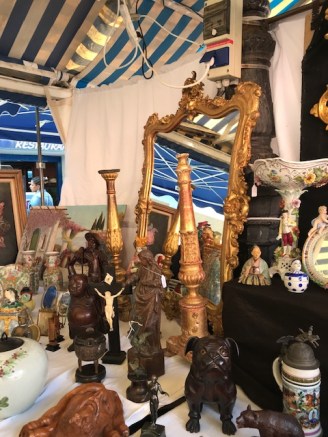
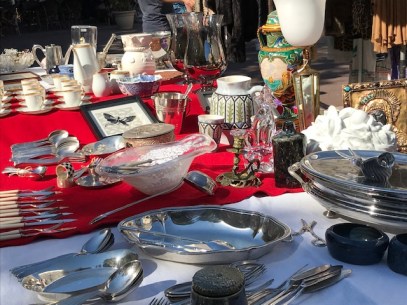
As luck would have it, we were in Nice on the day of their regular antique market, which in this case was blocks-long, winding from one square to another. I was in heaven, Steve not so much. One of the most striking aspects of these markets is the age and provenance of the goods. There are chandeliers and gilt mirrors, confit pots, textiles and more that I have just never seen in a market in the midwest.
Despite our “longer stay” on the Riviera, we left the next day, promising ourselves to come back. In fact I would call this our “preview visit” to the Riviera. There is so much more to see on the art trail, we never got to Monaco or St. Jean Cap Ferrat or Cannes.
This is the mantra of our travels. And it is, I suppose, why we are totally unapologetic about returning to places that we love. There’s always more to see. What about you? Are you willing to make a return trip to a destination you really liked? Or do you feel each place you visit — in this country or around the globe — needs to be new? I’d love to hear your thoughts on this.
Thank you so much for stopping by. See you next time!
 This is how it happens: people, places, or simply the tide of current events sweep by and my innate geekiness about history and American government go into overdrive. This week it’s the passing of Senator John McCain.
 Ivy & Ironstone