A different vibe in Florence

Florence fom San Miniato2I’m not sure if Florence has a different vibe from Rome or if we had a different vibe ourselves when we got there, but this leg of our trip was definitely a little “looser.”

If you read my post on Rome, you know we started there with some scheduled tours. In Florence, we started with two and a half days to explore the Uffizi, Duomo, Academia, and more. Because some of the sites in Florence require a reserved admission time (or a long wait in line), we had to arrange those, but that was pretty easy. On the fourth day there we had arranged to join a small tour from Siena to the Clay Hills, a monastery and a vineyard. We had a fifth day for anything we missed, wanted to go back to, etc.

Florence is a relatively short train ride from Rome and our hotel was a 10-minute walk from the Florence train station. Well, it actually took us at least 20 minutes. We didn’t pay really close attention to our map and we spent a lot of time marveling at the charming streets we were walking, the churches, the squares. Florence is just so pretty!

Florencepretty1
This is what it really looks like. One lovely view after another.

By the time we got to Florence I was feeling a pull between the obligatory museum and cathedral visits and simply wandering the sidestreets, poking around tiny boutiques, enjoying a daily gelato. The weather in Florence was still unseasonably chilly (I actually wore the same black sweater to dinner seven nights in a row!) and rainy from time to time, but I honestly don’t think it got in the way.

After checking into our hotel, we grabbed some lunch a few blocs away in the Piazza della Signoria and headed across the piazza for the Palazzo Vecchio. Oops! This is the day it closes at 2:15. So, we walked through the courtyard of the Galleria degli Uffizi and down to the Arno. There was a lot to take in: the architecture, the river, the people. Eventually, we headed back towards our hotel to meet friends from home (they were on the last day of their stay in Florence) for drinks and dinner.

PonteVecchio2
The Ponte Vecchio was once a marketplace, today it is home to upscale jewelry and leather shops.

After drinks in the hotel bar and debriefing each other on our recent travel adventures, five of us set out for what is loosely known as “the first nite restaurant,” named by mutual friends who had a tradition of spending Thanksgiving in Florence (which is apparently where all the pilgrims go when they want a change of scene). This was another wonderful saunter, window-shopping our way across the Ponte Vecchio and beyond to the tiny piazza where Trattoria 4 Leoni  is located. Seated at an outside table, we enjoyed a fabulous dinner (pasta filled with pear and asparagus in walnut butter sauce. One word: yum!) As we were finishing up with espressos and coffee, travel guru Rick Steves showed up. Alas, no film crew, but fun to know he chose this restaurant too!

The next morning we went to the Uffizi, which was glorious, but not without its comic moments. We had opted not to take their tour as we had downloaded a Rick Steves audio tour of the museum to our phones. His tours are very professional, introducing art historians to talk about various pieces. However, in this case, many of the pieces had been moved to accommodate renovations in the building! It really was pretty funny, took a few adjustments and we did our best.

The collections in the Uffizi beautifully demonstrate the transition from Medieval to Renaissance art and the growing sophistication of painters in their representation of the human form and their use of perspective.

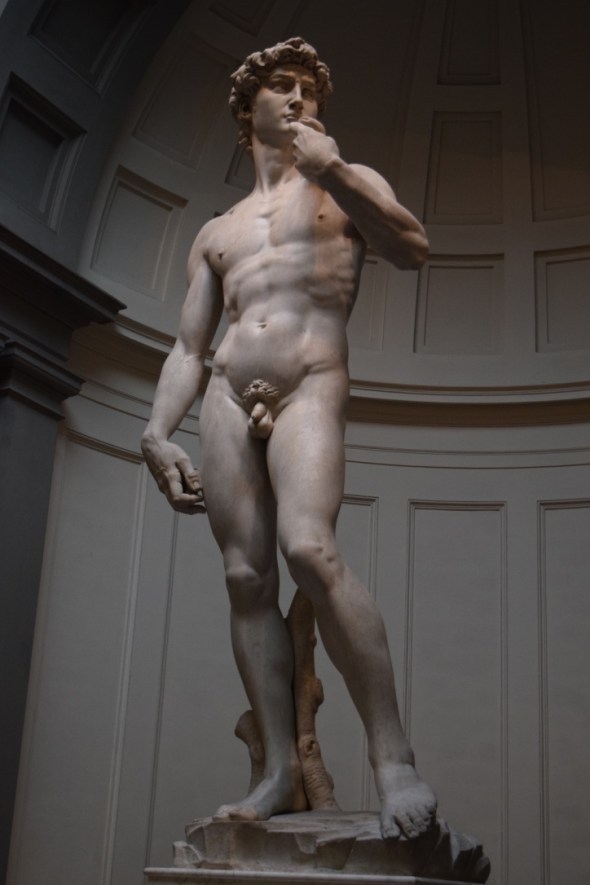
That afternoon we went to the Academia to see Michelangelo’s David. Of course, we had already seen “it” everywhere, including the copy in front of the Palazzo Vecchio. Despite all the photos, copies and general hype, seeing this in person is truly breathtaking.
David
Michelangelo’s David.

That night we had dinner at a Ristorante Paoli near our hotel. As we were enjoying yet another delicious plate of proscuiutto and melon, who should walk in but Rick Steves, again! Wow! Is he following us? We must be picking the right restaurants. (Disclaimer: Though the restaurants were recommended by friends, both are listed in his book.) He even came back to ask the couple next to us how they had found the restaurant and compliment us on dining at a European hour (it was well after 9:00 pm). And no, I did not mention that his audio tour of the Uffizi is way out of sync!

If you were feeling cynical…

You might say Florence is pretty commercial. Every square or piazza is ringed by stands hawking leather goods, scarves, refrigerator magnets shaped like Michelangelo’s David, etc. The most obvious cafes in these locations serve ho hum pasta, pizza and wine to tired tourists who are glad to have a seat. And don’t get me started on the parades of tourists following a guide wielding an umbrella or paddle in the air. It can seem a little grim.
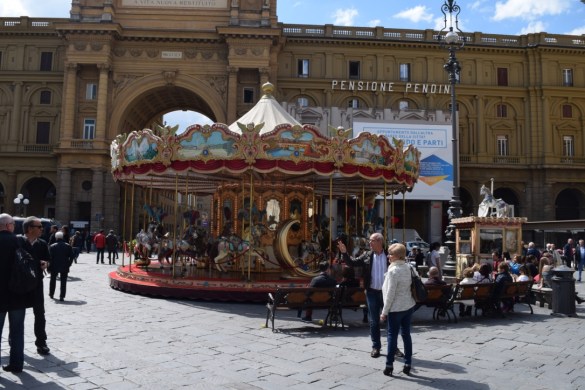
 

Carousel
Carousel and tourists in the Piazza della Repubblica. Our hotel was nearby, and we stopped by often to see what was happening.
Opera singer
Opera singers performing in the Piazza della Repubblica. Their performance was amazing.

But then you turn a corner, look a little further for what may be a quieter cafe with a local vibe, and you fall in love with Florence’s charm.

Florence street
We had one of our favorite lunches ever here, in a tiny cafe. The cook was also the owner and the winemaker!

One morning we were headed for the Duomo, but apparently our mental maps needed re-calibration, because we ended up at Santa Croce. It is the principal Franciscan church in Florence and the largest Franciscan Basilica in the world, consecrated in 1442 by Pope Eugene IV. Although its design is somewhat simpler inside, reflecting the Franciscan order, it is hardly plain. Many of the chapels are decorated by frescoes by Giotto and his pupils. Santa Croce is also the burial place for a number of important Italians, including Michelangelo, Galileo and Machiavelli. We also discovered the leather workshop adjacent to the church, where aspiring artisans learn the traditional techniques for creating the genuinely beautiful leather pieces Florence is known for. I’m sorry to say we missed the monument to Florence Nightingale, who was born in Florence and named for it.

If you stay flexible, willing to follow your nose, you may find a real treasure. Friends had recommended taking the #12 bus across the river to Piazzale Michelangelo, a great vantage point for photographing the city. We took advantage of a warm, sunny morning to do just that. The ride through Florence and across the river offered beautiful views of the city — narrow, cobble-stone streets, stucco and stone buildings and a veritable sea of tile roofs.

As the bus climbed to the sought-after vantage point, another passenger overheard us discussing which stop we needed. She nicely pointed out that it would be easy to identify — everyone would be getting off there.  But she also told us about another, better vantage point which we could could walk to from the bus stop. So we followed her up a steep path to San Miniato al Monte.

SanMiniatoalMonte2
San Miniato al Monte is a Romanesque jewel.

San Miniato was a Roman soldier condemned to death in the third century for being a Christian. As the legend goes, the beasts in the amphitheater refused to devour him and when the Roman soldiers then beheaded him, San Miniato picked up his head, crossed the Arno and walked up the hill to this point where he died. (I guess that makes it a mythical legend.) Eventually a shrine was built on this spot. Construction of the current church, considered one of the finest examples of Romanesque architecture and one of the oldest churches in Florence, was begun in 1037. The adjacent monastery was originally a Benedictine community, but it has been run by Olivetans since 1373.

A change of scene in Tuscany

If we were overloaded on art, basilicas and cathedrals when we left Rome, our days in Florence threatened to put us over the edge (and Steve and I like this stuff!). Happily, before we left home we had tracked down Tours by Roberto (another find on the Rick Steves forum) and arranged to join one of his groups on a day trip to the clay hills, a monastery and lunch and wine tasting at a Tuscan winery. These tours are limited to eight people, but on this day the tour had been oversold, so Roberto’s driver, Andre, picked us up at our hotel in Florence and we enjoyed a private tour until we caught up with the others at the winery. The day was a delight.


The scenic drive thru the hilly terrain and Andre’s knowledgeable conversation about rural life from Roman times to the present set the stage perfectly for a stop at the Abbazia de Monte Oliveto Maggiore. Although there were other tourists there, and the monks make and sell their own products as well as those of other monasteries, the atmosphere was steeped in quiet.

The monastery centers on a pavilion lined with frescoes begun by Signorelli (eight scenes dated 1497-98) and later finished by Sodoma. The frescoes tell the life of Saint Benedict. As was the case in the Borghese in Rome, one of the joys of this small tour was how close we were able to get to the frescoes and see the artistry in their detail. These artists were not without a sense of humor. Sodoma  inserted a self-portrait on one of the panels he painted, including his pet badgers at his feet! (Michelangelo and Raphael did the same in the Vatican, without the badgers!) In the top right image below, you see two horses in the distance, but because the artist was being hurried to complete his work, there are a total of only six legs.


We stopped to stretch our legs and take pictures in Chiusure, a tiny, tiny town, typical of those that dot Tuscany.


From there we headed to the agricultural estate of Santa Giulia in Montalcino and met up with Roberto and the rest of the group. The winery is just one aspect of the 18-hectare farm that has been in the Terzuoli family since 1950. It is stunningly beautiful, but that’s just part of the story.


Roberto took us into a storehouse where the salami, prosciutto and other meats made by the family from animals raised on the farm are cured. The winery produces a brunello wine from San Giovese grapes grown on the farm. The wine must be approved by a consortium that carefully protects the quality. Each grower is allowed a limited size vineyard with specific soil and exposure to produce the best grapes. The wine must meet specific standards throughout its production or it cannot be labeled brunello. (All of which, I suppose, allows them to look down on California wines, produced with far fewer restrictions!) The total production is small, about 10,000 bottles.

Eventually, we sat down with the other eight tourists, Roberto, Andre and the winemaker for one of our most memorable meals in Italy. As Roberto promised, when we ate the meat, made from the animals on that farm, and drank the wine made from the grapes on that vineyard, the flavors of that soil and sun blended perfectly. (Did anyone say say farm to table?)

And, yes, our case of Brunello arrived this week.

Everyone has their own Italy

Steve and I have a number of friends who have traveled to Italy, some of them many times. As we were putting together this post, we talked about how everyone has their own Italy. Our friends who traveled annually to Florence for Thanksgiving had previously traveled throughout the country but decided Florence was their city and stuck with it. Another couple we know has family well south of Rome in Lecce. They’ve tied their Lecce visits to travels throughout Italy, but always manage a few days in Rome. Others lean towards Naples and Capri. And we know a few others who have hit as many high points as possible on a single, escorted tour.

Right now I think we would love to go back to Tuscany, stay in one hill town and take the time to explore others.It’s worth adding that we said the same thing last year after a river cruise in Provence. Let’s go back and explore on our own. Although I love the history in the cities and would certainly not want to skip it, I think I truly enjoy the pace and the lifestyle of the smaller towns. What about you?

See you next time!

A Pair of Independent Travelers in Rome

I know, I’ve been missing from the blog, but I have a great excuse: My husband and I were traveling in Rome, Florence and Pisa and then stopped over in London for a few days on our way back to Chicago. Whew! A lot of miles, museums, art, food, wine, churches — too much for a single post, but let me start by telling you a bit about Rome…

This was our first trip to Italy, ever, and we were the quintessential tourists with all the classics on our must-see list in Rome: the Vatican, the Coliseum, the Forum, you know the drill. You should also know that we watch a lot of travel shows on TV, especially Rick Steves (which made running into him, twice, in Florence, really funny). In fact, we relied heavily on RS in planning the trip, reading his books and posing questions on his forums (which always results in great, informative responses).

I describe us as “independent travelers,” because we just like to move at our own pace. However, we did need some tour help to make sure we were making the most of our sightseeing, so we booked several specific tours well in advance of our arrival. Good thing, too. Rome is big, busy, boisterous and, as one friend who has traveled there often describes it, grittier than some other cities. Personally I would say it pulses with its own dynamic energy.

We arrived on a Sunday afternoon and checked into our hotel near the Piazza del Popolo in time to join the daily, late afternoon/early evening stroll known as the passeggiatia. (The piazza is located just inside the city’s northern gate known as the Porto del Popolo and is home to two churches, Santa Maria in Montesanto, built 1662-75 and Santa Maria dei Miracoli, built 1675-79. Brace yourself, history is everywhere here.)

PiazzadelPopolo
Looking down on the Piazza del Popolo with the dome of St. Peter’s in the background

We walked down the Via del Corso, headed for the Spanish Steps. Alas, see the fences? The steps were closed for renovations! (I guess you have to expect some of that in a city over 2000 years old, but really, the Spanish Steps?)

SpanishSteps

It was, however, a walk to remember, a people-watcher/sightseer delight: tourists and locals of every age, tiny alleys and passageways, gelato stands and sidewalk cafes. We kind of had to pinch ourselves, “are we really in Rome?”

The next morning we joined an 8:30 am tour at the Vatican with one of their guides and 25 other eager tourists. What we did not know, however, was that this was a national holiday, celebrating the defeat of the Nazis in WWII. So despite our early start, we were shoulder to shoulder with everyone else in Rome, it seemed, as the tour proceeded. The guide was awesome, her knowledge of the art and artists endless, but frankly I think I will always equate the Vatican first with massive crowds, then with the art.

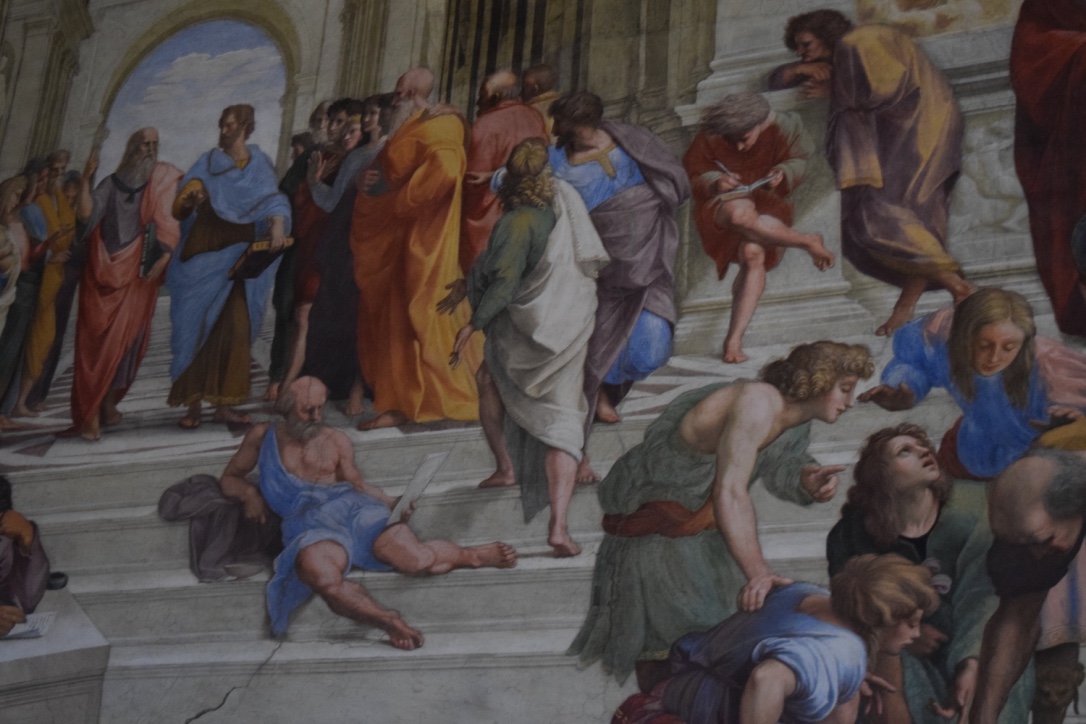
Rafael_1
Just a section of one of Rafael’s frescoes in the Vatican’s Papal Apartment. Our guide told us that unlike Michaelanglo who worked alone, Raphael had a crew of artisans who colored many of the frescoes he sketched. The artist was only 25 when he began these works!


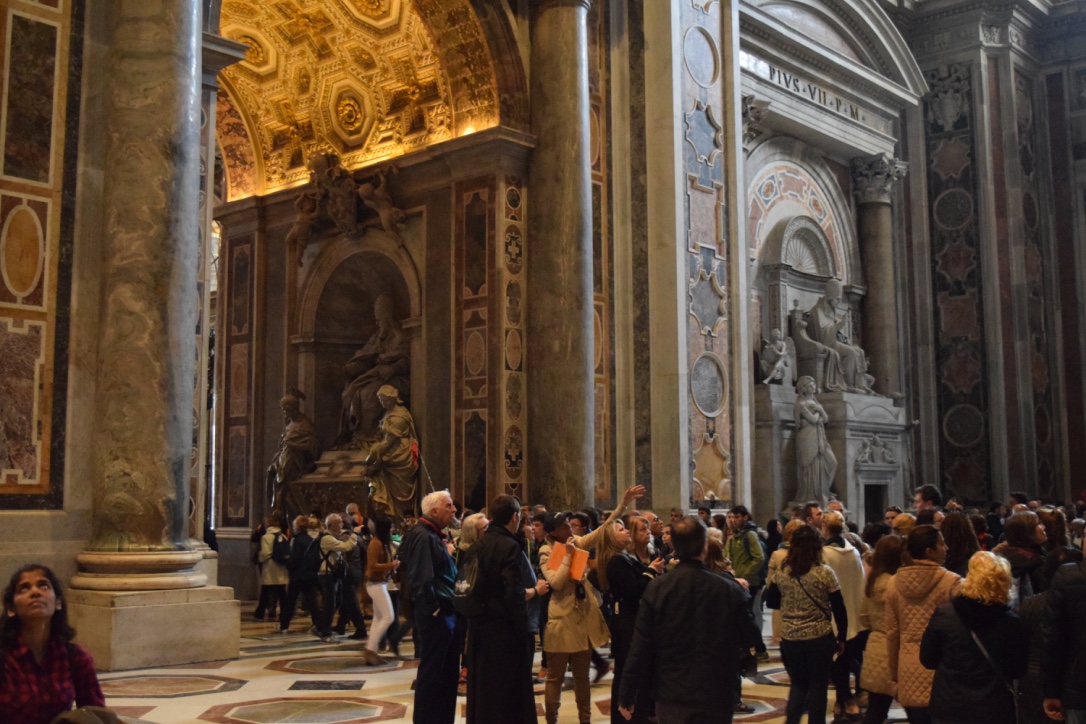
St.Peters
St. Peter’s is breathtaking and immense. I know that’s not saying much, but it pretty much left me speechless.

After more than three hours on foot at the Vatican, we were glad to take a quick lunch break and grab a cab for the Borghese Gallery for our next tour. We actually had not planned to do both in one day (and we paid for it with “museum overload”), but there was a last-minute change in museum schedules, and the tour company offered this change, so we went with it.

This tour was the exact opposite of our Vatican experience. Context Tours limits groups to six participants; this time there were only four of us with an art historian for two hours in the Borghese Gallery. The afternoon was essentially a mini-seminar in Italian art history.

The wealthy and powerful Borghese family built the villa to house and display their art collection, not unusual for Renaissance families. The gallery houses works by Bernini, Caravaggio and Titian, among others. Compared to most other European museums, it’s  small and intimate. We got a closer look at things in a much quieter setting.

RapeofPersephone
Bernini’s “Rape of Proserpine” (1622) is remarkable for so many reasons, not the least of which is his ability to capture detail in marble. Look at the hands and feet!

After this first day, we continued to move farther back in time, pulling back layers of Roman history to tour the Coliseum and ancient Rome via the Forum and Palatine Hill. It was occasionally rainy and a little chilly that afternoon at the forum, but impossible not to be struck by the history that transpired there, just think Julius Caesar.

Coliseum2
The Coliseum. Our guide told us that despite popular images of chariot races here, there was not room. They took place at the Circus Maximus.
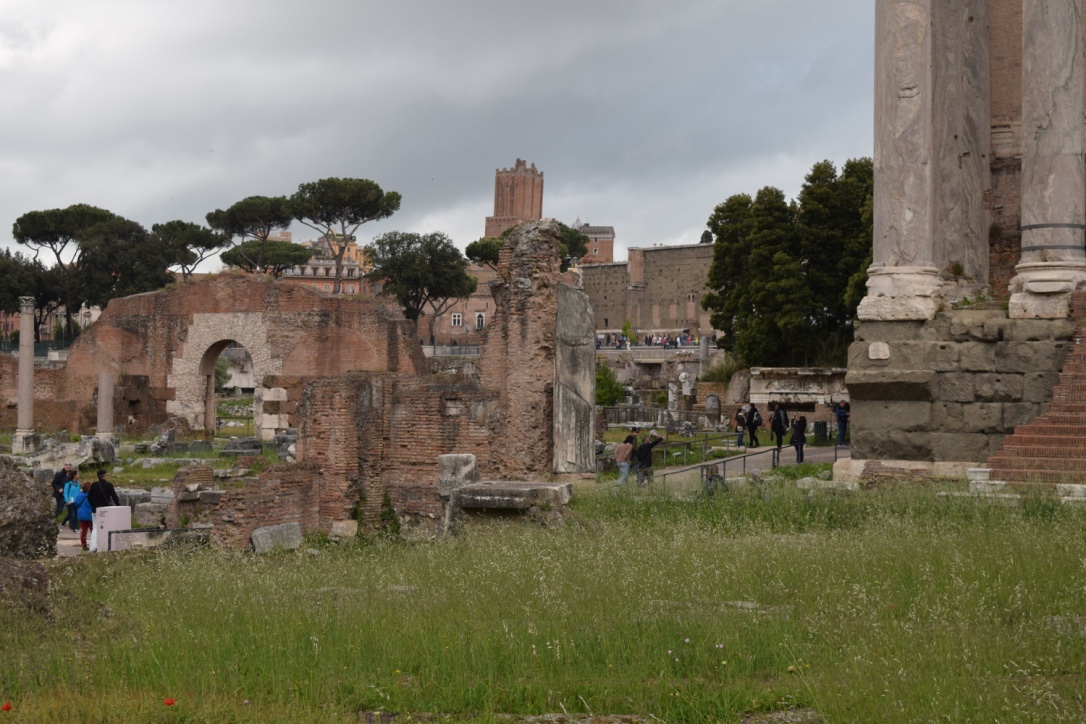
Forum
Though it was once the heart of the Roman Empire, the Forum was actually buried by centuries of flooding from the Tiber River and run off from the adjacent hills. It was  only excavated in the 19th century.

One rainy morning we set off on foot (again!) and found ourselves first at the Trevi Fountain and later at the Pantheon. In both cases I was struck by how tightly both of these sights seemed to be “squeezed” into their respective locations.  The Pantheon was completed by the emperor Hadrian and probably dedicated about 126 AD. The circular building is topped by what is still considered to be the world’s largest unreinforced concrete dome. The city just grew up around it!

Pantheon2
Originally built as a pre-Christian temple to honor all gods, then later converted to a church, Michaelangelo used the Pantheon dome as the model for the dome on St. Peter’s Basilica. Raphael is buried here.

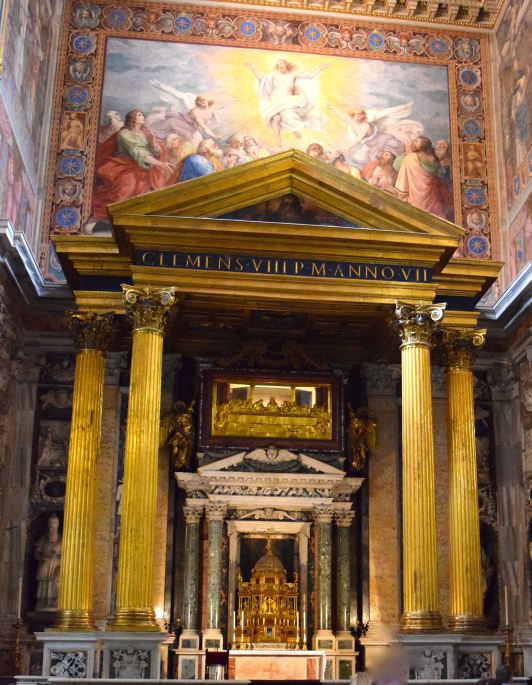
I can’t close out this Roman travelogue without telling you about the Archbasilica of St. John Lateran. It is the cathedral of the Bishop of Rome and ranks above all other Catholic churches. It was the home church of the popes before the Vatican, in fact before the papacy was moved to Avignon. During that time, the church was damaged twice by fires and despite repairs, was not thought to be adequate when the papacy returned from France. Ambitious renovations were eventually completed, notably the installation of the statues of the 12 Apostles in 1718.

Steve learned about it as we were doing our research about the trip, and we’re very glad we found our way there. It’s a remarkable place, nearly as big as St. Peter’s and as quiet as St. Peter’s is crowded.

I should note that this site, like others, had tight security. In addition to the obvious presence of heavily armed military and police, we entered through metal detectors. Backpacks and purses were scanned separately.  This is the world we live in today.

Lateran.jpg
The Archbasilica is the burial site for a number of early popes.

Across the street from the Archbasilica are the Holy Stairs, brought to Rome from Palestine by St. Empress Helena, mother of then-Emperor Constantine I and said to be the same stairs Christ traveled during his crucifixion. The marble stairs are protected by wood, but continue to be an important site for religious pilgrims.

Despite the crowds and the “iffy” weather, Steve and I had a terrific time in Rome. We walked, a lot, and were literally footsore by the time we returned to our hotel each day. We quickly adopted a rule that limited dinner to restaurants in a two- or three-block radius. Happily, the neighborhood was offered a number of small restaurants that served as many locals as they did tourists. (One night the waiters rearranged the dining room in mid-meal to accommodate a large family dinner!) We thought this was a good sign. Locals wouldn’t dine someplace that wasn’t really good.

Italians don’t even think about dining before about 8:30 or 9 and appearing earlier, even if the restaurant is technically open, seems a little rude. Instead, we would stop by around 7 pm and ask for a table later. They were always happy to hold one for us. Before we left home, a friend told us that restaurants would not serve wines they were not proud of. We took his advice and ordered the house red and it was always, always delicious.

Rome lived up to every expectation, but after four nights it was time to move on to Florence. More about that soon!

See you next time!


My Rules for a Good Book

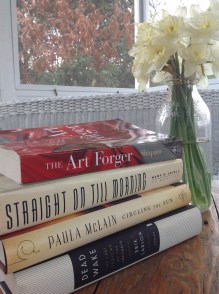
BooksA friend recently texted me, looking for a few book recommendations. After I texted back my current “short list” of favorites, I realized the request may fall under the heading of “careful what you ask for…”

I am a reader and always have been. In fact, when the first day of first grade came and went and I did not learn to read on that day, I was sorely disappointed and not at all sure I wanted to go back. Learning to read was my sole purpose in going to school.

Today I am one of those readers who likes to have a reading list or, better yet, a stack of books waiting, so I know what I’m going to read next. I get a little nervous if it seems I will finish one book without having another to pick up. Electronic readers have been an expensive boon for me. You can finish one book and immediately download another. And I’m embarrassed to say that I do.

Lately, I’ve had the pleasure of several good reads in a row, a few for one or the other of two book groups I participate in, others just for me. As I gathered them up to write this, I began to consider what makes a “good read.” I’m just offering three rules here. They aren’t exhaustive, but I think they are a good start.

Everyone seems to have read the 2015 Pulitzer Prize Winner for Fiction All the Light We Cannot See by Anthony Doer, about a young blind girl in Paris and a gifted orphan boy in Germany, growing up in the years leading up to and through WWII. They are leading meager, often lonely and always challenging lives before the war, but then are thrown into unthinkable circumstances that lead to unexpected acts of heroism.

I loved the characters, even the minor ones, some of them were charming and others unspeakably bad. I am not sure I would call this a war novel, though it’s set largely in wartime and the war plays a significant part. However, I thought it was about what makes a family (certainly not always blood), the obligations of friendship (life/death/survival) and the power of communication. Doer carefully alternates between the stories of Marie-Laure and Werner. There is enough detail and plot to bring them to life, but I never felt bogged down by it. The book covers a significant span of time, but Doer moves it along. I would describe his writing as tight, pushing the story (and the reader) forward.

One of my book groups read this, but the discussion focused largely on maybe the last third or even quarter of the novel. Doer does an interesting job of bringing his characters into the present and our discussion that morning trended to those points. However for me the journey of the two main characters was far more interesting.

Good book rule #1:
The author keeps the story moving forward rather than languishing in wordy description and unimportant detours.

Circling the Sun by Paula McClain is a biographical novel about Beryl Markham, a well-known horsewoman-turned-airplane pilot in Africa in the first half of the 20th century. I was anxious for this book’s release since I had read and loved a biography of Beryl Markham years ago, Straight on Til Morning by Mary S. Lovell, also a great read. As a pioneering aviator, Beryl Markham was the first woman to cross the Atlantic and the first person to fly from London to New York nonstop. (Paula McClain also wrote The Paris Wife about Ernest Hemingway and his first wife, Hadley.)

The Markhams emigrated from England to Kenya when Beryl was very young. Her father struggled to build a business as a horse breeder and trainer, but her mother never liked Kenya and abruptly returned to England. Beryl was left to be raised by her father and the local Kipsigis tribe who shared the land. Not surprisingly, Beryl grew to be a fiercely independent, resourceful young woman, one who loved Kenya, the natives, the land, the animals and the magical ways in which they all fit. She also loved and knew horses. But that’s the thumbnail version.

Beryl was part of the expatriate community in Kenya that also included Karen Blixson and Denys Finch Hatton (Remember Out of Africa?). Many had emigrated from England and other parts of western Europe in search of economic opportunity, adventure, or to escape their past. They were proper (Remember Karen and her white-gloved servants?) and held on to tradition in a setting that was anything but tame.

I would be the first to admit that this book is not Out of Africa, but McClain does a wonderful job of capturing the African landscape, the tenacity required to survive there, and a view of the English expat community. And then, of course, there is the story of Beryl Markham. She was young and totally unprepared for the life fate thrust at her (more than once). She had nowhere near the education or resources of Karen Blixen, but boy was she brave. She had no choice.

Good book rule #2:
You root for the characters. (Bonus points for biography, which I love.)

The same book group that read All the Light We Cannot See also selected Dead Wake by Erik Larson. We picked it because Larson would be speaking at the local junior college around the same time. That may have been serendipitous to the group, but I was disappointed. A factual accounting of the 1915 sinking of the Lusitania, no matter how heralded, seemed, at best, boring. I honestly have no interest in the details of ships or submarines. I had struggled through one of his earlier books, Devil in the White City, because of its Chicago setting. However, the point of this book group is to stretch our reading boundaries and delve into something we might not ordinarily choose, so I got the book.

I loved it! (And you probably saw that mini review coming.) Larson’s meticulous research and attention to detail made the diverse cast of characters on the Lusitania come alive. The ambitions of the German submarine commander, Walther Schweiger, were equally real. But I also loved the machinations of Winston Churchill, who as First Lord of the Admiralty of the British navy, was desperate for the US to enter the war at the same time as the Americans and President Woodrow Wilson were resisting every step of the way. And then there was the steamship line. I had to keep reminding myself that this was an actual event, a piece of history, and told by Larson in a factual way. The villains were real; I don’t think they were all German.

Good book rule #3:
You’re challenged to read something you would not normally choose, and it becomes a favorite.

So what did I recommend in reply to my friend’s text? I was pretty sure she was familiar with these three, but I had more to suggest. The Storied Life of AJ Fikry by Gabrielle Zevin about a small town book store owner is a reader’s delight, with a wide-ranging reading list woven into the story. The Art Forger by B. A Shapiro is a mystery with enough twists to keep you reading and an interesting view of the art world’s underside.

Two others are high on my list. Now that everyone is talking about visiting Cuba, Telex from Cuba by Rachel Kushner is set in an American enclave in 1950s Cuba, when the US was backing Batista and Castro was gathering rebels in the hills. Finally, Out to Lunch by Stacey Ballis is pure fun, especially for foodies, about a successful Chicago cook and caterer, with the requisite colorful cast of friends and suitors, reinventing herself after the sudden death of her business partner. If nothing else, read it for the amazing recipes.

Want more ideas? Check out http://www.whatmaggieread.com. (Disclaimer: It’s my daughter’s blog, which she has been writing for a few years. Her taste in books is a bit broader than mine, so if you are looking for ideas, she may have lots more!)

What do you think makes a good book? What are you reading? I can use all the recommendations I can get!

See you next time!

Vincent van Gogh, Provence and Chicago

Arles1
Place de la République in Arles, France.

This week my husband and I enjoyed one of those serendipitous times when a slice of our travel experience merged with our Chicago life. We went to Chicago’s Art Institute to hear a lecture and view the current exhibit on Vincent van Gogh’s three bedroom paintings. The travel part (besides taking the commuter train from Wheaton to Chicago) recalls our visit a year ago to Saint-Remy de Provence, France.

At this time last year, Steve and I were on a river cruise in Provence. (I think it may be a rule that retired baby-boomers take at least one of these cruises.) One of our first stops was in Arles, France, where van Gogh spent a considerable time, renting the yellow house where he did so much work, including the paintings of his bedroom.  (Unfortunately, the house was destroyed in WWII, although many other Arles structures survive.) The yellow house was extremely important to van Gogh, who had decided to leave Paris, where he believed the “artistic lifestyle” was unhealthy and keeping him from continuing his work.

Arles happened to be chilly and drizzly the morning we were there, and we did not have as much time to explore as I would have liked. (This is the upside/downside of a river tour, you see a lot but the price for that is having to move on to the next stop.) Arles is much more than a temporary home for van Gogh.

According to Wikipedia, historians have dated settlement in Arles to as early as 800 B.C.  The city was an important Phoenician trading port before being taken by the Romans in 123 B.C.,  expanding its influence. Constantine I built baths in Arles; Constantine II was born here. 

Arles Roman Ruins21
Roman ruins in Arles.
Arles Coliseum 21
Roman Amphitheater, Arles. In the Middles Ages, the population declined significantly; this site became a fortress, the residents living inside.

DSC_0046
The hospital in Arles where van Gogh was confined in December 1888 and January 1889 (after the legendary ear-severing episode) was later the subject of two of his paintings.

Van Gogh’s respite in Saint-Remy

After the tour of Arles, we took a side trip to Saint-Remy where van Gogh did so much painting. At the time, the artist’s mental health was very fragile, and he asked to be sent to Saint Remy de Provence to be confined at the Asylum of Saint Paul Mausole. Van Gogh’s mental health improved here, and he enjoyed an especially productive period artistically, completing almost 150 paintings and a number of drawings from May 1889 until May 1890.

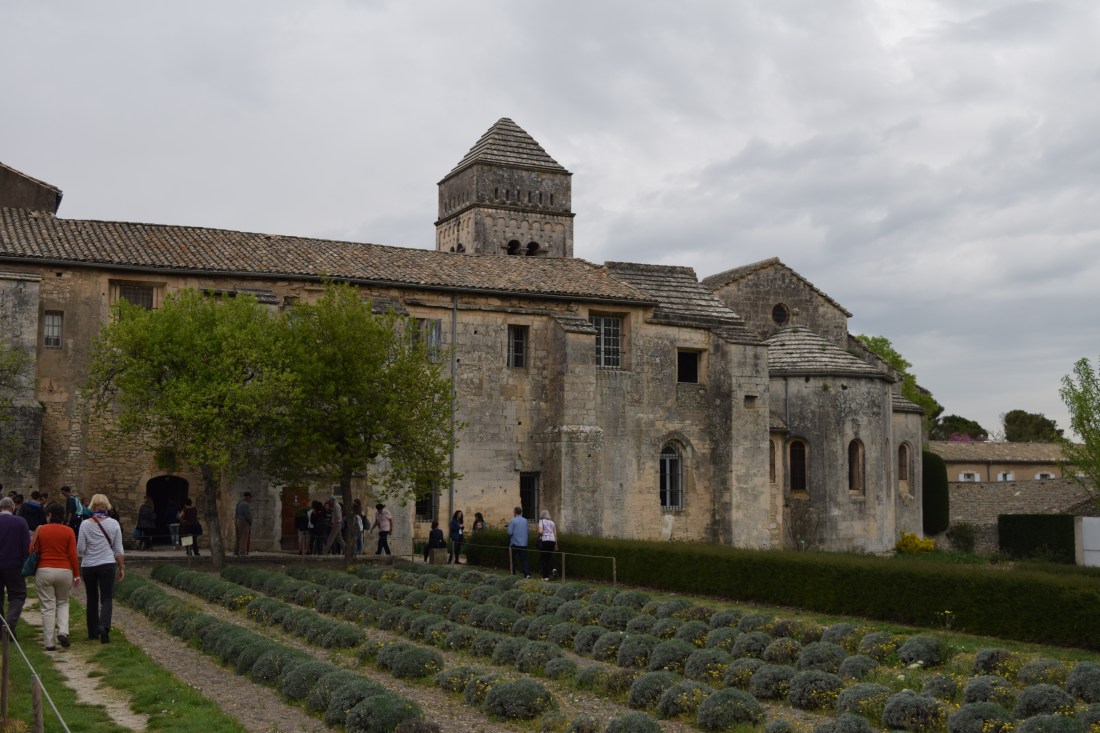
Although the monastery is probably best known for van Gogh’s stay, it is considered a masterpiece of Provencal Romanesque art. The Cloister dates to the 11th -12th Century. One wing houses a museum which retraces the period when Vincent van Gogh was committed to Saint-Paul. One room in the museum recreates the bedroom from his home in Arles that van Gogh painted.

DSC_0067
Gardens behind the monastery feature rows of lavender. Can you imagine what they look like in bloom?
DSC_0075
This is the beautifully spare chapel.

Back to the Art Institute in Chicago

Van Gogh actually completed three paintings of this bedroom, each just a little different in size, color and detail. Today, one painting is part of the permanent collection of the Art Institute of Chicago, one is housed in the Van Gogh Museum in Amsterdam and the third in the Musee d’Orsay in Paris. The current exhibition in Chicago is one of the few times all three paintints have been shown together.

for-comparison-this-is-the-original-1889-painting-by-van-gogh-on-view-at-the-art-institute-of-chicago

The Art Institute has done a remarkable job of pairing the paintings themselves with a multi media presentation of details that allow the visitor to closely examine the paintings, paying particular attention to those details that distinguish one painting from the other. I have not had an opportunity to research if or how other artists have painted subsequent versions of their own works. Monet was famous for the same scene in various lights, but that was not the intent with Van Gogh. 

If you are in Chicago or plan to be, this exhibit runs through May 10, 2016. Not surprisingly, it’s drawing record crowds, so check the website, www.artic.edu for details on admission and useful tips for best times to visit.

Provencal bonus: Le Baux

LeBaux afar1
There’s a town here?

I could not share that day in Provence without including the rest of that side trip. After Saint-Remy, we went to the tiny, hilltop town of Le Baux. At this point I was really glad we were part of a tour. I do not think we could have found LeBaux on our own!

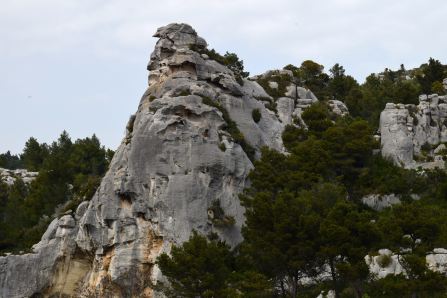
A diminutive fortress carved from a rocky outcrop in the Alpilles Mountains, LeBaux enjoys a long history. Traces of civilization here date to 6000 B.C. In the Middle Ages the area was a feudal stronghold. In the 15th century, the ruling lords of Baux were replaced by the barons of the Masons des Comtes de Provence. This ushered in a brief golden age for the Château, before it came under the control of the kings of France. From the 16th century on, various family feuds and wars of religion brought on the decline of the town. In 1633 Louis XIII agreed to the removal of the fortifications which, according to the townspeople, provided hiding places for rebels. In the early 19th century, bauxite was discovered here (hence the name) and extensively mined until it was exhausted in the late 20th century.

LeBaux no tourists1
Without tourists.
LeBaux tourists1
With tourists.

Today the commune or town is dedicated to tourism.  The population in the upper part of the town is just 22 and 436 in its entirety. Le Baux welcomes over 1.5 million tourists each year. Honestly, I struggle with places like this; it is now simply a tourist destination. On the other hand, it’s lovingly preserved to demonstrate history and culture. How else could we experience this?

This was just one day in Provence, which I clearly loved. I look forward to a return trip at a much slower pace. Have you been there? What did you think?

See you next time! 

My Unabashed Addiction to Pinterest

Unless you have been living under a rock or on another planet, you probably have some idea of Pinterest, a kind of online bulletin board that allows you to gather visual “pins” or images of just about anything of interest onto your own “board.” You can pin ideas for travel, organizing your bathroom, centerpieces, party favors, kids’ Halloween costumes, hairdos, wedding cakes, vacation destinations, etc., etc.

Or, you may be an avid Pinterest follower, in which case you will recognize my symptoms.

A few years ago my husband and I embarked on a gut renovation of our kitchen and the designer suggested we search around on Houzz (a similar site geared to building, remodeling and decorating) for appealing ideas. She didn’t know me well enough yet to realize that I hoard shelter magazines and, when the pile gets too tall, I go through them, tearing out pages of ideas I like. (Kind of a pre-internet Pinterest.) I had folders full of stuff to show her, but I was happy to try Houzz too. For some reason, Houzz did not really click for me, but my daughter suggested Pinterest.

What came next was a slippery slope.

I started looking at — and pinning — kitchen ideas. Then I realized that some of the bloggers I followed had Pinterest boards that I could cruise for ideas. As anyone who has spent an evening or more on Pinterest knows, one pin leads to another that leads to another. More ideas and eye candy with every click. (See my Pinterest boards here.)

Pinterest’s point and click (pin) interface is too easy. Finding images of gardens? Add another board. Kitchens invariably lead to dining rooms. Add a board. Love ironstone and transferware? I have a board for that. Two years later I have 25 boards, 1500 pins and 25 followers! And that’s just limited to decorating!

I think I have a problem. It’s such a smart system. Pinterest sends you pins you may like (it also sends stuff I never look at, thank goodness), so there’s always something new to look at. And pin! The app is right there on my iPad, but the images are bigger on my laptop. Feeling a little bored? Have a little time to kill before starting dinner? See what Pinterest is sending you. Pin, scroll. Pin, scroll. Oh, wait, what’s that smell? Dinner is burning?

I have some history with this.

Years ago when I began my magazine files, I hoped they would help me identify and develop my own style. I believe they really did. Decorating decisions have never been a huge issue for me. I always knew the look I was going for (although it has morphed considerably over the decades), and if I didn’t I would spread out the images I had stashed in one or more of those files and study them. (This is how I realized I needed to get rid of all the red/blue/yellow in my house and switch to cream and white. I realized that I was saving and loving image after image of neutral rooms!) You know the inspiration boards designers put together? They’re my version of my files and, now, my Pinterest boards. 

In all honesty, I have not spent much time editing my boards. There is a lot of duplication. You can look at them here. For example, I love everything the late Charles Faudree did and I’m sure I duplicated some of his pins on my Country French board. I have also duplicated some Amelia Handegan pins. (Interestingly, I went thru my old magazines files recently and realized I also had saved magazine shots of some of these same images.)

But I’ve also made a deal with myself about not expanding my pins beyond decorating and gardening. There is, after all, so much more to pin in cooking and quilting and fashion. I’m afraid I might not come up for air.

What I’d really like to know here is that I’m not alone. Are you into Pinterest? What are the topics of your boards? And how did you save ideas before Pinterest?

See you next time!


A Singular Bucket List Destination

halfdome 1
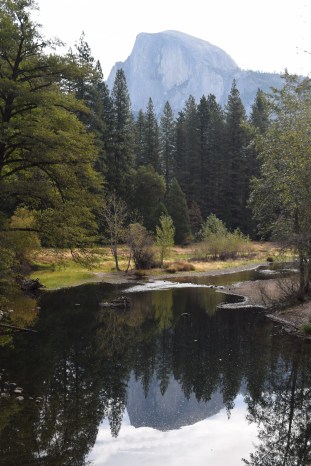
Half Dome reflected in a creek.

A news item about Yosemite National Park’s Ahwahnee Hotel changing its name — hopefully just temporarily — to the Majestic Yosemite Hotel caught my eye this weekend. I added Yosemite and the Ahwahnee Hotel to my non-existant Bucket List last fall after our first-ever, awesome visit there.

I should preface this by saying that I’m not a bucket list person. I have never, ever had any interest in parachuting from a plane or bungee-jumping from a bridge. As an editor I climbed the Great Wall in China and shopped at Istanbul’s Grand Bazaar. I’m not good at crowds, so New Years in Times Square or the Indy 500 hold no appeal for me. In truth, I have been blessed with family, friends, and work that I love. I didn’t want to get “greedy” with a list of additional experiences, though I have no problem with those who do.

Yosemite, however, was a destination that had slipped through our fingers. When my children were in grade school and my husband frequently traveled to Silicon Valley, we made plans for a family trip to Yosemite. Unfortunately, just a few weeks before we were due to leave, a family emergency forced us to cancel. Then, as so often happens, life just got in the way. Jobs changed, football and volleyball camps and the annual trip to the beach crowded the calendar. You know the drill. My husband and I traveled to Napa & Sonoma a number of times without getting to the park.

Yet, Yosemite was still there.

One of the joys of retirement, of course, is a remarkably flexible schedule. And I had two free air tickets — a retirement gift from my former employer — just burning a hole in my pocket. Finally, we were able to pair the Napa/Sonoma wine country (a favorite of ours) with a visit to Yosemite, including two nights at the legendary Ahwahnee Hotel there.

What can I say, this was so worth the wait.

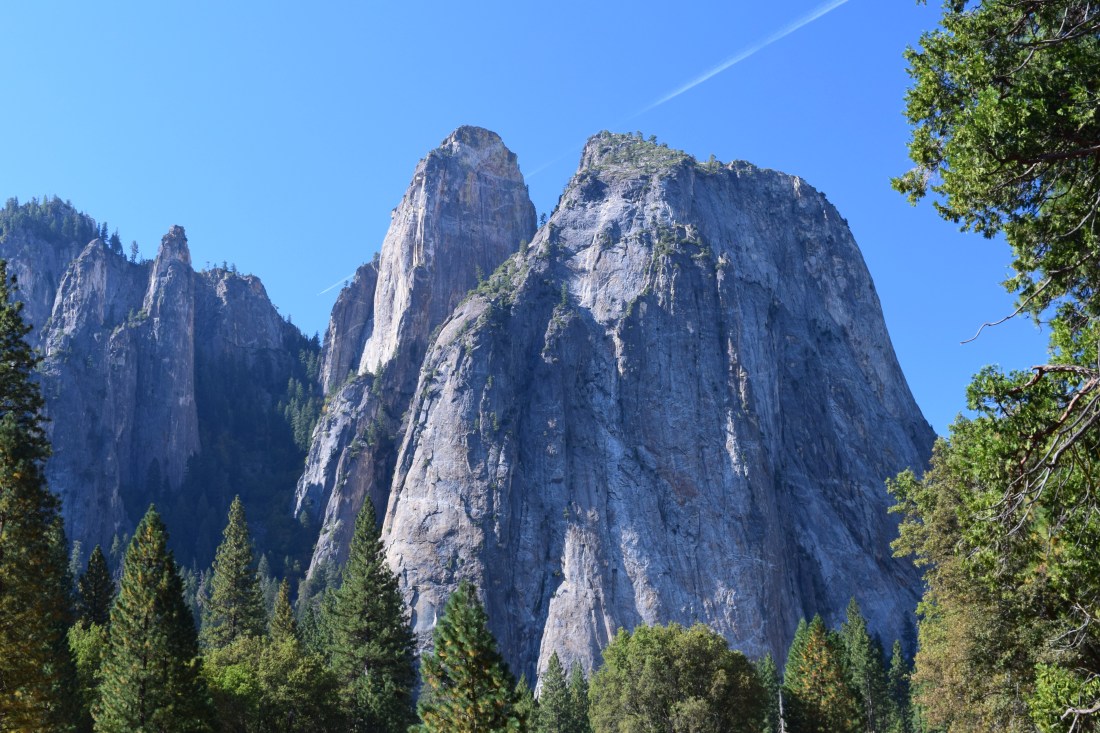
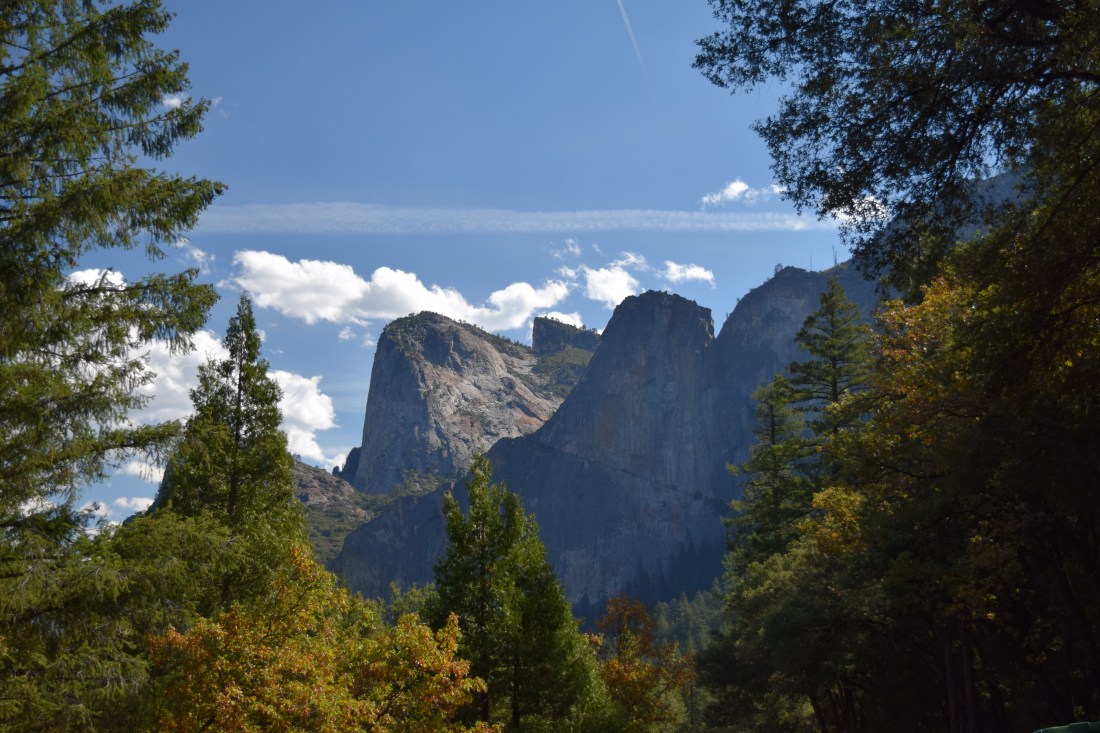
Yosemite is jaw-droppingly beautiful. Half Dome, El Capitan, Tunnel View and the like would be stunning under any circumstances, but under clear blue September skies they may have been even more so. For me, however, Yosemite is more than just the natural wonders. It also embodies an historic American commitment to preserving natural wonders and their ecological system. We were there in the fall, when the rivers and falls were all virtually dry, particularly in light of California’s continuing drought. But if we had visited in the spring, and I hope we do sometime, the landscape would have featured rushing rivers and powerful waterfalls driven by winter snow melt. Nature’s cycle is that powerful.

Yosemite
El Capitan


DSC_0717
A view of Yosemite Valley.

A bit of history: the park dates to 1864 when President Abraham Lincoln signed a bill protecting the area and creating what was known as the Yosemite Grant. This was the first time public land was protected in this manner and paved the way for Yellowstone, the first national park, created in 1872. A few years later, Yosemite Valley and the Mariposa Grove were ceded to California as a state park. Yosemite National Park was established in 1890.

I was especially struck by the fact that tourists discovered the area in the middle of the 19th century and a settlement was established to serve them. James Mason Hutchings and artist Thomas Ayres were among the first to tour the area in 1855. Their articles and artwork drove additional tourists to the area. The Wawona Hotel was built in 1879 to serve visitors to the Mariposa Grove of giant sequoias. Imagine traveling to the Sierras by horseback and/or stagecoach!

On our first day there, my husband and I took an open-air tram tour of the park with a ranger. The tram was really more of a flat-bed truck fitted out with benches and side rails. It clearly needs to be powerful enough to traverse the mountain roads while still affording the sightseers ample views. The guide was terrific, explaining the park’s geology and history in terms that all participants, including a number of children, could appreciate. The tour made several stops at notable park locations, but we actually back-tracked ourselves to some of them to take more pictures and simply enjoy the views on our own.

Back to the Ahwahnee, or Majestic Yosemite Hotel.

The hotel opened in 1927 to attract money and interest in the park. It’s both rustic and elegant, designed for a grander time and perhaps now a little frayed around the edges, but all the lovelier for it. I spent the better part of a morning reading in the Great Lounge, where the towering ceiling is lined with beams still sporting their original stencil decoration. The lounge itself is outfitted with dozens of deep sofas and chairs arranged for groups large and small.

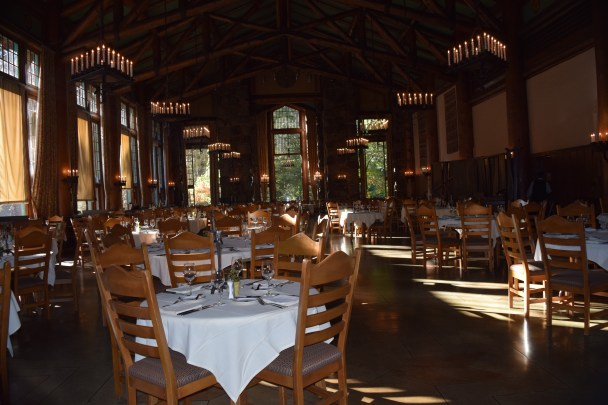
The dining room is equally stunning, a huge room that should seem cavernous but is actually cozy at dinner with chandelier- and candle-light. It’s equally lovely at lunch. The service is low-key but impeccable. How could you get tired of a place like this? I kept thinking of the people who have dined here.

Ahwahness_dining
The dining room…
Ahwahnee_Great_Lounge
…and the Great Lounge.

Can you see why, after the first day at Yosemite, my husband and I said this is a bucket-list place? Actually, we tried to text that to friends, but it’s tricky in Yosemite because cell service is really limited. Personally, I think this is just one more reason to love it. Guests can’t walk around glued to their phones because there is no service.

So, there you have it, my single-item bucket list, chosen after the fact. There is so much more to Yosemite, that what I just described: the incredible drive to get there, the Sequoias, and the sheer power of nature evident in the continung evolution of the landscape for starters.

What else would come close to add to the list? What would you add to your list?

See you next time! 

An Introduction


DSC_0036Ivy and Ironstone
is the name of this blog because neither “Antique Silver & Zinnias” nor “Hostas & Transferware” had the alliterative cachet of “Ivy & Ironstone,”  and I am a writer at heart.

This blog has been percolating in my brain for a long time.

In the last few years of my editorial career, I was writing and/or editing a handful of blogs for the trade associations I worked with and I liked that writing. Quick. To the point. A little more down-to-earth than a lot of the business writing I had done. It suited my personal voice as a writer. And I liked the potential this format offered. The best blogs invite interaction with the reader. Every writer wants to know there is someone out there reading and responding.   

Along the way, I became familiar with design blogs. Okay, more than familiar. I was hooked. I have always been a bit of an interior design junkie and an avid reader of shelter magazines. These blogs were like a continually refreshed magazine on my laptop! And although they offered inspiration for decorating the mantel (you can look for my take on that in an upcoming blog post), they covered the other fun stuff that captured my interests: cooking, entertaining, gardening, antiquing, travel. You can see where I’m going here.

Of course, now I was thinking I can do my own blog. I’m a competent writer. I’ve had lots of fun, some success and even a few decorating misadventures. I love the hunt for antiques and vintage collectibles. I am an enthusiastic hostess (Note: I did not say organized or excellent or any adjective that indicates quality. I like to entertain and I think many of life’s moments merit a celebration.) I’m an avid reader (I’ll share my book group experience later, including the book club that’s more than 35 years old). And I think travel is a very good thing. 

I started writing bits and pieces of blog posts, first in my mind and eventually in a file on my laptop. But they were really just bits and pieces, not one of them was a complete post.

By now, I was no longer “newly retired” (that first year just flew by!) and I realized I had missed several blog-worthy topics, including a gut renovation of our kitchen, trips to Edinborough, London, Paris, Provence, Napa/Sonoma, and Yosemite.

I ran the blog idea past my husband and daughter. My husband wondered when I was going to do something so I could keep on writing. My daughter, who is a media professional and a successful blogger on her own, added that a blog would also help me sharpen my photography skills. (Oh, right, I thought, a lifestyle blog would require photos to illustrate it. Is this good news or bad?)

Dig in or move on. So, here I am, blogging at Ivy and Ironstone. 

Once I began working seriously on this blog and registered the name, my husband began muttering about not understanding what Ivy and Ironstone means. Perhaps I should explain. Ivy and Ironstone is both a metaphor for my own grab-bag of interests and what I hope will be a readable, memorable name.

About the ivy…

Ivy is my code for gardens and gardening. I have always loved getting my hands in the dirt, potting or planting. There is a tactile quality to gardening that I find both relaxing and creative. And, of course, there is the pleasure in seeing something grow and flourish.


Although I am the ivy (and flower and herb grower, as well as a tender of landscape bushes and plants), it is my husband who is the true gardener. He plants and tends an oversized plot in a community garden where he grows tomatoes, beans, peas, potatoes and more.  It’s a time-consuming labor of love, where you sometimes even have to carry water in many buckets to tend the plants (which explains a lot about why this is his garden, not mine).

And then there is ironstone…

Ironstone is one of the first antiques I collected. I began with pitchers but quickly moved on to platters, sugar bowls, and other serving pieces. (Then I got into transferware, a whole other story!) To me white ironstone is the quintessential antique; the lack of additional color and pattern forces you to focus on the shape, the details on handles and spouts, the mix of form and function each piece embodies. These pieces were hard-working tools in someone’s kitchen, serving up fresh milk or a Sunday roast. I like the fact that these were useful pieces.

DSC_0041

Many of the things I collect — baskets, transferware, vintage linens — began life as useful objects, gaining their value as collectibles much later. The simple truth is that I love things with a patina, a little crazing or tarnish or a worn edge that adds character. (And if she were still here, my mother would point out that is also an apt description of me!)

Naming it

Finally, Ivy and Ironstone is the name of this blog because neither “Antique Silver & Zinnias” nor “Hostas & Vintage Linens” had the alliterative cachet of “Ivy & Ironstone.” I am a writer at heart. My first professional position (after college and my fling at grad school) was as a catalog copywriter. The details aren’t important, but I was coached by a magazine editor who critiqued every word and sent me back to the typewriter (yes, this was before computers) to edit and revise until every block of copy was perfectly crafted to capture the most sale-able essence of each item on that page.

Since then I have spent a lifetime as a writer and editor, often taking my pencil to someone else’s copy. Although the topics varied widely —  housewares, health care, fence installation, the Affordable Care Act, ceramic tile, and green building to name a few —  as a retired editor I love the prospect of writing about the things I care about. Cooking and entertaining. Collecting. Reading good books (and even a few that are not). Traveling with my husband. Chronicling this new retirement chapter in our lives.

Ivy and Ironstone. This is my new brand. I’m hoping you will spend some of your valuable time stopping by on occasion to read about what I’ve been up to.

 See you next time!